Before
World War II, women’s positions in the military were limited. With the changing
times of World War II, modern warfare called for a more active and present role
for women in the Armed Forces. Not only were droves of women volunteering for
nursing, but also their skills were needed across the board! From office,
clerical jobs to truck drivers, airplane mechanics and laboratory technicians,
radio operators, test pilots, to the new occupation of flight nursing, women’s
roles in the military were vital to victory.
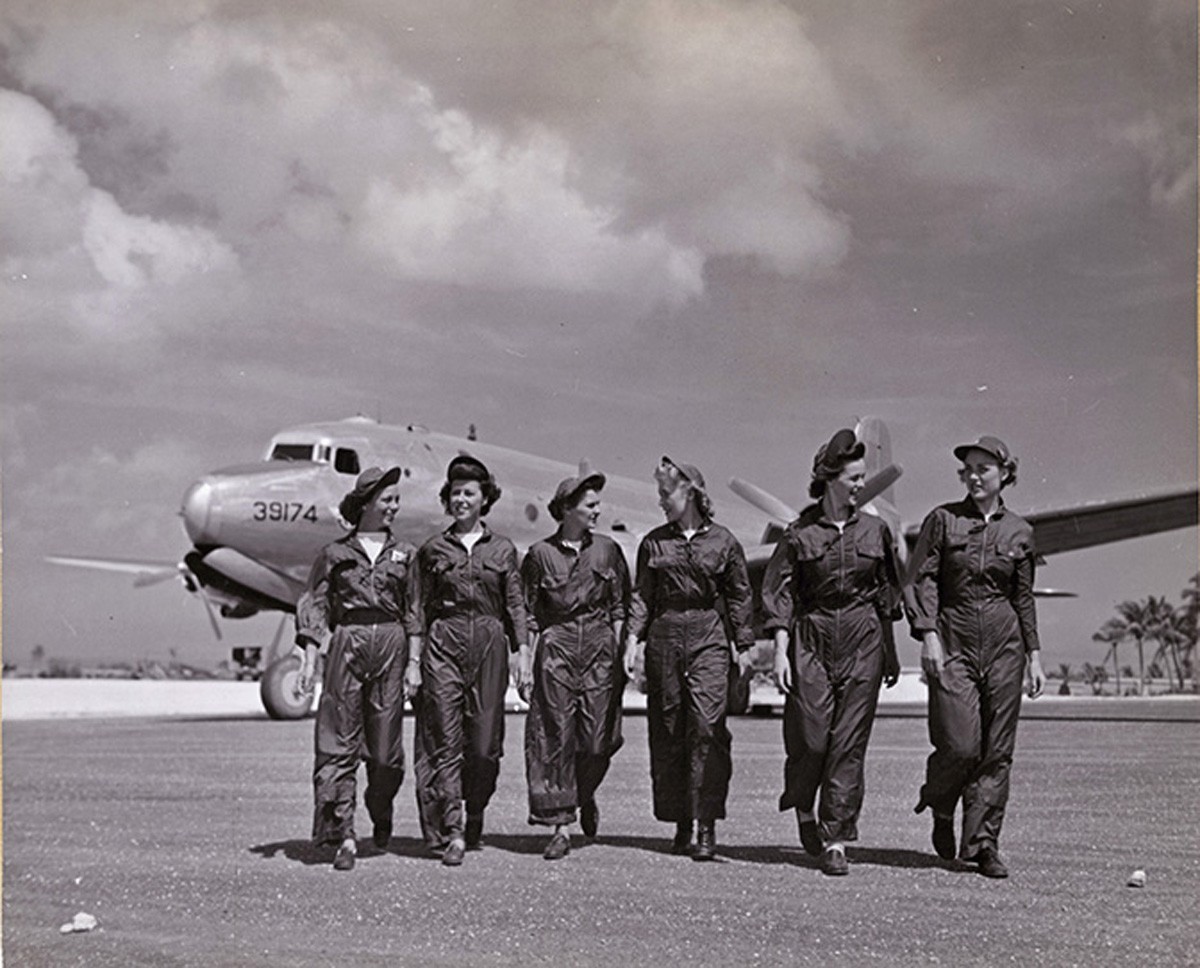 |
| Flight Nurses in Guam, WWII |
Flight nurses were introduced into the US Army
Air Force in 1942. The new program, the School of Air Evacuation, began in the
fall of 1942 at Bowman Field, Louisville, Kentucky and ran for six to nine
weeks, eventually moving to Randolph Field, Texas in October 1944. Training was
disorganized at best, a few squadrons even deployed overseas before training
was officially over for them. The first group of flight nurses to complete the
full course graduated in February 1943. Training consisted of aero-medical
physiology, field survival, map reading, crash procedures, and physical
conditioning.
A
flight surgeon and chief nurse were assigned to each Medical Air Evacuation
Squadron. Each squad was then
divided into four flights consisting of six teams of flight nurses and surgical
technicians. Cooks, clerks, and drivers were situated at headquarters section.
Typical Uniform:
- White
dress or skirted suit, not user friendly
-
Eventually adopted a waist-length gray-blue jacket and matching trousers/skirt,
with a white or light blue blouse
- In
1944, colors changed to olive drab
- The
insignia was a pair of golden wings with a maroon N in the middle. Later
changed to silver.
Duties of a Flight Nurse:
 |
| Evacuation Flight, WWII |
Flight
nurses were truly unique for their time. Not only did they operate under their
own authority, they outranked the male surgical technician that accompanied
them. Believe it or not, in the 1940s, only trained physicians could start IV’s
and oxygen on a patient, but the flight nurses were doing it on their own and
in hostile and dangerous environments. They also had to deal with extreme
medical emergencies, including shock, hemorrhage, and sedation.
As with
any military profession at the time, flight nursing did not come without its
risks and dangers. Those brave women had to keep the fighting men alive while
combating the dangers in the air over the European and Pacific theaters. Many
women were taken as POWs after crash landing behind enemy lines. In all,
sixteen flight nurses were killed during the war. “Through professionalism and
courage, the women who served as flight nurses in World War II saved many
hundreds of lives and comforted over a million sick and wounded servicemen.” –
Sarah Sundin
Our Very Own Angel of the
Airfields: Evelyn Kowalchuk
Like
many women, Evelyn felt compelled to serve her country during the war, by
taking care of the men who volunteered to fight for their democracy and
freedom. When she volunteered, nobody could answer her question of what flight
nursing was, but she viewed it as an adventure and began training in Kentucky
on C-46 and C-47 cargo planes transformed into ‘flying ambulances’. She used to
joke about how many times their uniforms changed throughout the war and how
disorganized it was for them. During training, she and the twenty-four other
girls living in one quonset hut with only one bathroom, with one toilet and one
sink! She has said before that it was a team effort; everyone helped each other
because they were all partaking in something unheard of in modern warfare.
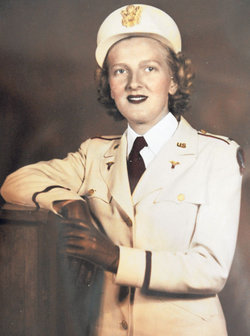 |
| Evelyn Kowalchuk in uniform. |
When
training was over, the women were sent to England. From there they were sent on
various missions to retrieve badly wounded soldiers. Evelyn landed on Omaha
Beach on D plus 3. She recalled that many of the nurses had never seen such
horrific wounds before in their lives. Many men had to be treated immediately,
so they could not be properly cleaned off or even remove clothing before their
limb was amputated. Each time they went back to England, the flight nurses were
to get on another fully stocked plane and travel back to retrieve more men.
Jeeps and ambulances had to be ready for their return to take the wounded to
the hospital as soon as possible. Fighter pilots were the only ones able to fly
them back and forth; however, if it was too late, the nurses had to sleep on
the beaches in the plane. Evelyn even spent a night in a foxhole on Omaha
Beach. She remembers hearing the bombs and guns in the distance. It was hard
for her and the other nurses to reconcile with the fact that so many young men
would live the rest of their lives without their limbs.
After
the day was done, it was rare when the women would talk about the events and
scenes of the day; they carried on and pushed forward. “We were patriotic”,
said Evelyn. Whenever she and her ‘sisters’ would get together throughout the
years for various events, they never really discussed the extraordinary and
horrific events they all went through, they wanted to look forward and continue
living their lives, proud of their past.
Take care,
Elizabeth
P.S- Are you are interested in learning more about Evelyn? If so, go to the February 2013 post entitled, "Voices by Land, Air, and Sea: The Extraordinary Stories of Those Who Were There", where you can watch a video interview with Evelyn!


No comments:
Post a Comment