Search This Blog

Showing posts with label Black History Month. Show all posts

Thursday, February 9, 2017

African American Women in the Army Nurse Corps during World War II

Hello, Again!

This week, we are featuring another blog by another one of our spring interns, Meika. She is a senior at Hollins University in Roanoke, Virginia and is double majoring in history and political science with aspirations to earn an M.A. in Public History and then work in history museums, historic sites, or historical societies. She’s a long-time enthusiast of World War II and we are excited to have her on board this spring! I hope you enjoy her blog on the African American women who served in the Army Nurse Corps during World War II.

-Maggie

__________________________________________________________________________

Black nurses landing in Scotland, 1944. 
African American women were not immune to the United States’ public call to arms after America entered World War II in 1941. Women who lived in a racially segregated and discriminatory country were willing and eager to join the Allied fight against tyranny and oppression in Europe. American white women are remembered for their heroic services during World War II as WACs, WAVES, nurses, factory workers, planters of Victory Gardens, and bandage rollers.  Stories of their service are well known and constantly perpetuated during elementary school lessons of Rosie the Riveter. However, the story of black women who also served their country during World War II are less well known. One of the ways through which American black women contributed during the war was through their participation in the Army Nurse Corps.

Due to the racial segregation and discrimination in the United States, black women found it difficult to join the ranks of the would-be 60,000 women in the Army Nurse Corps (ANC) during World War II.  Even though the candidates had the same training and education as most of the white women who were admitted, government quotas placed limits on the number of black women who were allowed to join the ANC in 1941. In subsequent years due to the influence of First Lady Eleanor Roosevelt, quotas for black nurses to join the Army Nurse Corps began to loosen up and completely abolish the quota system in 1944.

A black nurse treating a German P.O.W. in England, 1944.
Though their numbers were small in comparison to the 60,000 white nurses, the less than 600 black nurses eventually admitted to the ANC were happy to finally be able to serve their country. Despite their segregation, discrimination, and occasionally rudimentary jobs assigned to them, black nurses in the Army Nurse Corps were able to see a bit of the world during their service. Though black nurses were largely restricted to serving only in hospitals and aid stations occupied by black military men, a demand for medical care brought black nurses to England, Burma, Africa, and such faraway places such as Liberia and Australia, and other locations in the Pacific. Other nurses remained in or returned to the United States to work in convalescent, general, and station hospitals.

In addition to serving the black troops, black nurses were also provided medical care for German prisoners of war in England and in as obscure places as Arizona in the United States. Due to labor shortages in the United States, the government made use of a free source of labor: German prisoners of war, and thus transported them from Europe to work on farms or other labor sites.

The work given and sacrifice made by black nurses during World War II not only achieved progress for black nurses in the form of increased federal funding and recognition, but they also inspired a new generation of nurses. Following the eradication of the quota system in 1944, over 2,000 young black women enrolled in the Cadet Nurse Corps program and other nursing schools. The 600 African American nurses in the Army Nurse Corps deserve to become part of the narrative of American women who served during World War II and I hope that further research can be conducted and further recognition duly awarded.


-Meika

For  further reading on the topic, check out “The Army Nurse Corps Introduction.” Army History. http://www.history.army.mil/books/wwii/72-14/72-14.HTM

Thursday, February 2, 2017

The Treatment of Black Citizens and Civilians in the Range of Nazi Germany

Hello, Friends!

I’m excited to introduce a new contributor to our blog, Olivia. She is one of my spring interns and is working on her Masters of Art in History at Liberty University. Her primary field is Modern American Military History focusing on leadership in World War II and the Korean Conflict. Her work seeks to bring to light those leaders and subordinates whose impact is often overlooked or undervalued. She has also presented at several conferences and won an award for her work on the Japanese American Nisei Soldiers. I am very excited to have Olivia on board and hope you enjoy her post on treatment of African Americans in Nazi Germany!

-Maggie

__________________________________________________________________

The horrors afflicted by Nazi Germany from 1933 to 1945 are ingrained in the world’s memory with the tragedy and loss still present in the minds of people around the globe. While the atrocities Nazi Germany afflicted on groups such as the Roma and Jewish communities are well known there are other groups, which also suffered at the hand of Nazi controlled Germany. One of these lesser-known groups the black and mulatto citizens of in reach of Nazi Germany.

Before World War I there were not many black German citizens living in Germany. When Germany lost World War I the Treaty of Versailles stated Germany was so give up her colonies in land that is present day Tanzania, Rwanda, Burundi, Ghana, Togo, Cameroon, and Namibia. With the loss of these military outposts, military men and German colonial students, artisans, writers, and performers both white and black returned to Germany. Many military and colonial leaders also brought with them a system of deep racism and discrimination of black citizens. The Treaty of Versailles also stated troops were to occupy the Rhineland region of West Germany. The French assigned 200,00 soldiers both nationals and colonials to occupy the Rhineland. Racist propaganda groups in Germany quickly moved to compound the situation in order to spread racism and discrimination against blacks in the Rhineland and Germany. Propaganda viewed the black colonial French soldiers as rapist and carriers of disease. Other special interest groups blamed black soldiers for all of the unrest, rape, and murder of German women by the occupying forces, causing panic and uproar. This escalated and even resulted in Pope XV asking for the removal of black French troops and people writing to US President Woodrow Wilson demanding the removal of the black colonial troops. Even before Hitler’s rise to power, discrimination began with forbidding black citizens from holding any type of government jobs or roles in the military. Interracial marriage was also banned in Germany and all of its holdings.

However, with the rise of Hitler’s power in 1933 came wide spread persecution and further discrimination was implemented against blacks and mulattos living in Germany and the territories Hitler acquired. While there was never a program of systematic elimination, treatment of black citizens varied in levels of severity from discrimination and isolation to sterilization and medical experimentation. In Mein Kamph, Hitler stated that, “Jews had brought Negros into the Rhineland with the clear aim of running the hated while race by the necessarily-resulting bastardization.” In this statement Hitler used the previous post World War I tensions to push the German people to accepted racism and discrimination.

By 1937 the Germans decided something had to be done about the approximately 800 mixed raced children living in the Rhineland which Hitler deemed “an insult to the German Nation. Therefore, a committee created Commission Number 3, giving the German government power to start sterilizing mixed race children deemed “Rhineland Bastards”. As many as 400 German African mulatto children were gathered and sterilized, many with out the parents knowledge beforehand. Hans Hauck was a teenager at the time this organization was commissioned and was serialized by the Nazis. Hauck recalled in the documentary, “Hitler’s Forgotten Victims,” he was serialized without anesthesia. Once his procedure was completed he was given a certificate validating his procedure and told to avoid sex with German women. At the same time women who were found pregnant with mixed babies were forced to have abortions.  At the same time, persecution was also happening to the small population of full black German citizens.

Under Hitler’s rule all black citizens were banned from universities and in some cases the subjects of anthropological and medical studies, there were also cases of murder and abuse. Such is the case of Hilarius Gilges. Gilges was a 24-year-old native of Dusseldorf and an artist. In June of 1933 approximately a dozen SS officers attacked Gilges, captured, tortured, and killed the young man for his race identity and political affiliations. Today his life is memorialized in a plaza in Düsseldorf as the first marked death in Düsseldorf under the Nazi oppression. Others with similar stories are shared in published works such as Born to Witness: Growing Up Black in Nazi Germany, which tales the story of Hans Massaquoi who grew up during the War in Germany.


At the time Hitler and the Nazi’s came to power there were approximately 25,000 black or mulatto citizens in Germany out of population of 65 million. Taking into account the low population proportion of black and mixed German citizens during Hitler’s rule combined with the world wide level of accustomed prejudice and discrimination toward men and women with African heritage at the time it, is easy to see how the plight of those souls tortured and maimed by Nazi practices went unheard of for so many years. However, the policies of hatred and abuse toward those deemed “impure” or “a threat to the master race” practiced by Nazi Germany goes beyond the treatment of Roma, Jews, and Russians. The torment and pain Nazi Germany inflicted on the population of men, women, and children with African decent deserves to be told in shared with the same hope of never allowing such a travesty to occur in our lifetime and in future generations. 


-Olivia

Thursday, February 18, 2016

Commemorating Black History Month at the National D-Day Memorial

Hello, Friends!

320th Barrage Balloon Battalion
For the past few winters, the National D-Day Memorial hosts a Lunchbox Lecture series by staff and guest speakers that cover a range of topics on World War II. It is one of the highlights of our slow winter season. While I have enjoyed each of the lectures I’ve attended while at the Memorial, I think that this February’s lecture is going to be one of the best we’ve had. I’ve loved learning about the 320th Barrage Balloon Battalion and sharing their story with school groups while giving tours of the Memorial.

As a special evening lunchbox lecture and in commemoration of Black History Month, the National D-Day Memorial will host a special “Meet the Author” event with Linda Hervieux. Hervieux is the author of the recently released book Forgotten: The Untold Story of D-Day’s Black Heroes (Harper Collins). It tells the compelling story of the 320th Barrage Balloon Battalion, an intriguing unit of African-American soldiers sent in among the first wave of invaders on June 6, 1944. They were tasked with sending up a curtain of small blimps on cables, used to deter enemy aircraft and protect the historic landings on the Normandy coast. Heroically doing their job in the chaos of battle, they played a role that few have ever realized—until now.
Linda Hervieux

While Forgotten is her debut book, Linda Hervieux is hardly a novice writer. She’s a respected journalist and photographer whose work has appeared in such publications as The New York Times, the International Herald Tribune, the New York Daily News, and Fodor's Paris. A native of Lowell, Massachusetts, she lived for many years in Brooklyn before moving with her husband to Paris, where they now reside.


Corporal William Dabney,
320th Barrage Balloon Battalion
We are also honored to be able to host D-Day veteran William Dabney of the 320th Barrage Balloon Battalion at the lecture. On June 6, 1944, he was assigned to Omaha Beach as a Balloon Crew Chief. As he approached the beach, his leg was hit by shrapnel, but he taped it up and kept going. Once he realized that the barrage balloon was no longer attached, he was placed in a position where he needed to defend himself on the beaches of Normandy. In 2009, Dabney was awarded the Legion of Honor medal by the French government for his service on D-Day.

This lecture will take place Monday, February 22nd, 2016 at the Bedford Welcome Center and begin at 6:30PM. Copies of Forgotten will be available to for purchase, and Hervieux will sign books after her presentation. The event is free and open to the public, but due to the anticipated response we ask that attendees RSVP by calling 540-586-DDAY. Light refreshments will be served.

Special thanks to AREVA and Virginia Foundation of the Humanities, and Roanoke Valley Sister Cities for their support of this event. 


Hope to see you there!


Maggie

Tuesday, February 2, 2016

The Role of African Americans on D-Day

Hello Friends!

Each February, the United States recognizes the accomplishments of African Americans through Black History Month.

During World War II, the practice of segregating our armed forces applied most directly to African Americans. For those of African descent, segregation in the military most often meant being pigeonholed into non-combat positions. Despite their relatively high rate of enlistment in the Armed Forces, African Americans were for the most part assigned labor-intensive duties, such as quartermaster and cook. Though the frontline was denied to most African American servicemen during World War II, there were still a handful of segregated units that distinguished themselves in battle during the Normandy campaign.

The Tuskegee Airmen

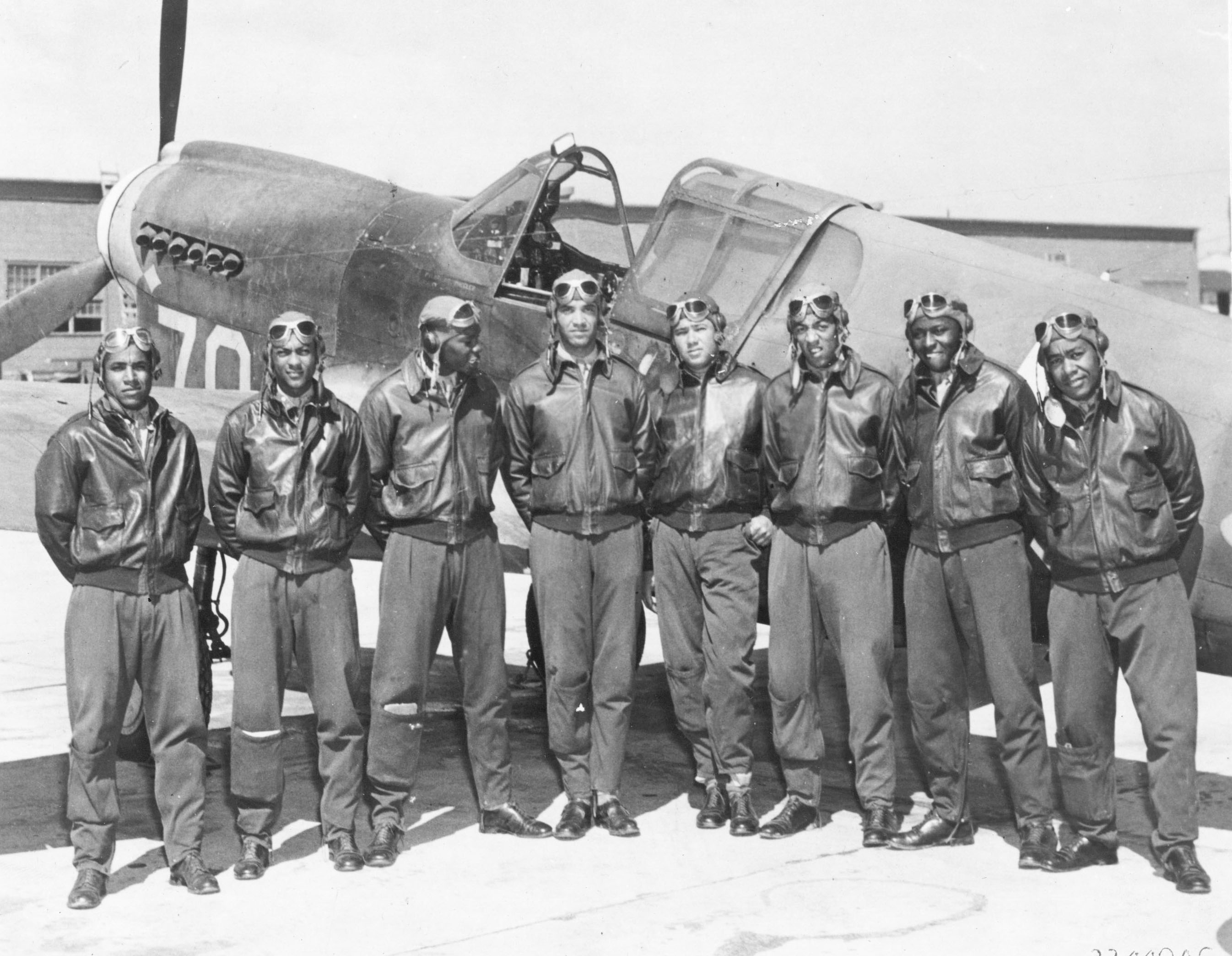
 The Tuskegee Airmen is the popular name of a group of African-American military fighter and bomber pilots who fought in World War II. They were the first African American military aviators. Formally, they formed the 332nd Fighter Group and 477th Bombardment Group of the United States Army Air Forces. They flew missions in Sicily, Anzio, Normandy, the Rhineland, the Po Valley and Rome-Arno and others. The red markings that distinguished the Tuskegee Airmen included red bands on the noses of P-51s as well as a red rudder, the P-51B and D Mustangs flew with similar color schemes, with red propeller spinners, yellow wing bands and all-red tail surfaces, hence the nickname “Red Tails.” The Tuskegee Airmen accomplished a lot during the war, including destroying over 400 enemy aircraft, 950 motor vehicles, 40 boats and barges, and put a destroyer out of commission.

761st Tank Battalion

Another segregated unit that distinguished itself in battle was the famous 761st Tank Battalion, also known as the “Black Panthers”. Though this unit did not land on D-Day, they did benefit from the sacrifice made on that day as they embarked onto Omaha Beach on October 10, 1944. As a part of Patton’s 3rd Army, the 761st fought bravely until the German surrender and was amongst the first units to link up with Soviet forces in Austria. The uniqueness and importance of this first African American tank battalion is perhaps best summed up in the words Patton used to greet them on Omaha: “I have nothing but the best in my Army. I don’t care what color you are as long as you go up there and kill those Kraut sons of bitches. Everyone has their eyes on you and is expecting great things from you. Most of all, your race is looking forward to you. Don’t let them down and, damn you, don’t let me down!”

320th Barrage Balloon Battalion

On D-Day in particular there was only one segregated unit that landed on the beaches with the assault forces. That unit was the 320th Anti-Aircraft Balloon Battalion, a unit of about 1,500 soldiers and 49 officers. Originally intended for defending the homeland, the 320th found itself reassigned to the Normandy invasion late in 1943. Their task was to defend the landing forces from low-altitude strafing aircraft by deploying gas-filled balloons attached to the ground by steel cables. These steel cables were meant to catch on the wings of passing aircraft, thus destroying them. Though originally designed to be manned by four-man teams, the soldiers of the 320th successfully performed their duties with only three-man teams. General Eisenhower praised the 320th’s service by saying that the battalion “carried out its mission with courage and determination, and proved an important element of the air defense team…your fine effort, has merited the praise of all who observed it.”

Not much has been written on the 320th Barrage Balloon Battalion, but there recently Linda Hervieux has published a book on the topic, Forgotten: The Untold Story of D-Day’s Black Heroes. We are fortunate to be able to host Mrs. Hervieux on
Monday, February 22nd at 6:30PM as a part of our annual Lunchbox Lecture series at the Bedford Welcome Center through the generosity of the Virginia Foundation of the Humanities. There will also be a book signing following her presentation.  This is no charge for admission to this lecture, but donations are appreciated to help support future educational programming. Call 800-351-DDAY for more information and to RSVP. Seating is limited.


It is incredibly important to honor and remember the valor, fidelity, and sacrifice of all who contributed to the success of D-Day and World War II no matter their gender or skin color. The brave men of the Tuskegee Airmen, 761st Tank Battalion, and 320th Barrage Balloon Battalion played integral roles in the success of the Normandy campaign and we are honored to help preserve their legacy.


Until next time,


Maggie 

Tuesday, February 17, 2015

Winter Lecture Series: Part Deux


 Hello All,

Snowy morning on Smith Mountain Lake, 2.17.15

Gi Jive 2015
I hope you all are enjoying our recent snowstorm! Just a reminder, the National D-day Memorial will be closed until Thursday, and possibly later, due to the current weather conditions. We want everyone to remain safe and warm while a very large portion of Virginia thaws out. Despite the snow and ice being treacherous at times, one cannot help but admire its beauty.

GI Jive table decor, 2015
I would also like to send out a HUGE thank you to all those who could attend the GI Jive this past Saturday, Valentine’s Day, and to the Trivium Estate for allowing us to host our event at your gorgeous location. The Jive was absolutely dazzling and could not have been more enjoyable! The evening was full of laughter, love, and fun and I hope all those who were in attendance this year will join us again next year! You definitely won’t want to miss out on all the excitement.

Our next event will be the second installment of our Lunchbox Lecture series entitled, “The Black Swallow of Death: The Life and Exploits of the First African American Pilot in Uniform” and will be held on Thursday, February 26th, beginning at noon until 1 PM. The lecture will take place, once again, at the Bedford Welcome Center’s Community Room and will be free admission, though donations are greatly appreciated.

Eugene Bullard
The lecture will explore the enthralling history of the first African-American pilot and spy in World War I, Eugene Bullard. Visitors will be able to sit back and enjoy a riveting presentation by the D-Day Memorial Foundation’s President, April Cheek-Messier, as she gives a detailed slideshow of Bullard’s life and accomplishments. Not only did Bullard have an exceptional reputation as a pilot and spy, he became a professional boxer, musician, nightclub owner, and war hero while in Europe, where he spent the rest of his life. Bullard also received a total of fifteen decorations by the French government for his service in both World War conflicts.

You will not want to miss out on this fascinating second winter lecture. Seating is based on a first come, first serve basis, and is usually filled rather quickly. If inclement weather should arise, please call our office for more information at (540) 586-3329.

Take Care,
Elizabeth

Tuesday, February 10, 2015

Honoring a Legacy: Tuskegee Airmen


Hello All,
War Bonds Propaganda
This week’s post is in honor of our African American veterans who served during World War II. As we all know, African Americans were not given the opportunity to serve in combat units until World War II. Blacks were almost always given the undesirable duties which were usually not what a soldier dreams of when volunteering to protect their country. These duties included grave registration, supply units, and construction, among other assignments. Slowly but surely, these men were overcoming generations of discrimination to prove they were as patriotic as any white man.

Considered the hallmark of African American advancement, The Tuskegee Airmen, along with many other all black units, changed the way Americans viewed African American contributions in the war effort. For decades, the popular belief was that African Americans were not motivated enough for combat duty. They would not fight aggressively enough, they would not be patriotic enough, and they would not be able to maintain the required skills of a white soldier. Clearly, the over 100,000 African Americans serving in World War II, and in past conflicts, have proved that theory wrong time and time again. Despite the fact that the Airmen were so influential, not only to the war effort, but also to the beginnings of the Civil Rights movement, many people have only just begun to acknowledge their legacy.
The first group of Airman to graduate from Tuskegee, March 1942
Before World War II, the United States Army was so sure African Americans could not perform in combat, that the Army War College conducted a study in 1925 that ‘proved’ African-Americans were both physically and psychologically unfit for combat duty. When military advances were being made, especially in the years leading up to the Second World War, the government refused to open special training schools for blacks in the military, but through the determination of the NAACP, black press, a lawsuit, and influence from the President and First Lady Roosevelt, the Army conceded to the “Tuskegee Experiment”, which would train African Americans in combat aviation. Located at the Tuskegee University, Alabama, the Army Air Corps began training on July 19, 1941. Ironically, aviation is considered one of the most psychologically and academically challenging professions in the military.
Capt. Benjamin Davis, Sicily
Twelve cadets and one officer, Captain Benjamin O. Davis, Jr. (the future first African American general in the Air Force) made up the first squadron to pass through the program that would eventually become the 99th Pursuit Squadron, or more popularly known, “Tuskegee Airmen”. Immediately, they began combat missions in the Mediterranean Theater, and eventually joined with newer squadrons to form the 332nd Fighter Group.
Not only were the Airmen successful, despite bets they would fail, they became envied by most other pilots because of their success. The Tuskegee Airmen proved to be some of the most talented pilots in the war effort and began the movement to fully integrate the U.S. Military by 1948. Their determination propelled the Civil Rights Movement into a force to be reckoned with in the eyes of the government. The population could no longer ignore the rights and talents of the black community. Not only that, but many of these men were able to continue their educations after the war, in areas of study such as law, political science, medicine, and education, continuing on a cherished legacy.
Tuskegee Airmen in front of a P-40 Fighter Plane, May 1942
It is a true testament to the will of these brave men that 926 Tuskegee Airmen were able to define the way the U.S. Military viewed African-American service in a time when it was socially acceptable to discriminate. 

Take Care,
Elizabeth