Search This Blog

Showing posts with label WWII Black History. Show all posts

Tuesday, February 2, 2016

The Role of African Americans on D-Day

Hello Friends!

Each February, the United States recognizes the accomplishments of African Americans through Black History Month.

During World War II, the practice of segregating our armed forces applied most directly to African Americans. For those of African descent, segregation in the military most often meant being pigeonholed into non-combat positions. Despite their relatively high rate of enlistment in the Armed Forces, African Americans were for the most part assigned labor-intensive duties, such as quartermaster and cook. Though the frontline was denied to most African American servicemen during World War II, there were still a handful of segregated units that distinguished themselves in battle during the Normandy campaign.

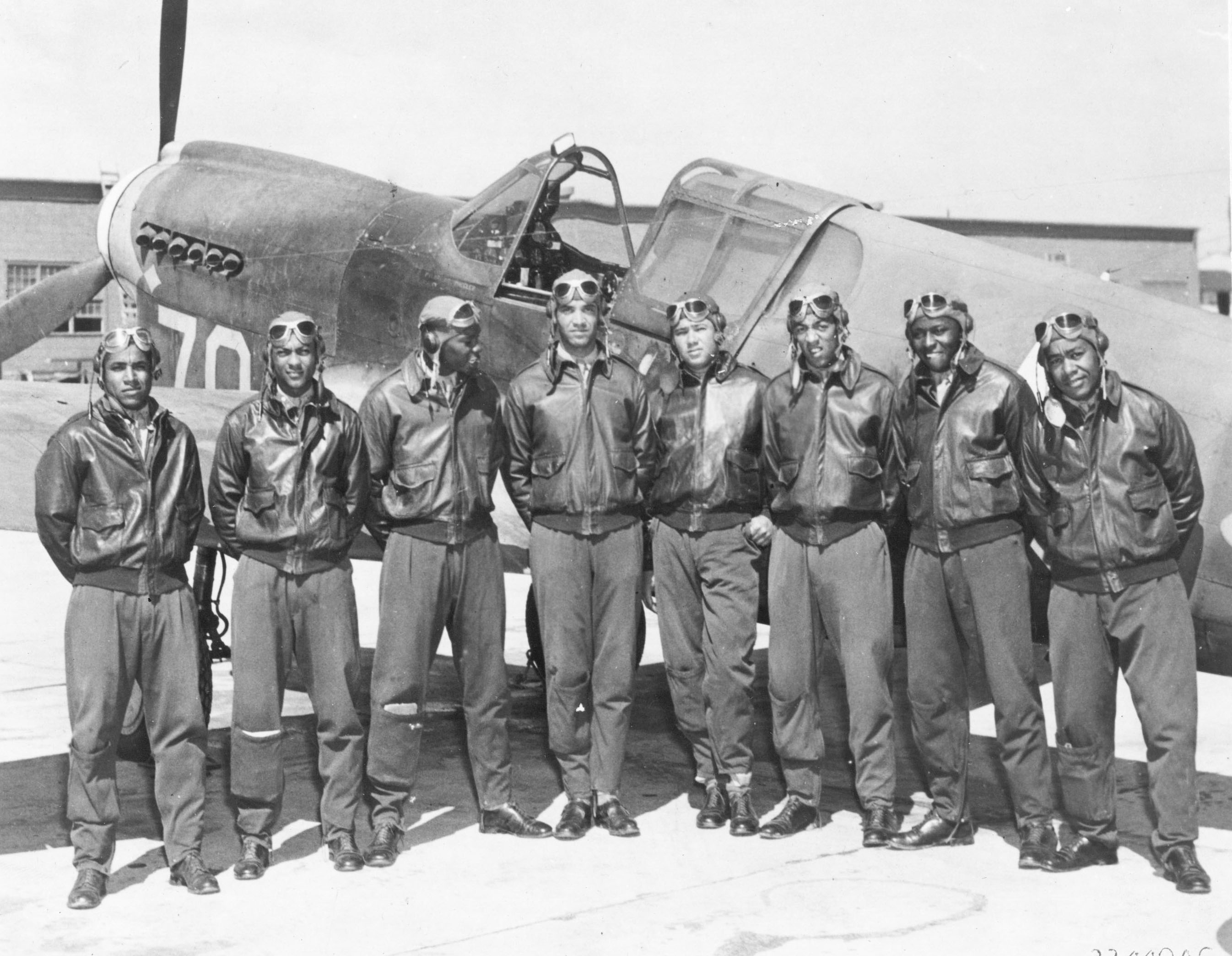
The Tuskegee Airmen

 The Tuskegee Airmen is the popular name of a group of African-American military fighter and bomber pilots who fought in World War II. They were the first African American military aviators. Formally, they formed the 332nd Fighter Group and 477th Bombardment Group of the United States Army Air Forces. They flew missions in Sicily, Anzio, Normandy, the Rhineland, the Po Valley and Rome-Arno and others. The red markings that distinguished the Tuskegee Airmen included red bands on the noses of P-51s as well as a red rudder, the P-51B and D Mustangs flew with similar color schemes, with red propeller spinners, yellow wing bands and all-red tail surfaces, hence the nickname “Red Tails.” The Tuskegee Airmen accomplished a lot during the war, including destroying over 400 enemy aircraft, 950 motor vehicles, 40 boats and barges, and put a destroyer out of commission.

761st Tank Battalion

Another segregated unit that distinguished itself in battle was the famous 761st Tank Battalion, also known as the “Black Panthers”. Though this unit did not land on D-Day, they did benefit from the sacrifice made on that day as they embarked onto Omaha Beach on October 10, 1944. As a part of Patton’s 3rd Army, the 761st fought bravely until the German surrender and was amongst the first units to link up with Soviet forces in Austria. The uniqueness and importance of this first African American tank battalion is perhaps best summed up in the words Patton used to greet them on Omaha: “I have nothing but the best in my Army. I don’t care what color you are as long as you go up there and kill those Kraut sons of bitches. Everyone has their eyes on you and is expecting great things from you. Most of all, your race is looking forward to you. Don’t let them down and, damn you, don’t let me down!”

320th Barrage Balloon Battalion

On D-Day in particular there was only one segregated unit that landed on the beaches with the assault forces. That unit was the 320th Anti-Aircraft Balloon Battalion, a unit of about 1,500 soldiers and 49 officers. Originally intended for defending the homeland, the 320th found itself reassigned to the Normandy invasion late in 1943. Their task was to defend the landing forces from low-altitude strafing aircraft by deploying gas-filled balloons attached to the ground by steel cables. These steel cables were meant to catch on the wings of passing aircraft, thus destroying them. Though originally designed to be manned by four-man teams, the soldiers of the 320th successfully performed their duties with only three-man teams. General Eisenhower praised the 320th’s service by saying that the battalion “carried out its mission with courage and determination, and proved an important element of the air defense team…your fine effort, has merited the praise of all who observed it.”

Not much has been written on the 320th Barrage Balloon Battalion, but there recently Linda Hervieux has published a book on the topic, Forgotten: The Untold Story of D-Day’s Black Heroes. We are fortunate to be able to host Mrs. Hervieux on
Monday, February 22nd at 6:30PM as a part of our annual Lunchbox Lecture series at the Bedford Welcome Center through the generosity of the Virginia Foundation of the Humanities. There will also be a book signing following her presentation.  This is no charge for admission to this lecture, but donations are appreciated to help support future educational programming. Call 800-351-DDAY for more information and to RSVP. Seating is limited.


It is incredibly important to honor and remember the valor, fidelity, and sacrifice of all who contributed to the success of D-Day and World War II no matter their gender or skin color. The brave men of the Tuskegee Airmen, 761st Tank Battalion, and 320th Barrage Balloon Battalion played integral roles in the success of the Normandy campaign and we are honored to help preserve their legacy.


Until next time,


Maggie 

Tuesday, February 10, 2015

Honoring a Legacy: Tuskegee Airmen


Hello All,
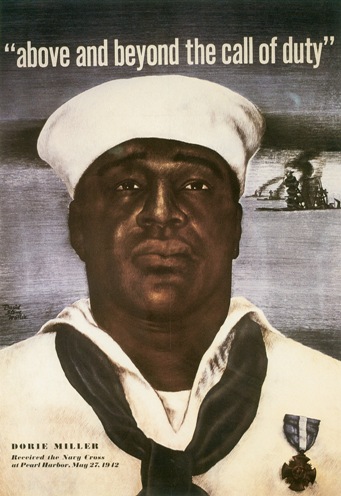
War Bonds Propaganda
This week’s post is in honor of our African American veterans who served during World War II. As we all know, African Americans were not given the opportunity to serve in combat units until World War II. Blacks were almost always given the undesirable duties which were usually not what a soldier dreams of when volunteering to protect their country. These duties included grave registration, supply units, and construction, among other assignments. Slowly but surely, these men were overcoming generations of discrimination to prove they were as patriotic as any white man.

Considered the hallmark of African American advancement, The Tuskegee Airmen, along with many other all black units, changed the way Americans viewed African American contributions in the war effort. For decades, the popular belief was that African Americans were not motivated enough for combat duty. They would not fight aggressively enough, they would not be patriotic enough, and they would not be able to maintain the required skills of a white soldier. Clearly, the over 100,000 African Americans serving in World War II, and in past conflicts, have proved that theory wrong time and time again. Despite the fact that the Airmen were so influential, not only to the war effort, but also to the beginnings of the Civil Rights movement, many people have only just begun to acknowledge their legacy.
The first group of Airman to graduate from Tuskegee, March 1942
Before World War II, the United States Army was so sure African Americans could not perform in combat, that the Army War College conducted a study in 1925 that ‘proved’ African-Americans were both physically and psychologically unfit for combat duty. When military advances were being made, especially in the years leading up to the Second World War, the government refused to open special training schools for blacks in the military, but through the determination of the NAACP, black press, a lawsuit, and influence from the President and First Lady Roosevelt, the Army conceded to the “Tuskegee Experiment”, which would train African Americans in combat aviation. Located at the Tuskegee University, Alabama, the Army Air Corps began training on July 19, 1941. Ironically, aviation is considered one of the most psychologically and academically challenging professions in the military.
Capt. Benjamin Davis, Sicily
Twelve cadets and one officer, Captain Benjamin O. Davis, Jr. (the future first African American general in the Air Force) made up the first squadron to pass through the program that would eventually become the 99th Pursuit Squadron, or more popularly known, “Tuskegee Airmen”. Immediately, they began combat missions in the Mediterranean Theater, and eventually joined with newer squadrons to form the 332nd Fighter Group.
Not only were the Airmen successful, despite bets they would fail, they became envied by most other pilots because of their success. The Tuskegee Airmen proved to be some of the most talented pilots in the war effort and began the movement to fully integrate the U.S. Military by 1948. Their determination propelled the Civil Rights Movement into a force to be reckoned with in the eyes of the government. The population could no longer ignore the rights and talents of the black community. Not only that, but many of these men were able to continue their educations after the war, in areas of study such as law, political science, medicine, and education, continuing on a cherished legacy.
Tuskegee Airmen in front of a P-40 Fighter Plane, May 1942
It is a true testament to the will of these brave men that 926 Tuskegee Airmen were able to define the way the U.S. Military viewed African-American service in a time when it was socially acceptable to discriminate. 

Take Care,
Elizabeth

Tuesday, February 18, 2014

Black History Month: The Men and Women Who Served


I hope everyone enjoyed all the snow last week.  On February 25 at noon, we hope you join us for our next lunchbox lecture at the Bedford Welcome Center.  Memorial President April Cheek-Messier will present about the historic USS Sea Cloud, a WWII Coast Guard cutter that proved not only the worth of African-American sailors and officers, but that whites and blacks would serve side by side.  In December 1943, U.S. Coast Guard made history when the USS Sea Cloud embarked for weather patrol duty in the North Atlantic with the first completely integrated crew in U.S. history.  This program is free to the public, though donations are welcome and appreciated.  Bring your lunch and enjoy this wonderful look at our history.  ~Felicia
~~~~~~~~~~~~~~~~~~~~~~~~~~~~~~~~~~~~~~~~~~~~~~~~~~~~~~~~~~~~~~~~~~~~~~
Working Together, World War II Propaganda Poster
Hello everyone!

In honor of Black History month, we here at the D-Day Memorial want draw attention to the brave men and women who not only went through a painstaking war, but had to break through racial barriers at the same time.

Technically, the United States Armed Forces did not desegregate until 1948, three years after wars end. However, World War II laid the groundwork for integrating both groups of people with a common purpose. At the time of Pearl Harbor (1941), only four thousand African-Americans served, by the end of the war, nearly 1.2 million troops had signed up, that includes thousands of women as well.

World War II Propaganda Poster
Of course, public opinion and practices influence military life, as with any other part of life. Units were segregated and often all-white units were picked over black units. It took the NAACP to get President Roosevelt to promise that the African American troops could enlist according to their percentage in the population, 10.6 percent. Even though that percentage was not obtained, the amount of influx in all branches of the military was noticeable.

Most African-Americans served in non-combatant units, such as maintenance and transportation. Their support was vital to the success of the war. The famous, “Red Ball Express”, a supply train that brought millions of tons of supplies to the front lines, was run by an African American unit. Mid-way through the war, the amount of loss on the front lines forced the military to bring African Americans to the forefront and take combatant roles, such as infantrymen, pilots, tankers, officers, and medics. Even though these men served with honor and courage as any  
American soldier had, they were still discriminated against even in war.

African American unit, World War II
Tuskegee Airmen, World War II
On the day of the Overlord invasion, 1,700 African American soldiers were part of the assault as an Anti-Aircraft Barrage Balloon Battalion and Quartermaster Service, as well as, tank units fighting through France with Patton’s Third Army. They were responsible for the capture of thirty major towns in France, Belgium, and Germany.


 Also, who could forget the Tuskegee Airmen? Three hundred thirty-two fighter pilots flew ground support missions in the southern portions of Europe. Nicknamed the “Redtails”, the Tuskegee Airmen suffered sixty-six deaths and flew more than 15,000 sorties from May 1943 to June 1945.

Despite the segregation of the times, the men and women who served were more than courageous, their services and efforts towards the greater good of American society planted the necessary seeds for the Civil Rights movement and the injustice of racism in society.

Take care,
Elizabeth

Wednesday, February 8, 2012

The Valor of Lieutinent Vernon Baker

I thought it would be fitting to submit a post in honor of Black History Month.  Sadly, relatively little information exists on African-American service during WWII, although the African-American contribution to the war effort was valiant and note-worthy.  One reason for the scarcity of information is the fact that during WWII the military was still a segregated institution.  In fact, African-Americans were barred from combat service until 1941, and even then, only one all-black Army division saw infantry combat in the European theater.  

92nd Infantry Division Patch
This division was the famed and now celebrated 92nd Infantry Division known as the Buffalo soldiers.  The 92nd was sent into combat for the first time during WWII late in the summer of 1944.  The division landed in Italy and made its way through the country until they encountered German troops in September of the same year.  The Buffalo soldiers continued in their quest to push the Germans farther and farther into Northern Italy.

In late Spring 1945, near Viareggio, Italy, Lt. Vernon Baker of the 370th Regimental Combat Team, 92nd Infantry Division, proved his devotion to his country through an incredible act of valor.  Lt. Baker single-handedly killed 9 Germans in a single day during a siege of an enemy stronghold.  After the attack subsided, Baker retrieved the dog tags of all 19 men killed in his regiment and returned each dog tag to headquarters that evening.

Lt. Vernon Baker
For his service, Lt. Baker was awarded the Distinguished Service Cross, but in 1992 the U.S. Army conducted an investigation into the qualifications outlined for Congressional Medal of Honor recipients.  The Army determined that several African-American servicemen who were eligible to receive the Medal of Honor were initially passed over based on racial discrimination.  Finally, in January 1997, President Bill Clinton awarded Lt. Baker the Medal of Honor - which he should have received decades earlier.

 
-Megan


References:
Orso, A. ed. (2008). Armchair reader WWII: Extraordinary facts and stories. Lincolnwood, IL: West Side Publishing