Hello All,
Please join us this Thursday
(2/26) for the second installment of our Lunchbox Lecture Series with President April
Cheek-Messier. Explore the extraordinary life of Eugene Bullard, the first
African-American pilot and spy in World War I. The lecture will be held at the Bedford Welcome Center
Community Room, promptly at noon until 1 PM. Admission is free, but donations
are greatly appreciated. For more information, please call the office at (540) 586-3329.
~~~~~~~~~~~~~~~~~~~~~~~~~~~~~~~~~~~~~~~~~~~~~~~~~~~~~~~~~~~~~
On this day, 71 years ago,
Major General Frank Merrill led a guerrilla style campaign through the northern
areas of Burma. Nicknamed ‘Merrill’s Marauders’, the unit’s purpose was to
engage in a “long-range penetration mission” agreed upon by both President
Franklin D. Roosevelt and Prime Minister Winston Churchill in August 1942.
 |
| Brig. Gen. Frank Merrill directing troops. |
The unit’s objective would
comprise of cutting Japanese communications and supply lines, and to essentially
create chaos within the enemy’s lines. The idea of such a daring mission was to
prepare a vantage point for General Joseph Stillwell’s Chinese American Force
to reopen the Burma Road, which would reopen a major supply channel back into
China.
Since a mission such as this
had never been done before, a ‘wanted’ ad was sent out, under the president’s
permission, to attract soldiers to volunteer for a ‘dangerous and hazardous
mission’. The US military knew their objective would be extremely difficult to
obtain and volunteers were vital. The sheer volume of stateside soldiers,
nearly 3,000 men, who volunteered created the 5307th Composite Unit,
code named “Galahad”, which would ultimately be remembered as Merrill’s
Marauders.
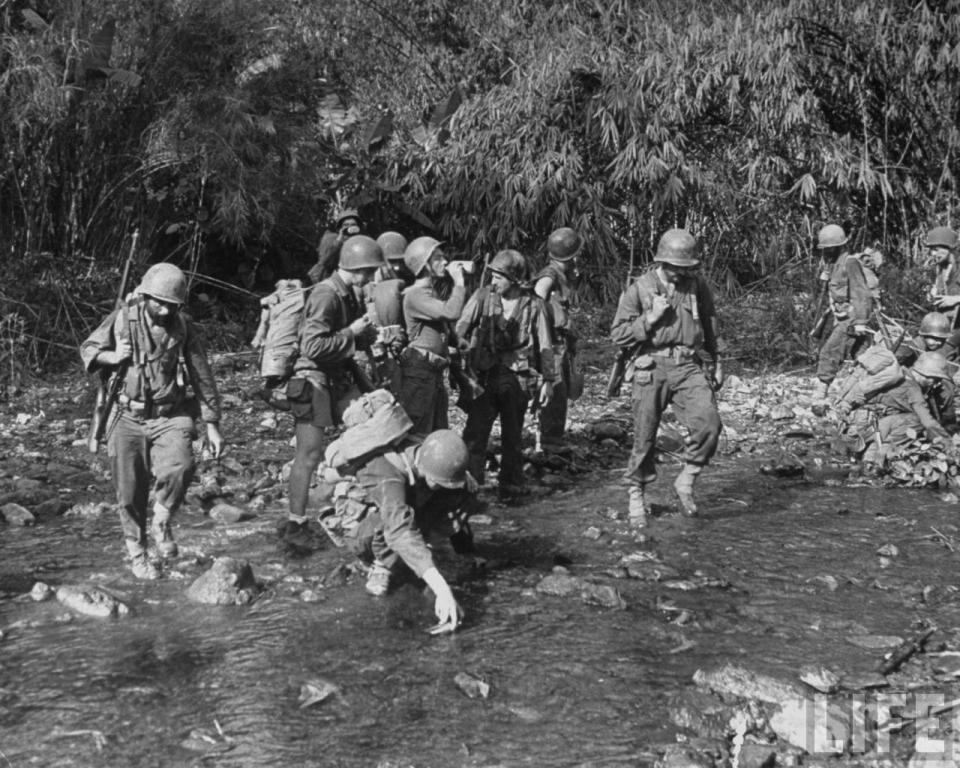 |
| Merrill's Marauder's trudging through the Burma jungle. |
Training for this unique
mission took place in the jungles of India, where Brig. Gen. Merrill taught his
soldiers the art of guerrilla warfare. The unit was split into six combat units
each with 400 men, Red, White, Blue, Green, Orange, and Khaki. The remaining
600 men were to stay in India to coordinate airdrops of supplies to the men
fighting.
On February 24, 1944, the
Burmese campaign began with a 1,000-mile walk through thick jungle without
artillery support. Carrying their supplies on their backs and on mules, and
only being resupplied by airdrops, the men withstood five major engagements
with the enemy, and nearly 30 minor engagements. Merrill’s Marauders were so
successful at confusing and disrupting the Japanese; they were able to capture
the Myitkyina Airfield in the process. By that engagement, only 200 soldiers,
of the original total, were present to take the field. A week later, on August
10, 1944, the unit was disbanded with a total of 130 men left. Out of the 2,750
men to enter Burma at the start of the mission, only two made it through
without hospitalization of major wounds or illness.
 |
| Soldiers taking a brief rest in the jungle. |
The mission was so
physically grueling, the surviving Marauders had to be evacuated to hospitals
and soon as humanly possible. The men diagnosed with “Accumulation of
Everything”, which included exhaustion, tropical diseases, and malnutrition, to
name a few. The unit was awarded the Distinguished Unit Citation, currently
known as the Presidential Unit Citation, in July 1944. Each soldier was also
awarded the Bronze Star, which was extremely rare for an entire unit to
receive.
These heroic men battled
impossible odds, sustained devastating losses, and yet managed to succeed in
their objective. Without their miraculous efforts, the course of the war would
have taken a destructive turn.
Take care,
Elizabeth


No comments:
Post a Comment