Hello All,
 |
| War Bonds Propaganda |
This
week’s post is in honor of our African American veterans who served during
World War II. As we all know, African Americans were not given the opportunity
to serve in combat units until World War II. Blacks were almost always given
the undesirable duties which were usually not what a soldier dreams of when
volunteering to protect their country. These duties included grave
registration, supply units, and construction, among other assignments. Slowly but surely, these men were overcoming generations of discrimination to prove
they were as patriotic as any white man.
Considered the hallmark of African
American advancement, The Tuskegee Airmen, along with many other all black
units, changed the way Americans viewed African American contributions in the
war effort. For decades, the popular belief was that African Americans were not
motivated enough for combat duty. They would not fight aggressively enough,
they would not be patriotic enough, and they would not be able to maintain the required
skills of a white soldier. Clearly, the over 100,000 African Americans serving
in World War II, and in past conflicts, have proved that theory wrong time and
time again. Despite the fact that the Airmen were so influential, not only to
the war effort, but also to the beginnings of the Civil Rights movement, many
people have only just begun to acknowledge their legacy.
 |
| The first group of Airman to graduate from Tuskegee, March 1942 |
Before World War II, the United
States Army was so sure African Americans could not perform in combat, that the
Army War College conducted a study in 1925 that ‘proved’ African-Americans were
both physically and psychologically unfit for combat duty. When military
advances were being made, especially in the years leading up to the Second
World War, the government refused to open special training schools for blacks
in the military, but through the determination of the NAACP, black press, a
lawsuit, and influence from the President and First Lady Roosevelt, the Army
conceded to the “Tuskegee Experiment”, which would train African Americans in
combat aviation. Located at the Tuskegee University, Alabama, the Army Air
Corps began training on July 19, 1941. Ironically, aviation is considered one
of the most psychologically and academically challenging professions in the military.
 |
| Capt. Benjamin Davis, Sicily |
Twelve cadets and one officer,
Captain Benjamin O. Davis, Jr. (the future first African American general in
the Air Force) made up the first squadron to pass through the program that
would eventually become the 99th Pursuit Squadron, or more popularly
known, “Tuskegee Airmen”. Immediately, they began combat missions in the
Mediterranean Theater, and eventually joined with newer squadrons to form the
332nd Fighter Group.
Not only were the Airmen successful,
despite bets they would fail, they became envied by most other pilots
because of their success. The Tuskegee Airmen proved to be some of the most
talented pilots in the war effort and began the movement to fully integrate the
U.S. Military by 1948. Their determination propelled the Civil Rights Movement into
a force to be reckoned with in the eyes of the government. The population could
no longer ignore the rights and talents of the black community. Not only that,
but many of these men were able to continue their educations after the war, in
areas of study such as law, political science, medicine, and education,
continuing on a cherished legacy.
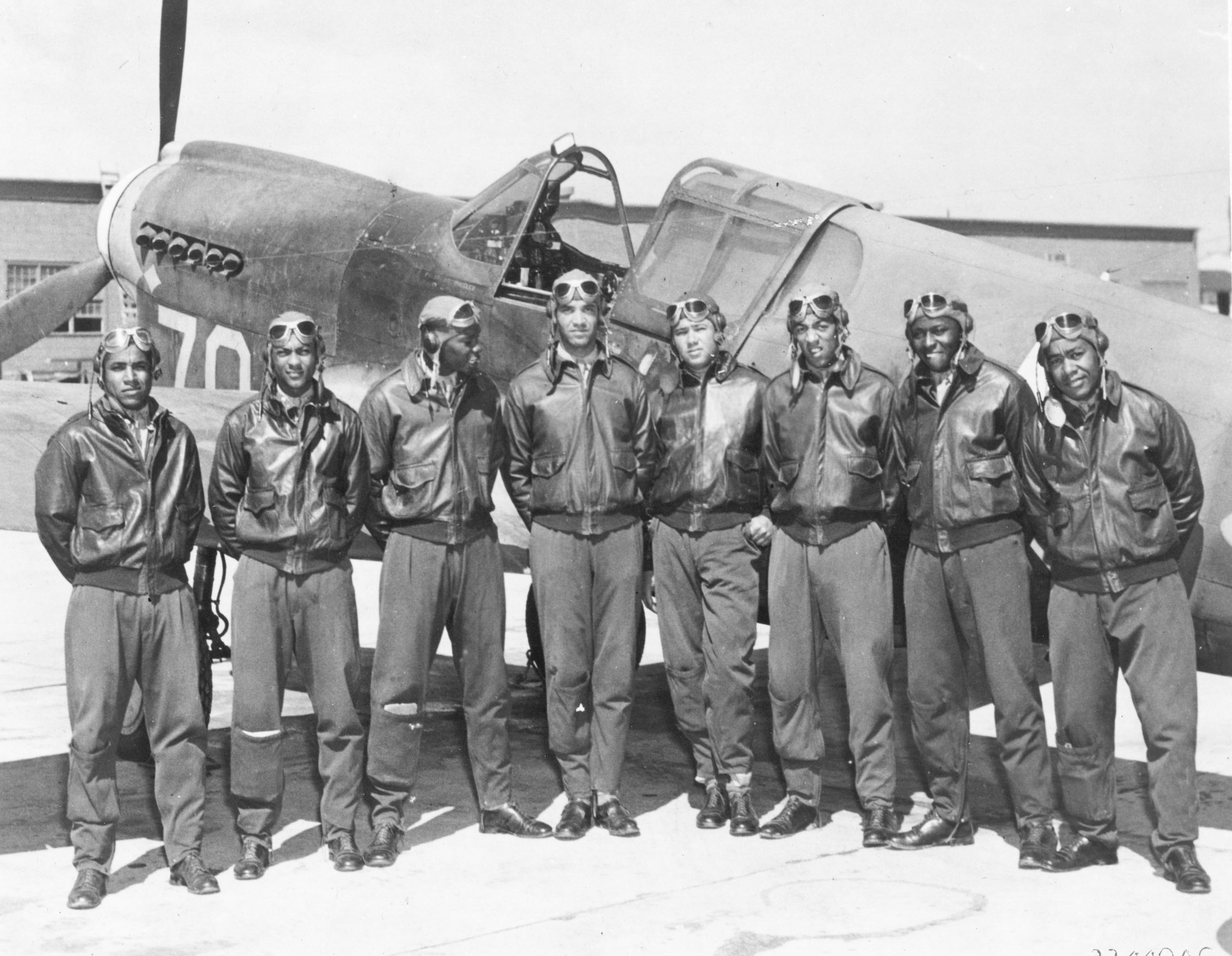 |
| Tuskegee Airmen in front of a P-40 Fighter Plane, May 1942 |
It is a true testament to the will
of these brave men that 926 Tuskegee Airmen were able to define the way the
U.S. Military viewed African-American service in a time when it was socially
acceptable to discriminate.
Take Care,
Elizabeth


No comments:
Post a Comment