 |
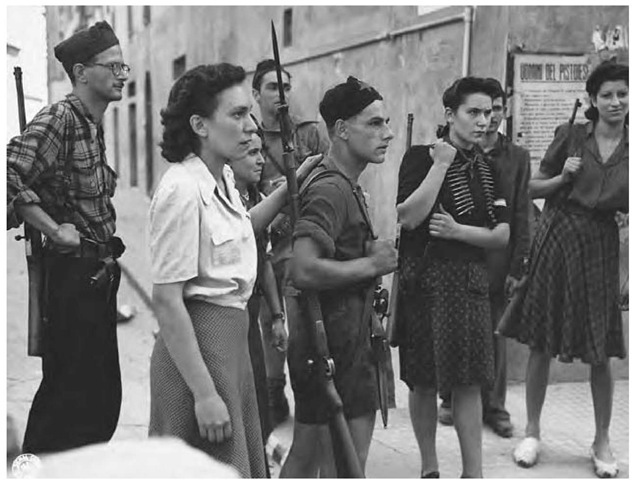
| Members of the Italian Resistance |
Today, it
is hard to imagine the Fascist and Nazi regimes of Italy and Germany were able
to captivate such a large population as they did before and during World War
II. It is much easier for us to believe people were adamantly against the evils
of such regimes, which was the case in Italy. The Italian resistance was born
in 1943, when Benito Mussolini was finally eradicated from power by the Fascist
Grand Council. At that time, almost half the resistance members were female,
105,000 out of 250,000 total, with 4,600 being arrested, 2,750 deported to
German Concentration Camps, and 623 murdered by Italian fascists or Germans.
The
politics of Italy from the 1920s to the 1940s were tumultuous to say the least.
Two very different forms of government were vying for control and power; the Italian
monarchy led by Marshal Pietro Badoglio, who consequently fled southern Italy,
while Mussolini was reinstated as a puppet figure for the Italian Social
Republic, who also had an alliance with Adolf Hitler. As a result of the
turmoil between the parties, an Action Party formed from the camaraderie of the
Communists, Socialists, and Christian Democrats. These particular sects of
people began small resistance units, as time wore on, the small groups joined
together under the National Committee for the Liberation of Northern Italy.
| Italian Resistance partisans after the liberation of Florance |
The
Western European world had never seen such a large involvement of women in a
resistance movement such as this before, it was extremely unique, especially
considering the traditional roles of Italian women. In Italy, women were expected,
and often lived up to such expectations, to be nurture’s of good and the
foundation of the family. These admirable qualities undoubtedly enhanced
women’s participation in the resistance movement. Their involvement was not
only a means to fight Fascism that was crippling their country, but also a
means to gain independence for women in general, breaking the traditional and
religious stereotypes of the time. However, preserving family values and
traditions was at the utmost importance to those women and it would only been
natural for them to take up arms against those who would threaten the safety of
their families.
 |
| Women in the Resistance |
The occupations
women performed for the movements were vital to the resistance survival. They
took care of the food, clothing, and medical supplies, typically from the
comfort of their own kitchens. However, their most important role was
collecting information and communication. These women were the perfect
candidates for clandestine communications and operations. They were the least
suspect by the ‘establishment’ and they would be able to get close to
unsuspecting men discussing their political agendas and plans. However, these
women were not only talented as messengers, but as fighters as well. They were
mostly tasked with sabotage, minor strike attacks, and serve as auxiliary to
the Brigades.
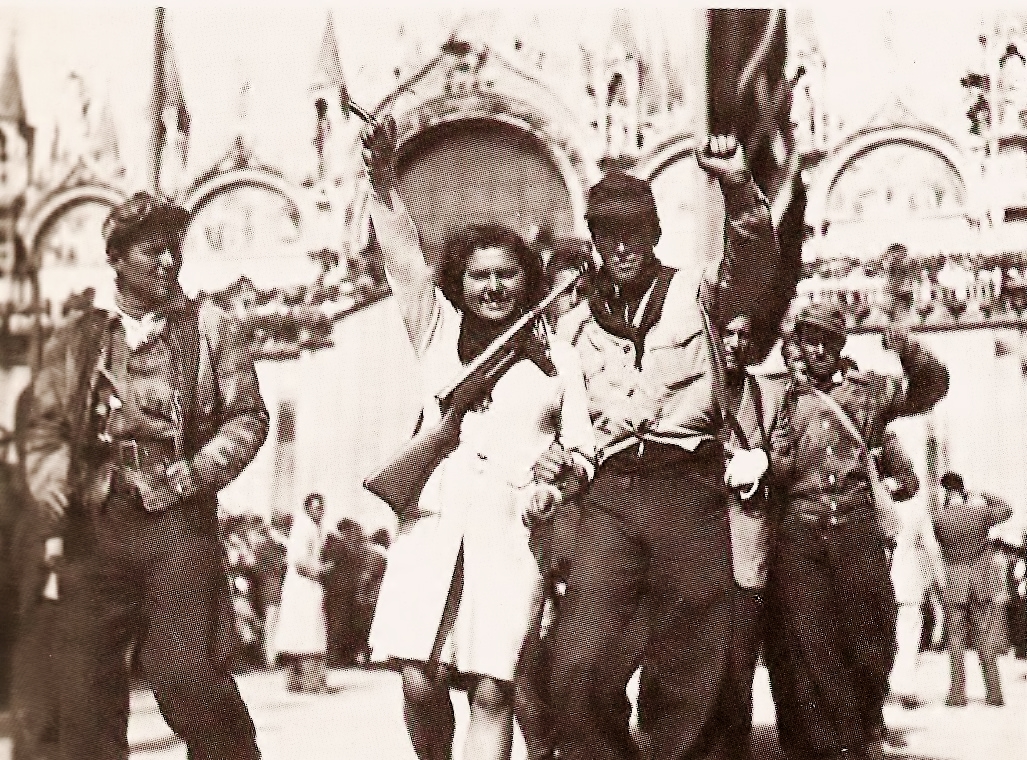 |
| Partisans celebrating victory |
Take Care,
Elizabeth


The Italian women were so brave. So many captured and tortured without talking...
ReplyDelete