Search This Blog

Showing posts with label women's history month. Show all posts

Wednesday, March 15, 2017

An Unsung Hero of World War II: Jacqueline Cochran

Discussions of the American women who participated in World War II has a tendency to revolve around the Women’s Army Corps (WACs), Women’s Nurse Corps, or of the thousands of women who worked in defense plants all across the country, who had picked up where their husbands, sons, and fathers had left off. While most people have basic understandings of women’s participation in the Navy via the WAVES and in the Air Corps via the WASPS during World War II, less is known about the women who started it all – the women who paved the way for female service in the United States military.

For this Women’s History Month, it is important to pay tribute to the women who opened the door to and began conversations about women’s involvement, treatment, and equality in the United States. When thinking of the World War II generation of women who had a great influence on our position in society today, my thoughts ran to Eleanor Roosevelt and the many Rosie the Riveters. However, this post is dedicated to all the unsung heroes, such as the lovely Jacqueline (Jackie) Cochran, who not only was a founder of the Women’s Army Service Pilots (WASPs) during World War II, but also helped normalize women in aviation in America. Jackie Cochran’s story is lesser known and for someone who was instrumental in American aviation and military history, she deserves to be recognized on this platform and many others.

Jacqueline Cochran was born May 11, 1906 in Florida. Soon an orphan, Jackie spent much of her childhood living with a foster family and grew up in poverty. As a teenager, Jackie began training to be a beautician, and as a young adult, made her way up the social ladder while residing in New York City and working in a prestigious salon on Saks Fifth Avenue. In 1932, Jackie married millionaire financier Floyd Odlum, which provided her the means and supported her in pursing other interests, such as taking flying lessons. In her 1953 autobiography, Jackie stated that, “at that moment, when I paid for my first lesson, a beauty operator ceased to exist and an aviator was born."

By the time World War II broke out in 1939 in Europe, Jackie had already established herself within the aviation community, having set and broke various flying records. Believing that she and other female pilots could put their passion and skill to good use serving their country, Jackie appealed to First Lady Eleanor Roosevelt to create a “squadron of female pilots…who [in the eventual U.S. involvement in the conflict] could fly military aircraft on support missions, releasing men for combat duty.” However, it was not until 1941 and 1942 did Jackie see her dream of flying for the military come to fruition. After being inspired by the female pilot squadrons utilized in England, Jackie returned to America and with the blessing of President Roosevelt, “hand-picked 25 American women recruits” to implement female aviation into the U.S. Army Air Corps by ferrying planes. After their success, Jackie was asked to organize a program for training women pilots in the United States. In 1943, Cochran’s program became known as the Women’s Air Force Service Pilots (WASPs).

The WASPs boasted impeccable flying records, and in “January 1944, the War Department announced that the Army Air Forces women's fatal and non-fatal accident rates were lower than the men's.” Cochran and the WASPs continued to train and fly non-combative missions for several months more, but the end of 1944 and the turn of the war in the Allies’ favor deemed the WASPs’ service obsolete and unnecessary. Jackie hoped that Congress would make the WASPs an official branch of the U.S. military, but this dream was not to be. The WASPs were grounded and absolved on December 20, 1944.


Jackie’s flying career did not end with the disbandment of her creation, the WASPs. After the war, she continued to fly and break more records. She competed in many races, such as the Bendix Race, “coming in second with a time of four hours and 52 minutes.” Moreover, the 1950s saw further aviation accomplishments for Jackie, including record speeds for “propeller driven aircraft” and becoming the “first woman to break the sound barrier.” Jackie continued to derive passion for flying until her health and her husband’s death began to inhibit her career. After Floyd died in 1976, Jackie, who was aged 70 at the time, saw her health deteriorate further, and she passed away on August 9, 1980. Jacqueline Cochran loved flying until the day she died, and was instrumental in creating more roles for women in not only the U.S. Air Force, but within the aviation community as a whole. If Jackie had been alive in 2009, it would have pleased her immensely to witness President Obama sign the bill that awarded Congressional Gold Medals to veterans of the WASPs.

-Meika

Sunday, March 12, 2017

The Women of World War II Mobile

When it comes to studying the impact American women had in World War many historians look solely at the numbers. Historians look at the number of women who joined the work force, the number of planes, ships, bullets, parachutes, bandages, and any other necessity these women produced that made Allied victory possible.  Yet, these women who took up new jobs in fields they never imagined, had an impact on history that goes beyond Allied production and victory. These women, who stayed behind to support the war effort by joining the work force, also witnessed the transformation of America, specifically the transformation of small towns that became centers for war production. Such a case can be made for the town of Mobile, Alabama.

Like so many American towns, Mobile went from a small, sleepy American city to a booming war production hub seemingly overnight. Before World War II began the work force in Mobile was around 17,000 men and few women. By 1943 Brookley Air Field would employ that many civilians by the end of the War and local ship building industries would employ over 30,000 workers by 1944. Before World War II women’s occupations were limited to administrative or teaching jobs where the average salary was around $800 a year. With the onset of war came a demand for ships, planes, artillery, and endless demands for support supplies. These goods required the skilled labor of welders and mechanics. At Huntersville or Redstone Arsenals women found jobs on assembly lines that paid around $1,400 annually. Shipyards in Mobile also hired laborers, paying $3,600 annually. These jobs provided unimaginable salaries and the chance for many to move to a new city and start a new life.

One such woman was Emma Bell Petcher. After graduating high school Petcher wanted a chance to put her love of mechanics to the test. Petcher breezed through the mechanics tests and secured a job working on airplanes. Petcher is just one example of women moving to take advantage of defense jobs in America. These women saw not only the value of their work and impact, but the American economy transform from the depths of the Great Depression to the vibrant booming economy of World War II. The economic boom would continue in the 1950’s with the War’s ed. It was due to the help of the six million women who entered the workforce that this economic boom was possible.

With workers came families. This caused the population of Mobile to more then double during the War from 110,805 in 1940 to 201,369 in 1944. With the great influx of workers came a housing shortage unseen in Mobile’s history. People were living in tents in vacant lots. Boarding houses would have four men per room or rent beds to multiple men and women with differing shifts. Oftentimes both men and women in the same family would take up a defense job, leaving childcare a much-needed commodity in Mobile. Thus, women ushered in and witnessed the evolution of day care in America. Day care centers were viewed as patriotic, promoting a safe place for loving mothers to leave their children as they went off and produced items needed to win the War. Women who manned and operated day care centers were viewed as protectors of liberty and praised for providing a service that allowed women to help win the War. Day care was not a practice forgotten after the War. Women would continue to use and work at day care centers after the War and into the later part of the twentieth century showing how the War gave women the tools needed to pursue both career and family.

The women of Mobile during World War II also witnessed many domestic events and policies that would help shape the remainder of the 20th Century. Mobile’s location in the Deep South made Mobile subject to Jim Crow laws. These racial regulations kept many black American citizens from taking advantage of defense jobs in the early days of war production. However, on June 25, 1941 President Roosevelt issued Executive Order 8802, banning racial discrimination in the defense industry. This was the first step toward equal opportunity employment in America, and women of all races, in Mobile witnessed the unrest and success this order brought. After the order was issued many small fights broke out in shipyards and factories in Mobile. Governor Chauncey Sparks called out 150 state guards to keep the peace, this created a precedent of having to use police and state troops to keep the peace as integration began and established itself in the defense industry. Segregated workspaces brought a peace and successful routine to the workforce in Mobile. However, Americans such as Thurgood Marshall and A. Philip Randolph were pushing to make the Fair Employment Practice Committee a permanent fixture in the Federal Government. It was the women of America, who stayed behind to serve and work who witnessed these milestone moments that would reshape America in the 1950s and 1960s.


The women of World War II Mobile gave their all to help American men win victory across the globe. The hundreds of thousands of hours spent in factories and shipyards gave the Allies and edge the Axis powers simply could not match. Yet, the women of Mobile also witnessed several key events and practices put into place during World War II that would shape the remainder of the twentieth century. Advancements in training, work assignments, childcare, and civil rights gave women new platforms to stand on after the War ended. These issues would also go on to be displayed on the national stage in the post-modern era. While it is important to remember and note the millions of supplies American women built and assembled to help the Allies win the war, it is equally important to note the transformation they witnessed and played a role in during World War II. 

-Olivia

Wednesday, March 16, 2016

Real Life Rosie the Riveters: Women on the Homefront in WWII

Hello Again, Friends!

Today, I want to continue celebrating Women’s History Month by sharing about Rosie the Riveters. And yes, Riveters being plural is intentional. Not only were there numerous renditions of Rosie the Riveter as seen in this fantastic video, but there were millions of real-life “Rosies” throughout the nation who answered the call to service on the Homefront.
 
Three “Rosies” posing for a picture before
work. The ladies are identified as Virdie
Gordon Reyes, Retha Maxine Warner, and
Ruth Gordon Davis. The Gordon sisters
were from Elkton, VA, but moved to
Baltimore during the war.
As the men went off to fight in World War II, there was a tremendous need for women to step up in their absence. Women, like those pictured in this photograph to the left from our archives, went to work in the factories that shifted from domestic to wartime production to supply the troops and ensure victory for the Allied nations against Nazi Germany and Japan.

In order to encourage women to fight, the U.S. government began a propaganda campaign starring “Rosie the Riveter” aimed at recruiting female workers for the munitions industry. Rosie the Riveter quickly became arguably the most iconic image of working women during the war.

Between 1940 and 1945, the female percentage of the U.S. workforce increased from 27 percent to nearly 37 percent, and by 1945 nearly one out of every four married women worked outside the home. Bedford, VA was no exception. Many of the female family members of the Bedford Boys worked in local factories that produced supplies for their boys. The Belding Hemingway textile mill where Verona Draper, sister of Frank Draper, Jr., and Bettie Wilkes, wife of John Wilkes, worked to make rayon thread that was used for the manufacturing of parachutes. Frank Draper’s mother worked at the Rubatex factory where they produced insulation for aircrafts and submarines and hoses for gas masks. There was also Hampton Looms that produced material for military uniforms and coats. Women in Bedford also contributed to the war effort in their free time by going to the Bedford County Library to roll bandages. On June 6th, they rolled 9,000 bandages in addition to the 68,300 they rolled in May.
Hampton Looms today in Bedford, VA

Over the past few years as the WWII generation passes on, the importance of honoring our nation's "Rosies" has garnered national attention-- even that of the White House. These women's service and support of the war were critical in winning the war, as well as integrating women into the workforce in the years following World War II.

Until Next Time,


Maggie

Tuesday, March 8, 2016

Women in World War II: Their Role in Code Breaking

Hello, Friends!

With Women’s History Month upon us, it would be a shame if we didn’t talk about the role of women in World War II. While a lot of people know about Rosie the Riveter and the push for women to work in the factories during the war, not as many recognize the role of women in other vital areas on the warfront, especially through intelligence gathering. Here’s a blog on the women who helped shorten the war through codebreaking by Ches.

________________________________________________________

Many believe that the role of women during World War Two was limited to work at home in the factories and abroad in clerical tasks. However, this doesn’t fully encompass what women did during the war. They weren’t just holding down the homefront ensuring that the economy would still function while their men were at war. They also weren’t just secretaries or nurses acting as support staff for the soldiers. Some women actually served critical roles in the code-breaking offices of the Allied nations.

It was through the work at Bletchley Park that the Allies cracked
the German's enigma code and helped hasten the end of the war.
Pictured is a plug board of an enigma machine.
From the breaking of the Enigma code to helping start the age of modern computing, women were vital in the code-breaking process. In the British code-breaking headquarters at Bletchley Park, Buckinghamshire, England, many women not only served as clerical support staff, but also assisted their male counterparts in actively fighting the Germans and Japanese by seeking to crack their cyphers. The women in this organization joined a military auxiliary branch, similar to the WAVES of the United States, called the Women’s Royal Naval Service, or the WRNs (called the Wrens by the British). These Wrens worked tirelessly to shorten the war for their Allies and countrymen. Certain historians estimate that of the more than 10,000 people working at Bletchley Park, two-thirds of them were women. Despite their often tedious tasks and monotonous work, these women were the keys to breaking the German and Japanese codes.

During the 1940s, British culture still dictated that men and women could not work in exceptionally close proximity—like they would need to be in order to crack the codes. As such, women were housed in separate bunkhouses and worked in separate rooms and buildings, although they had male supervisors. For many women at Bletchley Park, the work was tedious with 12 hour shifts listening to a radio operator transmit Morse code messages back and forth. They were each assigned certain operators and came to “know” their enemy counterpart very well.

Poster from the hit movie, "The Imitation
Game," based on Alan Turing and the
enigma machine
These women were chosen through often unconventional methods to crack the codes. One method was to send out a crossword puzzle to the local newspapers. People who solved it within a certain time were asked to report to an office where they swore an oath of secrecy before being told what they were about to do. After being trained in cyphers and codes and sent to Bletchley Park, women who were able to pass a test were given encrypted transmissions from the Japanese and German radio operators and asked to decrypt them.

There are a few exceptionally successful women from this group. These women worked with Alan Turing on the Enigma machine that some scholars estimate shortened the war by over two years. One of these women, Joan Clark, was featured in the recent Hollywood hit, “The Imitation Game,” as she was briefly Turing’s fiancée. Margaret Rock, Mavis Levey, and Ruth Briggs also worked with Clark in the cyphers office. These women were in a sense the predecessors to the modern computer assisting the men who designed the Enigma machine and the Colossus machine, one of the world’s first electronic computers.

The Wrens and civilian codebreakers are often overlooked because of their vow of silence, which was enforced for decades. It wasn’t until just a few years ago that the British government declassified all of its code-breaking files from the Second World War and their achievements could be known—including the involvement of women.

Recently discovered picture of Wrens at Bletchley Park
More women continue to step forward as the veil of secrecy has been lifted from their past. Recently, a secret, forgotten photograph hidden away in a dresser drawer was discovered of Wrens at Bletchley Park. These Wrens worked on the Colossus C watch at Bletchley Park, as well as working the Bombe machines, both of which took up entire rooms.Even though their names are not commonly known and their stories even less so, it is vital that we as students of the past remember them and their service- both to their own country and to the Allies as a whole.


-Ches

Tuesday, March 31, 2015

Eleanor Roosevelt: Passionate Spirit, Tenacious Ambition


Hello All,

Today marks the last day of Women’s History Month for the year 2015. To celebrate the end of a most enjoyable month, let’s discover more about one of the most influential woman of the 1940s, Former First Lady Eleanor Roosevelt. Not only was she a power-house politically, she was also an impassioned spirit capable of accomplishing anything she set her mind towards.

As many of you already know, Eleanor grew up in a wealthy home in a ritzy area of New York. Her uncle, Former President Theodore Roosevelt, helped the Roosevelt clan reach and maintain celebrity amongst the American public. His work in social reforms undoubtedly influenced Eleanor as she grew older; reinforcing her tendency at doing good works and philanthropy.
Roosevelt family portrait
Born October 11, 1884 in New York City, Anna Eleanor Roosevelt grew up in a lavish life that was struck by tragedy all too soon. At the tender age of eight years old, Eleanor lost her mother and then her father only two years later. Naturally, with such a tragic loss, it would be very easy for a child to revert into themselves; however, boarding school in England helped Eleanor regain her self confidence, setting the groundwork for the woman she would become.

In her early twenties, Eleanor fell in love and married her distant cousin, Franklin D. Roosevelt, the future President of the United States. Together, the pair had six children: Anna, James, Franklin, Elliot, Franklin Jr. and John. The first Franklin died in infancy. Having many children did not slow Eleanor down in the slightest. During the First World War, Eleanor stayed active in the American Red Cross, among many other civic duties.

Eleanor visiting soldiers abroad.
Eleanor’s public service prepared her for one of the biggest trials she and Franklin would face together, his polio disease. Franklin was diagnosed with polio in 1921 and suffered from limited mobility, making everyday tasks difficult, especially for a future president. When Franklin took office in 1933, Eleanor became his eyes and ears throughout the country. She wanted to take charge of the situation dealt to her family and become a leading role in American politics, forever changing the expectations of a First Lady. Her biggest concerns were for family matters and women’s issues, but she spoke fervently about Human Rights in press conferences and in her very own newspaper column, “My Day”; which mainly dealt with the country’s poor and social justice for all. When war broke out across the world for a second time, Eleanor did not hesitate to visit U.S. troops overseas.

Despite Franklin's death in 1945, Eleanor continued to work in public service for another fifteen years. She spent some time, 1945-1953, as a delegate to the United Nations General Assembly, as well as participated in the Human Rights Commission.  Her greatest achievement would be when she helped draft the Universal Declaration of Human Rights. She wrote several autobiographies, including On My Own (1958) and Autobiography (1961) and she later appointed chair of the Commission on the Status of Women by President John F. Kennedy.
 
Eleanor’s work throughout her life was invaluable for women, then and now. She changed the way women were viewed, not only in politics, but in the work force as well. Eleanor passed away at 78 years old to cancer. Her humanitarian efforts and political fervor has created a long lasting legacy for all women to aspire towards.

Take Care,
Elizabeth 

Thursday, March 26, 2015

Hanna Reitsch: German Avaitrix and Test Pilot


Hello All,
 
Hanna Reitsch
To continue with Women’s History Month, I would like to introduce you to Hanna Reitsch, an accomplished German aviatrix and Nazi test pilot during World War II. She was the only female to be awarded the Iron Cross First Class and the Luftwaffe Pilot/Observer Badge in gold with diamonds. It is important to remember that both sides of this horrific conflict suffered greatly and triumphed in different ways, and while Hanna supported the opposing side, her accomplishments surpassed those of the average woman of her day and age.

Hanna was born 29 March 1912 in Hirschberg, Silesia (Now in Poland) to an upper middle-class family. Her father was a doctor and hoped his daughter would follow in his footsteps. Hanna agreed with her father but had her own unique agenda in mind; a flying missionary doctor for Northern African countries. She studied medicine at the Colonial School for Women and began flight training soon after, in 1932, at the School of Gliding. She later enrolled in a German Air Mail flying school for powered aircraft, adding to her skill set immensely. Noticing her talents as a pilot, Hanna’s instructors encouraged her to become a fulltime pilot. She decided to leave medical school in order to pursue a career as a pilot/instructor for a gliding company and was later approached for stunt piloting in the film, “Rivals of the Air”. Her proficiency won her many competition prizes and distinguished medals. 

Candid photo of Hanna in her aircraft
Naturally, when war broke out in Europe for the second time, Hanna’s aptitude for flying made her highly qualified for the Luftwaffe. Reitsch became the first female helicopter pilot and was also one of the few to fly the first fully controllable helicopter, which earned her the Military Flying Medal. Her well mannered demeanor and good looks (particularly an Aryan look) made her a propaganda gem for the Nazi Party, which became her primary claim to fame.

To keep up appearances, Hanna ran daily ‘missions’ and partook in various expeditions in the late 1930s. But one of her major tasks was to test pilot all the latest and greatest aircraft in production. She would provide detailed reports on how the aircraft handled and any concerns that may arise for other pilots. Hanna crash landed only once during her time as a test pilot, which put her in the hospital for five months. Despite her injuries, she was still able to give a full detailed report on the aircraft. That particular incident earned her the Iron Cross First Class.

Hanna Reitsch propaganda
As her notoriety grew, her influence with military hierarchy grew alongside it. After visiting the Luftwaffe on the eastern front, post Battle of Stalingrad, Hanna presented Hitler with the idea of suicide flight bombers, known as Operation Suicide. This operation would entail volunteers to fly gliders into enemy targets, essentially acting as gigantic bombs. At first, Hitler believed the situation for Germany did not warrant such an extreme plan; however, by the summer of 1944, the plan was set in motion. Reitsch began test piloting suitable gliders and made several successful flights before training the volunteers. The operation was never employed; by the time training would have been sufficient, the war had taken a terrible turn for Germany. Regardless, the idea that a well mannered woman could enact such an extreme plan suggests her determination for German victory.

When the Russian Red Army began heavy bombardment of Berlin, Hitler invited Reitsch to his Führerbunker. The Red Army was already invading the area when she flew into Berlin. Her low altitude flight training served her well, enabling her to find an alternative escape route, landing close to the bunker. Upon arrival, Hitler gave Hanna a vial of poison, fully prepared to die alongside her leader. However, before such drastic measures were needed, an escape plan was initiated. Using the same improvised airstrip as before, Reitsch was able to successfully take off despite the Red Army’s advances.
 
Hanna meeting Adolf Hitler
Nevertheless, soon after her escape from Berlin, Hanna was captured by American military intelligence officers and was questioned as to why she had left the Führerbunker on April 28, 1945. Her statement included little detail, only that she was disappointed she could not die alongside the leader of her country. Hanna was particularly inexperienced in regards to Hitler’s ulterior motives for Germany. She refused to believe the atrocities Hitler and Nazi regime committed during the war, believing the rumors to be falsified. When questioned, those around her validated her convictions that the news was indeed fiction. They wanted to keep her in the dark to protect their propaganda agenda. She spent the remainder of the war in captivity. 

Hanna meeting Pres. John F. Kennedy
After war’s end, Hanna settled in Frankfurt and began flying gliders once several of the bans for German citizens were lifted. She continued with flying competitions as before the war, becoming a German champion in 1955. She was able to break the women’s altitude record in 1957 and earned her first diamond of the Gold-C badge. In 1959, she was invited to India to institute a gliding center; then, in 1961 she was invited to the White House by President Kennedy. The celebrity of her career followed her for the rest of her life, but she was determined to follow her heart’s first desire one way or another. In the mid 1960s, Hanna moved to Ghana, establishing the first black African gliding school.

At first, the people of Ghana were apprehensive of Reitsch past, but it quickly became apparent that she was politically naïve and her past opinions no longer rang true. She felt a kindred spirit with the friendships she built in Ghana and had a new respect for other cultures. However, despite building a new life for herself in Africa, Hanna could never fully shake the events of the war, especially while in the Fuhrer’s bunker. She loved Germany with a passion and believed the country had deep regret for the war, but were more upset they had lost. Hanna returned to Frankfurt but unfortunately died shortly after, at 67 years old, in 1979. She would never marry, nor have children to carry on her legacy. It has been rumored Hanna kept the poison Hitler had given her so many years ago and that she finally used it under the pact she and another had made; however, it is more universally believed she died from a heart attack.
Reitsch test piloting.

In the end, Hanna had written four autobiographies and has been portrayed in various films, three of which were produced before her death.

Take Care,
Elizabeth

Thursday, March 19, 2015

The Untold Story: Women in the Italian Resistance, WWII

Hello All,

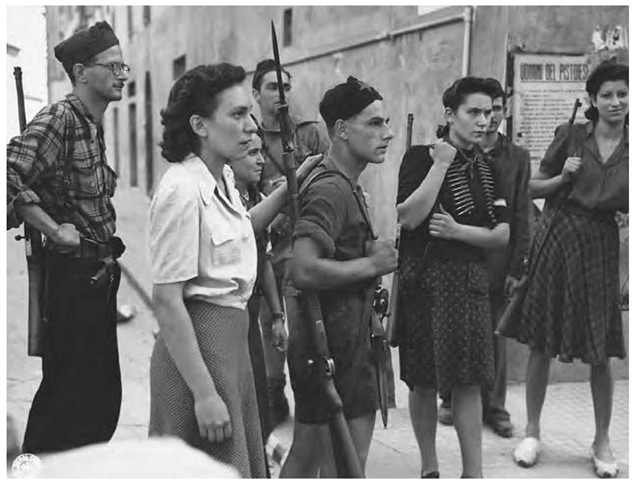
Members of the Italian Resistance
Today, it is hard to imagine the Fascist and Nazi regimes of Italy and Germany were able to captivate such a large population as they did before and during World War II. It is much easier for us to believe people were adamantly against the evils of such regimes, which was the case in Italy. The Italian resistance was born in 1943, when Benito Mussolini was finally eradicated from power by the Fascist Grand Council. At that time, almost half the resistance members were female, 105,000 out of 250,000 total, with 4,600 being arrested, 2,750 deported to German Concentration Camps, and 623 murdered by Italian fascists or Germans.  

The politics of Italy from the 1920s to the 1940s were tumultuous to say the least. Two very different forms of government were vying for control and power; the Italian monarchy led by Marshal Pietro Badoglio, who consequently fled southern Italy, while Mussolini was reinstated as a puppet figure for the Italian Social Republic, who also had an alliance with Adolf Hitler. As a result of the turmoil between the parties, an Action Party formed from the camaraderie of the Communists, Socialists, and Christian Democrats. These particular sects of people began small resistance units, as time wore on, the small groups joined together under the National Committee for the Liberation of Northern Italy.

Italian Resistance partisans after the liberation of Florance
Once Mussolini was eradicated, a ‘crisis of conscience’ occurred through the masses that affected women just as potently as the men. Very soon after Mussolini’s demise, the Women’s Defense Groups began in Milan to coincide with the National Committee of the Liberation of Northern Italy. A major piece of women’s’ contributions to the cause were grassroots mobilization, as well as the legitimization of women’s roles in politics, particularly through the efforts of the Union of Italian Catholic Women and the Union of Italian Women.

The Western European world had never seen such a large involvement of women in a resistance movement such as this before, it was extremely unique, especially considering the traditional roles of Italian women. In Italy, women were expected, and often lived up to such expectations, to be nurture’s of good and the foundation of the family. These admirable qualities undoubtedly enhanced women’s participation in the resistance movement. Their involvement was not only a means to fight Fascism that was crippling their country, but also a means to gain independence for women in general, breaking the traditional and religious stereotypes of the time. However, preserving family values and traditions was at the utmost importance to those women and it would only been natural for them to take up arms against those who would threaten the safety of their families.

Women in the Resistance
The occupations women performed for the movements were vital to the resistance survival. They took care of the food, clothing, and medical supplies, typically from the comfort of their own kitchens. However, their most important role was collecting information and communication. These women were the perfect candidates for clandestine communications and operations. They were the least suspect by the ‘establishment’ and they would be able to get close to unsuspecting men discussing their political agendas and plans. However, these women were not only talented as messengers, but as fighters as well. They were mostly tasked with sabotage, minor strike attacks, and serve as auxiliary to the Brigades.

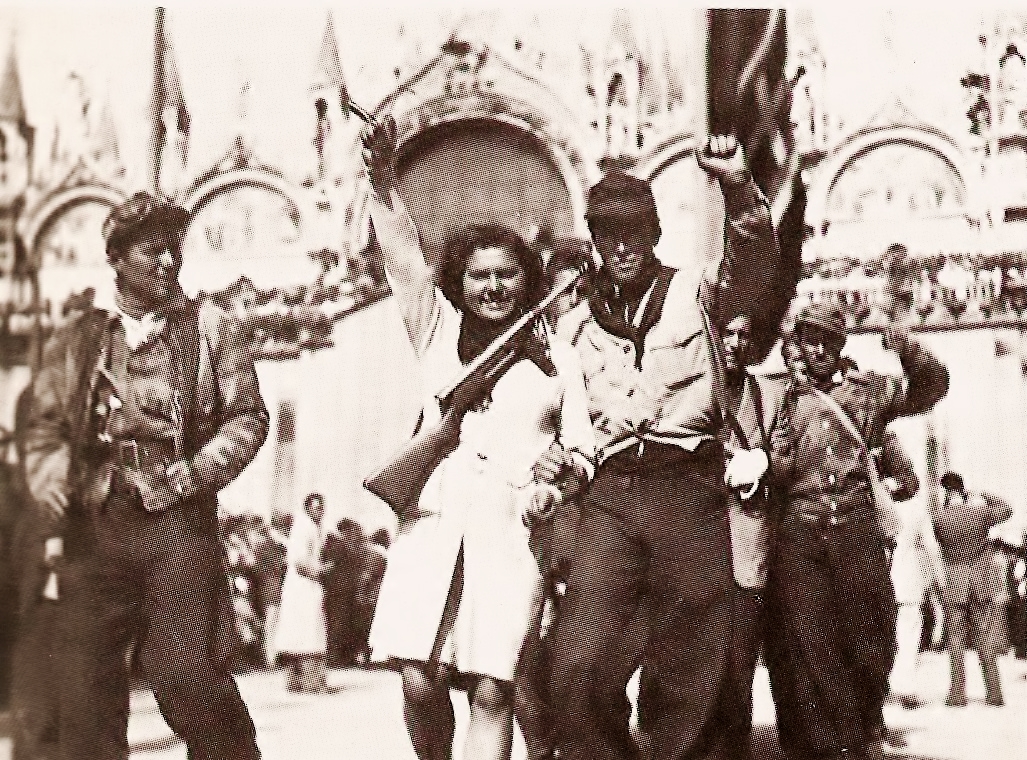
Partisans celebrating victory
Through their hard work, sacrifice, and determination, these brave Italian resistance fighting women were able to make headway in equal opportunity for themselves after war’s end, and the first order of business was granting them the vote. By 1948, Italy was declared a democratic republic, which guaranteed equality for all, no matter their sex, religion, race, or opinion.

Take Care,
Elizabeth