Hello All,
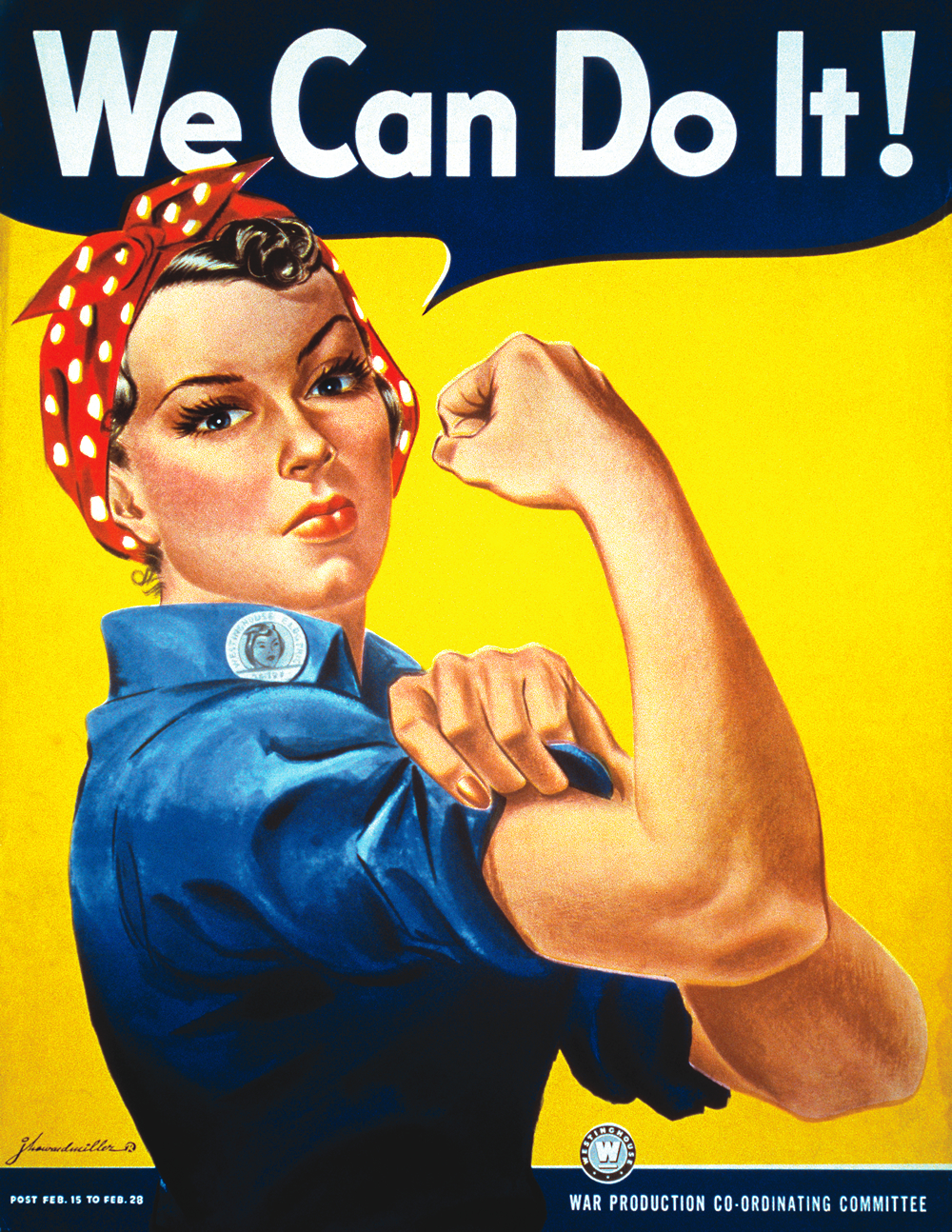 |
| Original poster, 1942 |
Since I have been feeling homey
lately, what with the temperatures cooling and the holidays just around the
corner and all, I thought it would be nice to write about Rosie the Riveter and
the Home front! And as an added bonus, anyone looking for a fabulous female idol
to be for Halloween should definitely follow in Rosie’s footsteps.
Rosie the Riveter, icon of the
1940s, was a symbol for independent and hard working women across the nation.
The widespread male enlistment into World War
II created huge gaps in the workforce that needed to be filled immediately,
naturally, able bodied women were the only ones left to work. By 1945, practically
one out of four married women worked outside the home. Rosie’s initial role in propaganda
was to bring women into the munitions industry, but her sense of strength and
empowering demeanor became the most successful recruitment tool for women during
the war.
 |
| Factory worker, 1944 |
Women were now able to work in
industries traditionally dominated by men. The aviation field saw the highest
increase, with 310,000 women working for the U.S. aircraft industry in 1943.
Munitions also saw a huge increase in female employees, most likely due to
Rosie’s popularity. While Rosie the Riveter is technically a fictional representation,
her inspiration came from a real munitions worker, whose loose illustration was
first seen on a Westinghouse Power Company poster with the iconic slogan “We
Can Do It”, originally printed in 1942. She became so popular there was even a
song written about her by Redd Evans and John Jacob Loeb, solidifying her name
forever.
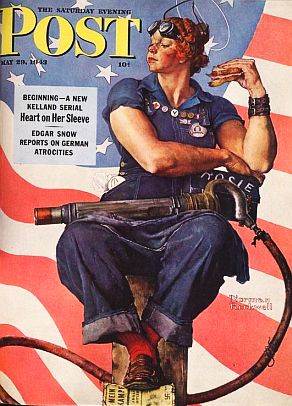 |
| Norman Rockwell's version of Rosie, 1943 |
Rosie reminded women of their
patriotic duty to their country. Not only did women come out in droves to work
for various factories, nearly 350,000 joined the Armed Services as well. First
Lady Eleanor Roosevelt, along with women’s groups, urged General George
Marshall to support the introduction of the Women’s Auxiliary Army Corps, which
gave women full military status. Known as WACs, the women involved worked in
200 non-combatant roles, not only at home but on the front as well. By war’s
end, there were at least 100,000 WACs and 6,000 female officers. The Army Air
Corps created the WASPs, Women’s Airforce Service Pilots, whose primary role
was to fly across America transporting cargo and help in training missions. In
all, they flew a total of more than 60 million miles. Their positions with the
Air Corps allowed thousands of men to serve overseas. Out of the 1,000 women
who served as WASPs only 38 lost their lives during the war. Their heroism was
not recognized until 1977 when they finally received full military status.
The Navy’s version of WACs was the WAVES or
Women Accepted for Volunteer Emergency Service. The Coast Guard and Marine
Corps eventually allowed for similar groups but the number of volunteers was
not as large as the Army or Navy.
Rosie's influence was undoubtedly
the result of strong female minds of American patriotism. We must not forget,
not only were women working hours on end out of the home, they still had to
maintain the daily needs of their families. They became the head of their households
and the primary bread winners, all while their boys were fighting abroad.
If you are interested in Rosie as a potential Halloween costume, you will need a few simple items:
 |
| Air WACs in World War II with new shoulder insignia |
- blue long-sleeve button-up top,
- red bandana for your hair,
- and red lipstick, of course.
Hope you enjoyed!
Elizabeth


No comments:
Post a Comment