Search This Blog

Showing posts with label homefront. Show all posts

Tuesday, April 14, 2015

Home-School Event: April 24, 2015

Calling All Home-Schooled Students!


Want to experience World War II history through interactive stations and living history? Would you like to participate in activities geared towards you and all your friends? Then join us for the National D-Day Memorial Home-School Event on Friday, April 24, 2015, 10:00 AM - 1:00 PM. All age groups are welcome and fees are $4.00 per person. Children under 6 are free. Space is LIMITED, please register by April 15, tomorrow, at the very latest.


For more information or to register, please contact the National D-Day Memorial's Education Department at (540) 586-3329, ext. 114.


Hope to see you all there!

Take Care,
Elizabeth

Thursday, November 27, 2014

Thanksgiving in the 1940s

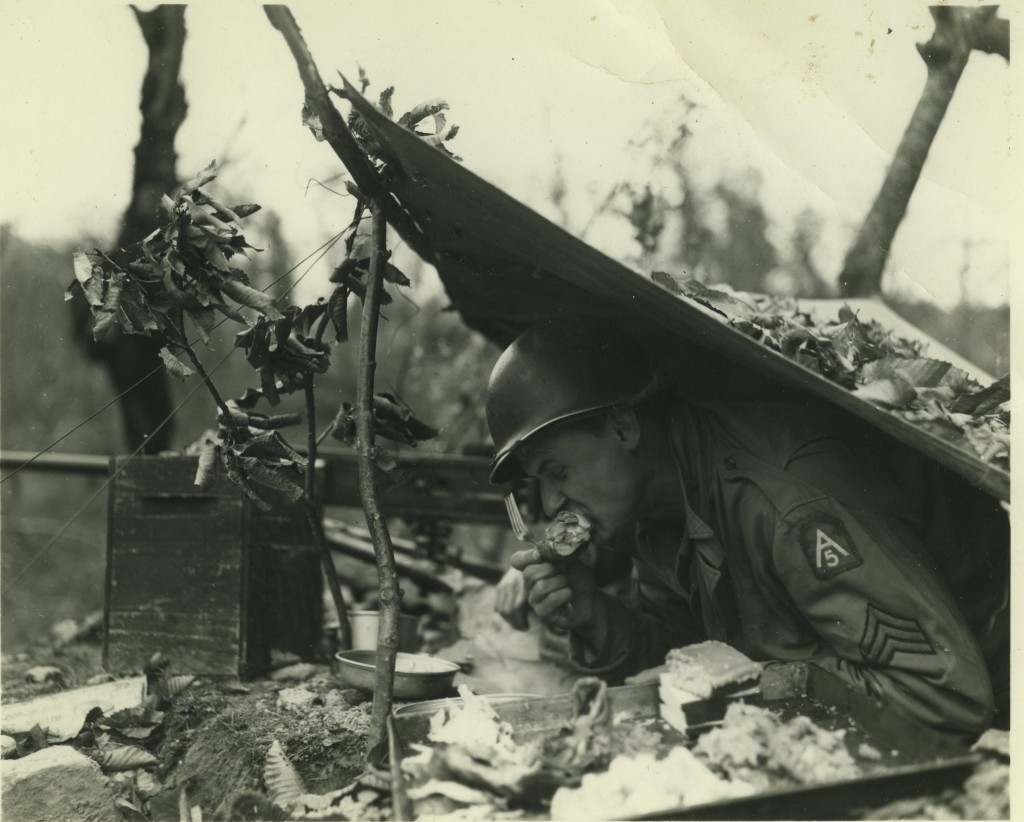
Thanksgiving dinner, Italy, 1944

Happy Thanksgiving, Everyone!

I hope you all are going to enjoy copious amounts of delicious foods and reflecting on all the things to be thankful for this year and in your lives. Does this day make you wonder what Thanksgiving may have been like in the 1940s? How would people possibly be able to have a full Thanksgiving meal amidst the rations and shortages? Not surprisingly, they managed to make the holiday the best it could be with what they had, always making the most of any situation. I would like to begin by sharing a poem by an unknown soldier on the frontlines…

They’re celebrating Thanksgiving on this very day,
My thoughts are at home, though I’m far away;
Soldiers choosing their prized turkey for Thanksgiving, 1943
I can see everyone, eating dinner deluxe,
Whether it is chicken, turkey or even a duck;
The fellows over here won’t whimper or moan.
They’ll look to the next one and hope to be home.
Truly and honestly, from way down deep.
They want you to be happy and enjoy your feast.
These holidays are remembered by one and all.
Those happy days we can always recall.
The ones in the future, will be happier, I know
When we all come back from defeating the foe.

Thanksgiving in the 1940s

Norman Rockwell painting, "Freedom of Want"
Often referred to as ‘The People’s Holiday’, Thanksgiving Day is a holiday that is neither a religious, state, nor a political holiday. The holiday was born from the nation and has remained so since the birth of the nation; the coming together of varied peoples. From the first Thanksgiving, to the Thanksgivings of the 1940s, not much had changed. The holiday still meant family coming together to celebrate the good fortunes of life. Not even the Second World War could change that for America. In fact, the Norman Rockwell painting, “Freedom from Want”, became the token image for the holiday. The spirit of the holiday could have been dampened by all the shortages, rations, and restrictions, but the people would not let that happen.

As everyone knows, Thanksgiving is always the fourth Thursday of the month of November. Many people believed Abraham Lincoln made the day official in 1863, but he did not. In 1939, the last Thursday happened to also be the last day of the month and retailers were worried about the shortened shopping season for Christmas (back then it was custom to wait until after Thanksgiving to begin the Christmas season). Franklin D. Roosevelt decided to change the holiday celebration to the third Thursday of the month. With any major change, the new date was quite unpopular across the nation, with eighteen states refusing to comply. For three consecutive years, thanksgiving was held on two separate dates, the old date nicknamed the ‘Republican Thanksgiving’ and the new date the ‘Democrat Thanksgiving’ or ‘Franksgiving’. But even President Roosevelt knew the date change had no real effect on retailers and decided on October 6, 1941, to reestablish the fourth Thursday of November as the official day of Thanks.

Thanksgiving for our Soldiers

Basting a turkey in the field on Thanksgiving
Throughout the U.S. involvement overseas, military officials did their best to provide a traditional, hot holiday meal for the soldiers overseas. In 1943, the American people sent two liberty ships fully stocked with Thanksgiving supplies for the soldiers. Everything was included, turkeys, trimmings, cranberry sauce, and even various pies, all sent throughout the European and Pacific theaters, all the way to the frontlines. Those lucky enough to be stationed on board one of the Navy’s vessels received excellent food all the time, but Thanksgiving was particularly scrumptious for the servicemen. Despite the good intentions of the higher ranks, every man missed their families, especially during the holidays, but the soldiers had each other through the hardest time of their lives. However, no Thanksgiving could quite compare to the ones held at home. Some men observed that the feeling of Thanksgiving wasn’t there, not like at home.

Challenges with Rationing and Shortages

1942 was the year of the first wartime Thanksgiving and even though sugar was technically the only rationed item in the grocery, shortages of meat and butter created even more of a challenge for cooks. They also had limited access to certain traditional spices because they came from areas now occupied by the Japanese and cargo space needed to be reserved for wartime supplies.
Carving the turkey, Thanksgiving Day

Things were no better by 1943 and 1944. Not only were meats, butter, and sugar being rationed, but cheese, fats, and canned or processed foods were as well. Some folks would save their ration stamps for the holidays and use innovative techniques to create the perfect meal. Ironically, even though chicken and other birds were not rationed, finding a turkey for your own table was quite a chore since many of the birds were shipped overseas for the servicemen!

As if the food shortages were not enough, tire and gasoline rations made it difficult for family’s to gather together under one roof. However, even smaller, intimate gatherings were just as important as big family reunions.


Interesting Trivia

  • Since so many young men were drafted, America’s favorite sport, football, was put on hold for the war. But in 1943, the Philadelphia Eagles and the Pittsburgh Steelers combined their teams in order to fill their rosters and the team was nicknamed the ‘Steagles’.
    Macy's Thanksgiving Day Parade, 1940
  • Rubber was the hardest material to come by because 92% of our supply came from Japanese occupied lands. Everyone had to do their part to aid in the war effort, even Macy’s Department Store. Macy’s famous Thanksgiving Day parade used marvelous, gigantic rubber balloons for their annual parade. The balloons were donated to the cause and shredded for scrap rubber, thus cancelling the parade for the duration of the war. America would not see another parade until 1945.
  • Benjamin Franklin suggested the national bird for the newly founded country of America should be the Turkey because it was a “much more respectable bird” and “a true original native of America.” Instead, we prefer to eat the bird.
  • Abraham Lincoln was not the first President to urge Americans to celebrate Thanksgiving. George Washington, John Adams, and James Madison all issued proclamations regarding the holiday.
  • Gimbel’s Department Store in Philadelphia was the first major store to host a Thanksgiving parade and not the famed Macy’s Department Store.
Thanksgiving Day Football Game, 1940s.
  • Cranberries were actually used by the Native Americans in the first Thanksgiving dinner, as well as for their daily medicinal needs. Today the meal is incomplete without the delicious fruit.
  • The first Thanksgiving football game was held in 1876, about the same time the sport was officially recognized.


I hope you all enjoyed!

Take care and Happy Thanksgiving,
Elizabeth

Tuesday, October 21, 2014

Rosie the Riveter


Hello All,

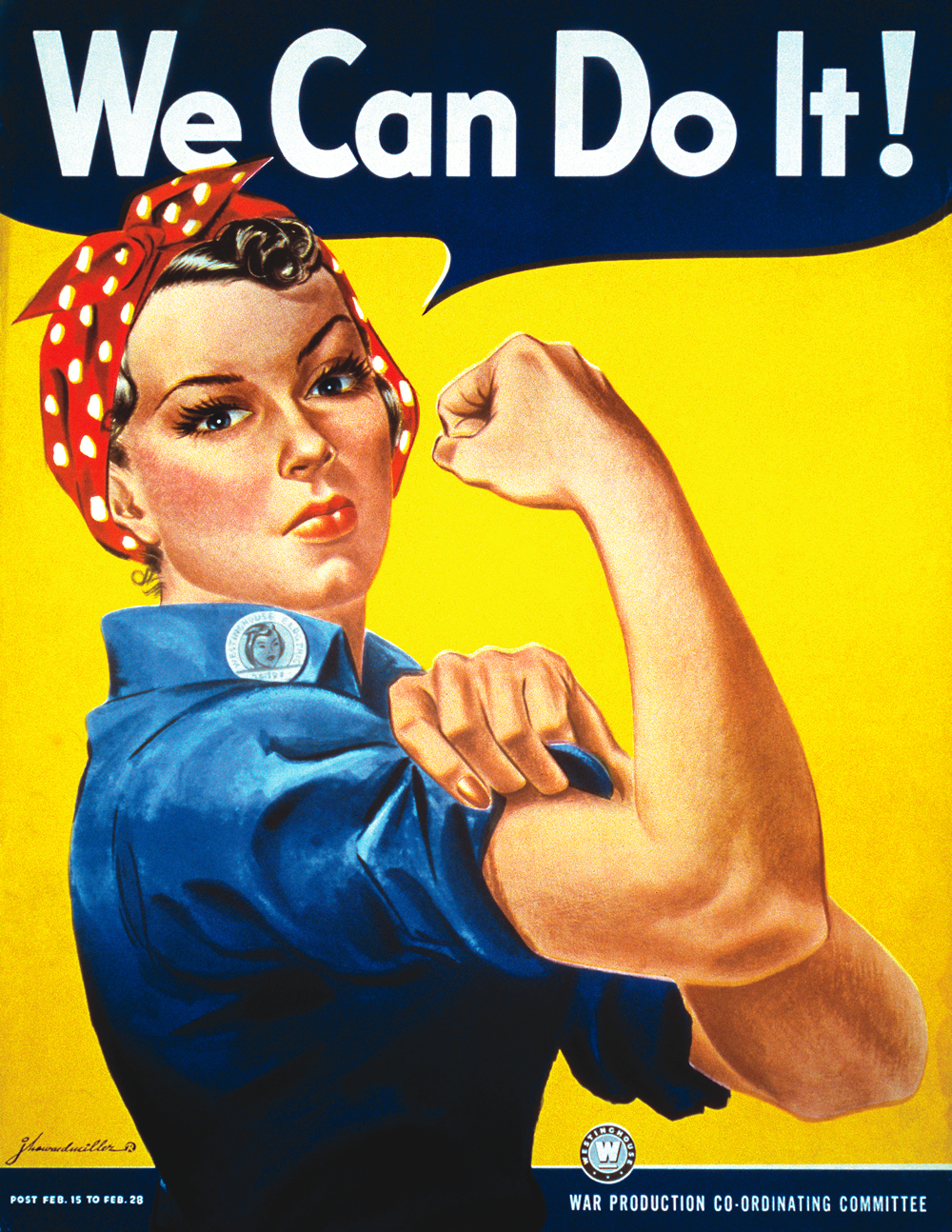
Original poster, 1942
Since I have been feeling homey lately, what with the temperatures cooling and the holidays just around the corner and all, I thought it would be nice to write about Rosie the Riveter and the Home front! And as an added bonus, anyone looking for a fabulous female idol to be for Halloween should definitely follow in Rosie’s footsteps.

Rosie the Riveter, icon of the 1940s, was a symbol for independent and hard working women across the nation.  The widespread male enlistment into World War II created huge gaps in the workforce that needed to be filled immediately, naturally, able bodied women were the only ones left to work. By 1945, practically one out of four married women worked outside the home. Rosie’s initial role in propaganda was to bring women into the munitions industry, but her sense of strength and empowering demeanor became the most successful recruitment tool for women during the war.

Factory worker, 1944
Women were now able to work in industries traditionally dominated by men. The aviation field saw the highest increase, with 310,000 women working for the U.S. aircraft industry in 1943. Munitions also saw a huge increase in female employees, most likely due to Rosie’s popularity. While Rosie the Riveter is technically a fictional representation, her inspiration came from a real munitions worker, whose loose illustration was first seen on a Westinghouse Power Company poster with the iconic slogan “We Can Do It”, originally printed in 1942. She became so popular there was even a song written about her by Redd Evans and John Jacob Loeb, solidifying her name forever.

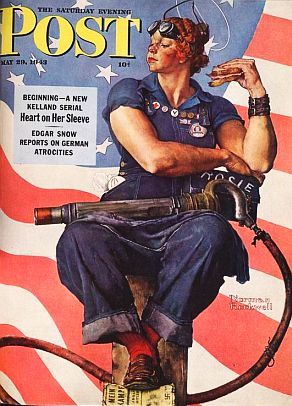
Norman Rockwell's version of Rosie, 1943
Rosie reminded women of their patriotic duty to their country. Not only did women come out in droves to work for various factories, nearly 350,000 joined the Armed Services as well. First Lady Eleanor Roosevelt, along with women’s groups, urged General George Marshall to support the introduction of the Women’s Auxiliary Army Corps, which gave women full military status. Known as WACs, the women involved worked in 200 non-combatant roles, not only at home but on the front as well. By war’s end, there were at least 100,000 WACs and 6,000 female officers. The Army Air Corps created the WASPs, Women’s Airforce Service Pilots, whose primary role was to fly across America transporting cargo and help in training missions. In all, they flew a total of more than 60 million miles. Their positions with the Air Corps allowed thousands of men to serve overseas. Out of the 1,000 women who served as WASPs only 38 lost their lives during the war. Their heroism was not recognized until 1977 when they finally received full military status.  The Navy’s version of WACs was the WAVES or Women Accepted for Volunteer Emergency Service. The Coast Guard and Marine Corps eventually allowed for similar groups but the number of volunteers was not as large as the Army or Navy.

Rosie's influence was undoubtedly the result of strong female minds of American patriotism. We must not forget, not only were women working hours on end out of the home, they still had to maintain the daily needs of their families. They became the head of their households and the primary bread winners, all while their boys were fighting abroad.

If you are interested in Rosie as a potential Halloween costume, you will need a few simple items:
  • high-waist/sailor pants,
    Air WACs in World War II with new shoulder insignia
  • blue long-sleeve button-up top,
  • red bandana for your hair,
  • working boots,
  • and red lipstick, of course.
Hope you enjoyed!
Elizabeth

Monday, March 3, 2014

Happy 110th Birthday, Dr. Seuss!


The Memorial is closed yet again because of snow.  However, that doesn’t mean that we are taking the day off!  After not getting to post last week (it was crazy busy), I will double the efforts for this week.  We are marching ever closer to the 70th Anniversary of D-Day; however, before we look toward June, I want to take a moment and mark the 110th birthday of Theodor Seuss Geisel – whom you probably know as Dr. Seuss.  Born in Springfield, Massachusetts on March 2, 1904, Geisel was a lifelong writer, poet, and cartoonist.  Over the course of his life, he published 46 children’s books which are what he is most known.  Today, however, I want to talk about some of the political cartoons he produced during World War II. 

From 1941-1943, Geisel served as chief editorial cartoonist for the New York newspaper PM.  During that time he drew over 400 editorial cartoons!  Overall Geisel was supportive of President Roosevelt’s handling of the war, highly critical of isolationists (most notably Charles Lindbergh), and encouraged the public to do their part through rationing and purchasing war bonds.  There is no way I can talk about 400 cartoons – for that I would need to write a book.  However, I do want to talk about war bonds – one of many themes of his cartoons.  Ten cartoons are included in this set of war bonds and honestly these are some of my favorites from his collection.  
December 26, 1941
May 24, 1942
In the cartoon on top, you see the caricature of a moose.  Those of us who grew up with his children's books expect this kid of drawing.  Both of these cartoons is attempting to encourage people to buy more Defense Bonds and Stamps.  Produced just after Christmas, the cartoon on top is drawing a connection to the materialistic nature of the holiday with the idea that we on the homefront need to be doing everything we can to make sure the war is successful.  During the war, every little bit helped ensure Allied victory. 
July 28, 1942
October 13, 1942

 These next two cartoons were produced just a few months shy of each other to look at the two main Axis leaders.  Unlike Walt Disney, Geisel took an early (and often) look at the Pacific Theater.  We could spend all day discussing the racism in these cartoons--comparing his racist treatment of all Japanese-American versus his condemnation of the the treatment of the Jewish population in the United States.  You will notice that three of the four cartoons here were produced in 1942 - this is the year that Geisel started working for the Treasury Department directly creating propaganda posters for public distribution. 

In 1943, Geisel joined the Army as a Captain and was commander of the Animation Department of the First Motion Picture Union of the US Army Air Forces.  During this time he wrote propaganda films including ,a 1945 film about peace in Europe after the war and the Private Snafu training films.  In 1947, his film Our Job in Japan, was adapted for commercial use and entitled Design for Death.  This film, a study of Japanese culture, won in the Academy Award for Documentary Feature.  

Geisel died on September 24, 1991.  Today, his birthday marks National Read Across America Day.  If you would like to view more of Geisel's political cartoons visit this wonderful site dedicated to these cartoons hosted by the library at UC San Diego.

Until next time, 

Felicia