Search This Blog

Showing posts with label Rosie the Riveter. Show all posts

Wednesday, March 16, 2016

Real Life Rosie the Riveters: Women on the Homefront in WWII

Hello Again, Friends!

Today, I want to continue celebrating Women’s History Month by sharing about Rosie the Riveters. And yes, Riveters being plural is intentional. Not only were there numerous renditions of Rosie the Riveter as seen in this fantastic video, but there were millions of real-life “Rosies” throughout the nation who answered the call to service on the Homefront.
 
Three “Rosies” posing for a picture before
work. The ladies are identified as Virdie
Gordon Reyes, Retha Maxine Warner, and
Ruth Gordon Davis. The Gordon sisters
were from Elkton, VA, but moved to
Baltimore during the war.
As the men went off to fight in World War II, there was a tremendous need for women to step up in their absence. Women, like those pictured in this photograph to the left from our archives, went to work in the factories that shifted from domestic to wartime production to supply the troops and ensure victory for the Allied nations against Nazi Germany and Japan.

In order to encourage women to fight, the U.S. government began a propaganda campaign starring “Rosie the Riveter” aimed at recruiting female workers for the munitions industry. Rosie the Riveter quickly became arguably the most iconic image of working women during the war.

Between 1940 and 1945, the female percentage of the U.S. workforce increased from 27 percent to nearly 37 percent, and by 1945 nearly one out of every four married women worked outside the home. Bedford, VA was no exception. Many of the female family members of the Bedford Boys worked in local factories that produced supplies for their boys. The Belding Hemingway textile mill where Verona Draper, sister of Frank Draper, Jr., and Bettie Wilkes, wife of John Wilkes, worked to make rayon thread that was used for the manufacturing of parachutes. Frank Draper’s mother worked at the Rubatex factory where they produced insulation for aircrafts and submarines and hoses for gas masks. There was also Hampton Looms that produced material for military uniforms and coats. Women in Bedford also contributed to the war effort in their free time by going to the Bedford County Library to roll bandages. On June 6th, they rolled 9,000 bandages in addition to the 68,300 they rolled in May.
Hampton Looms today in Bedford, VA

Over the past few years as the WWII generation passes on, the importance of honoring our nation's "Rosies" has garnered national attention-- even that of the White House. These women's service and support of the war were critical in winning the war, as well as integrating women into the workforce in the years following World War II.

Until Next Time,


Maggie

Tuesday, October 21, 2014

Rosie the Riveter


Hello All,

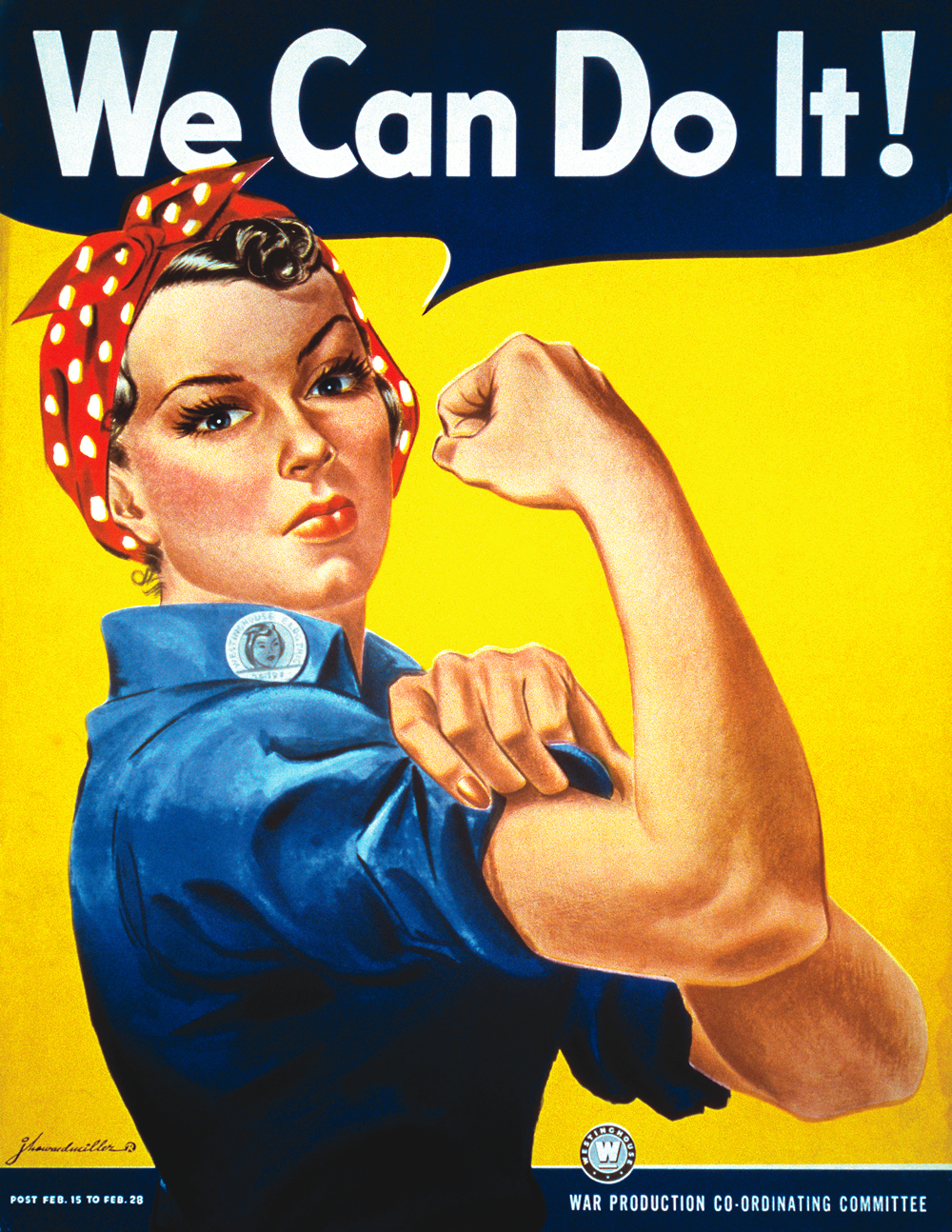
Original poster, 1942
Since I have been feeling homey lately, what with the temperatures cooling and the holidays just around the corner and all, I thought it would be nice to write about Rosie the Riveter and the Home front! And as an added bonus, anyone looking for a fabulous female idol to be for Halloween should definitely follow in Rosie’s footsteps.

Rosie the Riveter, icon of the 1940s, was a symbol for independent and hard working women across the nation.  The widespread male enlistment into World War II created huge gaps in the workforce that needed to be filled immediately, naturally, able bodied women were the only ones left to work. By 1945, practically one out of four married women worked outside the home. Rosie’s initial role in propaganda was to bring women into the munitions industry, but her sense of strength and empowering demeanor became the most successful recruitment tool for women during the war.

Factory worker, 1944
Women were now able to work in industries traditionally dominated by men. The aviation field saw the highest increase, with 310,000 women working for the U.S. aircraft industry in 1943. Munitions also saw a huge increase in female employees, most likely due to Rosie’s popularity. While Rosie the Riveter is technically a fictional representation, her inspiration came from a real munitions worker, whose loose illustration was first seen on a Westinghouse Power Company poster with the iconic slogan “We Can Do It”, originally printed in 1942. She became so popular there was even a song written about her by Redd Evans and John Jacob Loeb, solidifying her name forever.

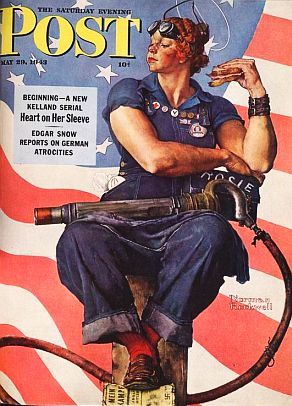
Norman Rockwell's version of Rosie, 1943
Rosie reminded women of their patriotic duty to their country. Not only did women come out in droves to work for various factories, nearly 350,000 joined the Armed Services as well. First Lady Eleanor Roosevelt, along with women’s groups, urged General George Marshall to support the introduction of the Women’s Auxiliary Army Corps, which gave women full military status. Known as WACs, the women involved worked in 200 non-combatant roles, not only at home but on the front as well. By war’s end, there were at least 100,000 WACs and 6,000 female officers. The Army Air Corps created the WASPs, Women’s Airforce Service Pilots, whose primary role was to fly across America transporting cargo and help in training missions. In all, they flew a total of more than 60 million miles. Their positions with the Air Corps allowed thousands of men to serve overseas. Out of the 1,000 women who served as WASPs only 38 lost their lives during the war. Their heroism was not recognized until 1977 when they finally received full military status.  The Navy’s version of WACs was the WAVES or Women Accepted for Volunteer Emergency Service. The Coast Guard and Marine Corps eventually allowed for similar groups but the number of volunteers was not as large as the Army or Navy.

Rosie's influence was undoubtedly the result of strong female minds of American patriotism. We must not forget, not only were women working hours on end out of the home, they still had to maintain the daily needs of their families. They became the head of their households and the primary bread winners, all while their boys were fighting abroad.

If you are interested in Rosie as a potential Halloween costume, you will need a few simple items:
  • high-waist/sailor pants,
    Air WACs in World War II with new shoulder insignia
  • blue long-sleeve button-up top,
  • red bandana for your hair,
  • working boots,
  • and red lipstick, of course.
Hope you enjoyed!
Elizabeth