This past weekend, over 200 Boy and Girl Scouts, troop
leaders, and parents gathered at the National D-Day Memorial for its annual
Scout Day – a day full of educational, hands-on programs that related to World
War II and D-Day, a tour of the Memorial, a chance to meet and speak with a
D-Day veteran, and the opportunity to participate in a program to earn a merit
badge. On May 5, 2017 from 10am – 1pm, the National D-Day Memorial will be
hosting a similar day for home school children in the area.
Home School Day will feature three distinct hands-on
activities: Ration Recipe Round-Up, Barrage Balloon Blitz, and Envision the
Invasion. Each of these rotating stations allow children to learn about the
World War II home front, a special military unit on D-Day, and the essential
planning process and execution of the D-Day invasion. Volunteers and interns of
the Memorial facilitate each station and present a lesson, followed by the
activity.
Additionally, Home School Day will include a tour of the
Memorial that will inform students and families all about the planning,
execution, and victory stages of the D-Day Invasion on June 6, 1944.
Furthermore, children will have the opportunity to also meet a local D-Day
veteran and be able to hear a first-hand account of the invasion. Home School
Day is a rare opportunity for children to learn about D-Day and World War II in
a hands-on and creative way. Registrations for Home School Day is open now so
don’t hesitate to sign up because slots will fill up fast! Visit the event page
www.dday.org to find more information and to register!
African-Americans were not the only ones to experience racism
and discrimination by the armed forces during World War II. After the Japanese attack
on Pearl Harbor on December 7, 1941, first generation Japanese Americans, Issei, and second generation, Nisei, soon faced harsh discrimination
and assaults on their character and loyalty to America. Out of wartime fear, two
months after Pearl Harbor, President Roosevelt signed Executive Order 9066,
which authorized the internment of some 110,000 Japanese-American citizens.
However, perhaps President Roosevelt and ordinary Americans should not have acted
so rashly to detain over 100,000 Japanese Americans, because the war in Europe
would soon demand any able bodied men to join the fight.
As
American-born citizens with Japanese descent, many Nisei were eager to serve
their country, but due to further discrimination, Nisei were not permitted to
join the United States military. About a year after internment began, President
Roosevelt reversed this policy and authorized the enlistment of Japanese
Americans. However, though they were now allowed to serve in the military,
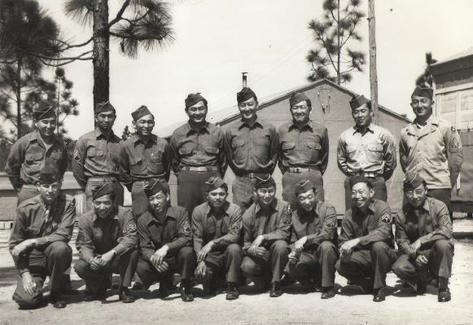
Japanese Americans were restricted to a segregated infantry outfit. This unit
became known as the 442nd Infantry Regimental Combat Team. Upon
requests for volunteers, 10,000 Japanese Americans reported to recruiting
offices in 1943.
In 1944, as the Allied fight in North Africa and
Italy met increased opposition from German forces, the 442nd found
themselves under the command of General Mark Clark, commander of the Fifth Army
in Italy. The 442nd joined the 100th Infantry Battalion,
which was a majority Japanese American unit from Hawaii, created in 1942 before
the ban on Japanese American involvement in the military. This unit was battle
hardened, having seen action in North Africa and Italy for some time. By June
1944 and the fall of Rome, the 100th experienced many casualties and
were in need of reinforcements in order to continue the fight into central
Europe.
The 442nd soon proved not only their loyalty to
America, but also their indispensability in Clark’s army. They were
instrumental in pushing the German lines back and their heroism and bravery
were admired and revered by many. General George Marshall said of the 442nd:
“They were superb! They showed rare courage and tremendous fighting spirit.
Everybody wanted them.” The 442nd further demonstrated their
“extraordinary bravery and valor” for their service and sacrifice in France in
the fall of 1944. These Nisei soldiers who were “once considered a problem by
the army, [were now] seen as a problem solver,” and were called upon for a
special rescue mission of the 141st Regiment who were surrounded by
German forces in France. In an effort to rescue these 275 men of the 141st,
the 442nd experienced immense casualties. In addition to North
Africa and Italy, Japanese Americans assisted in the Pacific Theater by serving
as interpreters and translators against the Japanese as part of the Military
Intelligence Service.
The 442nd in France.
The Japanese American soldiers,
such as the 100th and the 442nd are often overlooked in
the history of World War II. Despite the discrimination they met at home and on
the battlefield, the Nisei soldiers proved to America their worth and loyalty. The
role of minorities during World War II cannot be overstated; the efforts of
Japanese Americans, African Americans, women, and Native Americans were vital
to allied victory. While many recognized the effort and sacrifice of Japanese
Americans in both theaters of war, these soldiers were not acknowledged for
their service and bravery for almost six decades after the war. When they were
finally recognized, twenty men from the 442nd were awarded the Medal
of Honor.
Hayden Furrow, D-Day Veteran,
during a school program at the
National D-Day Memorial
What better day to share one of my favorite love stories
than Valentine’s Day? I’ve always been a sucker for a good love story whether it’s
a book, movie, TV show, or real life. I guess you can say that I am a bit of a
romantic, even though it is hard to see unless you get me on the topic. Well
today, I want to share a video about one of our volunteers, who is also a D-Day
veteran, on his 70th wedding anniversary which occurred just a few days
ago. Hayden Furrow is one of the sweetest men you will ever meet and his
enthusiasm for sharing his story with the next generation endears him to me as
an educator—it’s an experience that our school visitors will never forget. But every
time I see him and he mentions his wife, Katie, he lights up like he’s back in
his youth and you can tell how deeply he cares for her. Recently, a local TV
station aired an interview of the Furrows on their milestone wedding
anniversary, as seen at this link. I hope you enjoy the video as much as I did and that
their story is a reminder of the good things that life can bring.
This week, we are featuring another blog by another one
of our spring interns, Meika. She is a senior at Hollins University in Roanoke,
Virginia and is double majoring in history and political science with
aspirations to earn an M.A. in Public History and then work in history museums,
historic sites, or historical societies. She’s a long-time enthusiast of World
War II and we are excited to have her on board this spring! I hope you enjoy
her blog on the African American women who served in the Army Nurse Corps
during World War II.
African American women were not
immune to the United States’ public call to arms after America entered World
War II in 1941. Women who lived in a racially segregated and discriminatory
country were willing and eager to join the Allied fight against tyranny and
oppression in Europe. American white women are remembered for their heroic
services during World War II as WACs, WAVES, nurses, factory workers, planters
of Victory Gardens, and bandage rollers. Stories of their service are
well known and constantly perpetuated during elementary school lessons of Rosie
the Riveter. However, the story of black women who also served their country
during World War II are less well known. One of the ways through which American
black women contributed during the war was through their participation in the
Army Nurse Corps.
Due to the racial segregation and discrimination in the United
States, black women found it difficult to join the ranks of the would-be 60,000
women in the Army Nurse Corps (ANC) during World War II. Even though the
candidates had the same training and education as most of the white women who
were admitted, government quotas placed limits on the number of black women who
were allowed to join the ANC in 1941. In
subsequent years due to the influence of First Lady Eleanor Roosevelt, quotas
for black nurses to join the Army Nurse Corps began to loosen up and completely
abolish the quota system in 1944.
A black
nurse treating a German P.O.W. in England, 1944.
Though their numbers were small in comparison to the 60,000 white
nurses, the less than 600 black nurses eventually admitted to the ANC were
happy to finally be able to serve their country. Despite their segregation,
discrimination, and occasionally rudimentary jobs assigned to them, black
nurses in the Army Nurse Corps were able to see a bit of the world during their
service. Though black nurses were largely restricted to serving only in
hospitals and aid stations occupied by black military men, a demand for medical
care brought black nurses to England, Burma, Africa, and such faraway places
such as Liberia and Australia, and other locations in the Pacific. Other nurses
remained in or returned to the United States to work in convalescent, general,
and station hospitals.
In addition to serving the black troops, black nurses were also
provided medical care for German prisoners of war in England and in as obscure
places as Arizona in the United States. Due to labor shortages in the United
States, the government made use of a free source of labor: German prisoners of
war, and thus transported them from Europe to work on farms or other labor
sites.
The work given and sacrifice
made by black nurses during World War II not only achieved progress for black
nurses in the form of increased federal funding and recognition, but they also inspired
a new generation of nurses. Following the eradication of the quota system in
1944, over 2,000 young black women enrolled in the Cadet Nurse Corps program
and other nursing schools. The 600 African American nurses in the Army Nurse
Corps deserve to become part of the narrative of American women who served
during World War II and I hope that further research can be conducted and
further recognition duly awarded.
I’m excited to introduce a new contributor to our blog, Olivia. She is one of my spring interns and is working on her Masters of Art in
History at Liberty University. Her primary field is Modern American Military
History focusing on leadership in World War II and the Korean Conflict. Her
work seeks to bring to light those leaders and subordinates whose impact is
often overlooked or undervalued. She has also presented at several conferences
and won an award for her work on the Japanese American Nisei Soldiers. I am
very excited to have Olivia on board and hope you enjoy her post on treatment
of African Americans in Nazi Germany!
The horrors afflicted by Nazi Germany from 1933 to 1945
are ingrained in the world’s memory with the tragedy and loss still present in
the minds of people around the globe. While the atrocities Nazi Germany
afflicted on groups such as the Roma and Jewish communities are well known
there are other groups, which also suffered at the hand of Nazi controlled
Germany. One of these lesser-known groups the black and mulatto citizens of in
reach of Nazi Germany.
Before
World War I there were not many black German citizens living in Germany. When
Germany lost World War I the Treaty of Versailles stated Germany was so give up
her colonies in land that is present day Tanzania, Rwanda, Burundi, Ghana,
Togo, Cameroon, and Namibia. With the loss of these military outposts, military
men and German colonial students, artisans, writers, and performers both white
and black returned to Germany. Many military and colonial leaders also brought
with them a system of deep racism and discrimination of black citizens. The
Treaty of Versailles also stated troops were to occupy the Rhineland region of
West Germany. The French assigned 200,00 soldiers both nationals and colonials
to occupy the Rhineland. Racist propaganda groups in Germany quickly moved to
compound the situation in order to spread racism and discrimination against
blacks in the Rhineland and Germany. Propaganda viewed the black colonial French
soldiers as rapist and carriers of disease. Other special interest groups
blamed black soldiers for all of the unrest, rape, and murder of German women
by the occupying forces, causing panic and uproar. This escalated and even resulted
in Pope XV asking for the removal of black French troops and people writing to
US President Woodrow Wilson demanding the removal of the black colonial troops.
Even before Hitler’s rise to power, discrimination began with forbidding black
citizens from holding any type of government jobs or roles in the military.
Interracial marriage was also banned in Germany and all of its holdings.
However,
with the rise of Hitler’s power in 1933 came wide spread persecution and further
discrimination was implemented against blacks and mulattos living in Germany
and the territories Hitler acquired. While there was never a program of
systematic elimination, treatment of black citizens varied in levels of
severity from discrimination and isolation to sterilization and medical
experimentation. In Mein Kamph, Hitler stated that, “Jews had brought Negros
into the Rhineland with the clear aim of running the hated while race by the
necessarily-resulting bastardization.” In this statement Hitler used the
previous post World War I tensions to push the German people to accepted racism
and discrimination.
By 1937 the Germans decided something had to be done
about the approximately 800 mixed raced children living in the Rhineland which
Hitler deemed “an insult to the German Nation. Therefore, a committee created
Commission Number 3, giving the German government power to start sterilizing
mixed race children deemed “Rhineland Bastards”. As many as 400 German African
mulatto children were gathered and sterilized, many with out the parents
knowledge beforehand. Hans Hauck was a teenager at the time this organization
was commissioned and was serialized by the Nazis. Hauck recalled in the
documentary, “Hitler’s Forgotten Victims,” he was serialized without
anesthesia. Once his procedure was completed he was given a certificate
validating his procedure and told to avoid sex with German women. At the same
time women who were found pregnant with mixed babies were forced to have
abortions. At the same time, persecution
was also happening to the small population of full black German citizens.
Under Hitler’s rule all black citizens were banned from
universities and in some cases the subjects of anthropological and medical
studies, there were also cases of murder and abuse. Such is the case of
Hilarius Gilges. Gilges was a 24-year-old native of Dusseldorf and an artist.
In June of 1933 approximately a dozen SS officers attacked Gilges, captured,
tortured, and killed the young man for his race identity and political
affiliations. Today his life is memorialized in a plaza in Düsseldorf as the
first marked death in Düsseldorf under the Nazi oppression. Others with similar
stories are shared in published works such as Born to Witness: Growing Up Black
in Nazi Germany, which tales the story of Hans Massaquoi who grew up during the
War in Germany.
At the time Hitler and the Nazi’s came to power there
were approximately 25,000 black or mulatto citizens in Germany out of
population of 65 million. Taking into account the low population proportion of
black and mixed German citizens during Hitler’s rule combined with the world
wide level of accustomed prejudice and discrimination toward men and women with
African heritage at the time it, is easy to see how the plight of those souls
tortured and maimed by Nazi practices went unheard of for so many years.
However, the policies of hatred and abuse toward those deemed “impure” or “a
threat to the master race” practiced by Nazi Germany goes beyond the treatment
of Roma, Jews, and Russians. The torment and pain Nazi Germany inflicted on the
population of men, women, and children with African decent deserves to be told
in shared with the same hope of never allowing such a travesty to occur in our
lifetime and in future generations.
It has been a very busy fall at the National D-Day
Memorial with events, field trips, and even livestreaming programs for schools
across the nation! With all of the busyness, we haven’t been able to post as
many blogs as we would have liked to, but we will definitely be making up for
that in the next few weeks with information about upcoming events, stories from
D-Day veterans, and even the use of pigeons in WWII.
Today, I am excited to introduce a new author for the
blog, Sandra Parece. She joined the Memorial’s staff in July and works as the Assistant Site Manager.
She spent years as a teacher with our local school system and we have enjoyed
having her in our D-Day family. Check out her blog below on our upcoming
luminaries event.
-Maggie
_____________________________________________
This year, December 9-11, 2016 will be special days for the
National D-Day Memorial with our annual Flames of Memory and Christmas in
Wartime Presentation. On these three days from 6PM to 9PM, we remember the
4,413 men killed on D-Day by lighting luminaries. Arranged throughout the Memorial and all the
way down our access road, thousands of luminaries will shine in recognition of
Overlord’s fallen and in tribute to the ultimate sacrifice to ensure our
freedom.
As a new employee, I have had the opportunity to help
assemble luminaries in preparation for this event. At first, I saw the task as a productive way
to occupy my time and temporarily take my thoughts away from the stresses of
the upcoming holidays. However, as I worked,
I realized that placing sandbags into a luminary bag is not just part of the
job, but an honor. Each sandbag
represents a soldier who paid the ultimate sacrifice of giving his life so that
I can enjoy the freedoms that we share as Americans. Seeing the thousands of
luminaries also helps to put the sacrifice of D-Day into perspective. Losing
4,413 Allied men in one day is unfathomable for students who are growing up in
a world where it took around 6 years to hit that number of killed in action in
Iraq.
You may purchase a luminary in honor of or in memory of a
loved one that has served or is currently serving in the armed forces. To ensure that your loved one is included in
the printed program, luminaries must be purchased by December 5, 2016. Luminaries
are $20.00 each or 6 for $100.00. All
gifts are tax-deductible and group sales are available. To purchase a luminary, click here, email
giving@dday.org, or call (800) 351-DDAY.
If you are in the area, I encourage you to visit the Memorial
and see the magnificence of the luminaries for yourself. Admission is free,
although donations are greatly appreciated. Special thanks to sponsors for this
event the Virginia Moose Association and Member One Federal Credit Union!
I wish you peace and happiness this holiday season!
Often, we hear stories of those who made it home from war
or those who paid the ultimate sacrifice fighting for their country. However,
we do not always hear the stories of those who were captured or never found in
conflict—our nation’s Prisoners of War (POW) and Missing in Action (MIA). Nonetheless,
their families grieve just like Gold Star families, but without closure. To put
this into perspective, as of June 9, 2016, there are still 1,618 unaccounted
for POW/MIAs from the Vietnam War according to the National League of POW/MIA
families.
Personally, when I think of D-Day MIAs, my first thought
goes to Staff Sgt. Raymond S. Hoback, one of our Bedford Boys. His story, as
told below by his sister, Lucille, demonstrates the pain felt by MIA families:
The next day [after receiving the news of Bedford’s death
on D-Day], in our childish way, my sister Rachel and I thought we might cheer
our folks up by making them some ice cream.
We were over the freezer cranking away when there was another knock –
another telegram. “The War Department
regrets,” the too-familiar preamble read, “to inform you that your son, Staff
Sgt. Raymond Samuel Hoback is missing in action.” Mom and Dad were overcome with grief and I
along with them. To this moment I can
remember nothing else that happened that day.
Time simply stopped.
Raymond Hoback, D-Day MIA
Raymond was never found. Several of his company mates
subsequently reported seeing him lying on the beach near water’s edge, whether
wounded or dead they did not know. What
is clear is that he, along with dozens others like him, was taken by the tide
into the sea. A word now about
Providence, which manifested itself in the form of a package that arrived at
our house a few days later. It was a
book sent by a soldier from W. Virginia, who had landed a day after Raymond had
gone ashore. “While walking on the beach
on D-Day plus one,” he wrote, “…I came upon this Bible, and as most any person
would do I picked it up from the sands to keep it from being destroyed.” It was the Bible she had given Raymond for
Christmas in 1938. It was her only
tangible connection to her missing son.
She treasured it for the rest of her life, as I treasure it today.
Because they were unable to bring home Raymond, the
Hobacks chose to keep Bedford in the American Cemetery at Normandy.
Unfortunately, this is just one of the thousands of stories of POW/MIA families
across the United States.
If you are in the area, we would love for you to join the
National D-Day Memorial on Saturday, September 17 at 11 a.m. for a ceremony to
honor our nation's POWs and MIAs. The
event will include a special Missing Man ceremony, wreath laying, songs by Rick
Dellinger, and keynote speaker Robert O. Gray, POW, Korea. Gray enlisted in the
Army in 1949 at the age of 17. He was stationed in Japan as part of the 24th
Infantry Division until he was sent to Korea at the start of the war
there. He was captured by the enemy in
November 1950, and spent 34 months in a POW camp.
Gates open at 10 a.m. and admission is free until
noon. Please bring a chair as seating is
limited. Sam's Dogs will be on site with
food available for purchase. Rolling Thunder Chapter 4 and Lynchburg Harley
Davidson will also host a Benefit Run to the Memorial on the morning of this
event. For more information on how to
participate or donate to the cause, email RTVACH4@gmail.com or click here.
Every year when school starts back, we eagerly await the
arrival of over 360 first years from Virginia Tech’s Corps of Cadets for their
annual visit. It is always exciting to watch the next generation of servicemen and women learn
about the valor, fidelity and sacrifice of those who served before them—especially
considering the Virginia Tech and D-Day connection.
Virginia Tech (VT) was established in 1872 with
agricultural and military training central to its mission. During World War II,
not only did students serve but the campus was transformed into an active-duty military
installation. In all, more than 7,000 VT alumni served in WWII, of whom 323
died in service to their country.
One of our Bedford Boys and D-Day fatalities, John
Schenk, was a Business Administration major at Virginia Tech. You can read more
about John’s experience here. Throughout the first month or so of the invasion,
VT lost 20 alumni in and around Normandy. There is a plaque just outside of the
Memorial’s Gray Plaza that memorializes VT’s contribution to the D-Day
Invasion.
Today, the Virginia Tech Corps of Cadets’ mission is to
nurture and create great leaders ready to pursue military careers or to enter
the public and private sectors after graduation. This summer, many of the
cadets went to Normandy and learned first-hand about the sacrifices made by
those whose footsteps they are following. Read about their trip to Normandy
here.
Thankfully, it was a mild morning for the 360 or so first
year cadets to rotate through seven different stations at the Memorial. Many of
our volunteers, and even one of our World War II veterans, come out year after
year to lead a station and share about the valor, fidelity, and sacrifice of
those who stormed the beaches on June 6, 1944 because it is inspiring to see
young men and women who understand the importance of service to their country.
Check out the following news stories to hear more about
the visit from the cadets themselves:
My name is Victoria
Carr. I am a senior at Mary Baldwin College as a history major and I’m spending
my summer as an intern at the National D-Day Memorial. As an intern with the
Education Department, I have worked closely with the school groups, giving
tours, and assisting with educational programs and events.
During World War I,
a group of elite men was added to the U.S Navy to help with destroying enemy
defensive obstacles. In World War II, these men were called frogmen and were a
part of the Naval Combat Demolition Unit. Today, this group is known as the
Navy SEALs.
Once the US entered
WWII, the Navy saw that in order to defeat the Axis powers they would need to
perform a large number of amphibious attacks. They decided that men would have
to go in to reconnoiter the landing beaches then locate and destroy obstacles
and defenses. The Army and Navy established the Amphibious Scout and Raider
School at Fort Pierce, Florida in 1943 to train men in the specialty of amphibious
raids and tactics. Most of these men used their skills though North Africa, the
Pacific, and the Normandy landings.
As time went on,
there was a need for men to destroy obstacles. In 1943, the Navy created a
large dedicated force for this task called the Naval Combat Demolition Unit, or
NCDU, also located at Fort Pierce, Florida. The NCDU force meant recruitment
beyond just the pool of experienced combat swimmers to the Seabees (the Navy’s
construction battalions), the U.S Marines, and U.S Army combat engineers. Most of these men were used to disarm
explosives, but now they were going to learn to use them offensively. One
innovation was to use 2.5 pound packs of tetryl placed in a rubber tube so that
they could twisted around obstacles for demolition.
By June 1944, 34
NCDU teams were deployed in England as a part of Operation Overlord. The Germans
had placed defenses on the French lines to make it hard for the Allied forces
to attack without heavy lost. As the NCDU teams arrived in England, the scouts
and raiders were out getting information on the obstacles placed along the French
coast. For training, they built a replica of the Belgian Gates on the south coast
of England for the teams to practice on. They learned that they could blow the
gate to pieces creating more of an obstacle, but they would need to find the key
corner joints so that it fell down flat. The Allied attack plans had the NCDU
teams landing in the second wave of the D-Day invasion on 6 June 1944 and
working at low tide to clear the obstacles so that troops could get though.
NDCU 140- Hill's Hellions
My Great
Grandfather, Donald C. Carr, was part of the NCDU team during World War II and
D-Day. His NCDU was called the “Hills
Hellions” or NCDU 140. He wrote a letter to his high school when he returned
from Normandy. He wrote:
“I returned
recently from the invasion of Normandy. The demolition crews to which I am
attached were the first to land on the shores of France. Our mission was to
destroy the beach obstacles so that the incoming troops and supplies could be
landed with minimum of loss. Landing slightly before H-hour, we encountered
heavy enemy resistance. After completing our mission we remained on the beach for
28 days then returned to the French debarkation point for transportation to
England and the United States. I am sorry to say that we only returned with 53%
of our men. There are many new
cemeteries on the shores of France that are filled with men who gladly gave
their lives for the cause. As men have said before, you give us the equipment,
we shall do the rest.”
It has been an
honor to spend my summer interning at the National D-Day Memorial and having
the opportunity to honor and preserve the men who stormed the beaches on June
6, 1944, like my grandfather.
On June 5 or 6, 1944, hours before embarking on the
greatest invasion of WWII, American soldiers, sailors and airmen received a
special message from their commander, Gen. Dwight Eisenhower. The printed “pep
talk” informed the men that they were “about to embark upon the great crusade,”
defined the coming fight as one of freedom versus tyranny, and encouraged the
men that “we will accept nothing less than full victory.” Known as the Order of
the Day, the D-Day message was one of the most important military documents in
US history.
Bob Slaughter, D-Day Veteran Founder of National D-Day Memorial
Few of the men that day, facing the biggest fight of
their lives, thought to save their copies of the Order of the Day. But one man
who did was the founder of the National D-Day Memorial:
John Robert “Bob” Slaughter of Roanoke.
Bob was a survivor of D-Day, a sergeant in the 116th
Regiment of the 29th Division at Omaha Beach on June 6, 1944. Like
his fellow soldiers, he received a copy of the Order of the Day as he awaited
the order to begin the invasion of Normandy. But unlike most of the men, he
realized the historic nature of the document and of the day. He circulated
through his company and had his buddies sign their names to his copy; then
folded it into a plastic bag and tucked it into his wallet. He carried his
Order of the Day through the rest of his time in service, and afterwards
described it as his “most treasured souvenir of the war.”
It was, for many years, his own personal memorial to the
men of D-Day. Of the 75 soldiers who signed Bob’s Order that night, eleven
would be dead within hours.
Bob went on to become perhaps the best known D-Day
veteran in the nation, but he never forgot the men who never made it off those
beaches. Often he would speak to school groups, club meetings, or civic
organizations, and show his Order of the Day as he told his poignant story.
Slaughter's copy of the Order of the Day
Bob died in 2012. Earlier this year, his family donated his
framed copy of the Order of the Day, along with the rest of his papers, to the
Memorial he did so much to build.
The tattered scrap
of paper is now one of the most significant items in our collection, a tangible
reminder of the costs of that crucial day in history. It was actually there on
Omaha Beach, and against all odds survived. Very few original copies of Ike’s
Order survive, and even fewer with the signatures of D-Day participants. That’s
why the staff and volunteers who have had the chance to see and hold Bob’s
Order (it’s too fragile to be on public display, so only limited access is
permitted) find it a chilling experience. All have been awed; some have been moved
to tears, as they realize that for so many heroes it was the last time they ever
wrote their name.
The Order is, sadly, in very fragile shape. Printed on
inferior wartime paper, it literally endured months of battlefield conditions.
Creased, torn, faded and unfortunately repaired with tape, this highly
significant artifact stands greatly in need of conservation. Yet the rarity and
historical significance of Bob’s Order of the Day make it imperative to preserve
this endangered artifact. It’s a testament to one of the most important battles
of the 20th Century and to the men who fought it.
That is why the National D-Day Memorial has nominated Bob’s
Order of the Day for the Top Ten Endangered Artifact program of the Virginia
Association of Museums. And to raise awareness of the need to preserve such
treasures, our supporters are invited to vote online through the month of
August in the popular poll!
Anyone and everyone can cast their votes at www.vatop10artifacts.org.
Supporters are encouraged to vote as often as they like—there is no limit of
one vote per person or one vote per day. We’ve timed it—you can vote about five
times in one minute!
Those wishing to make a lasting impact can also donate to
the conservation of any of the twenty nominated artifacts, including the Order.
We have participated in the Top 10 Endangered Artifacts
Poll for many years, but this time we are hoping folks will support our
nomination in record numbers. It’s an important part of our history and a great
way to honor the men who won the war for us. So get started voting—vote early,
vote often!
On May 8, 1945 Nazi Germany surrendered to the United
States and other Allies marking the end of the war in Europe. This surrender, known
as VE Day marked the end of World War II for millions of soldiers and civilians.
For the American soldiers in Europe that had fought across the continent from
the beaches of Normandy this was the end of 335 days of combat and the start of
occupation. In order to fairly decide which units and soldiers were sent to the
Pacific theater and which would be sent home the Army developed a points
system. This system, officially designated the Advance Service Rating Score,
quickly became a hot topic with the troops.
Point System for Discharges at End of WWII
The Army’s reasoning behind this system was two-fold. Instead
of shipping units whole from Europe the Army understood that it’s soldiers
wanted to go home and soon. Draftees and National Guardsmen that had been in
for the duration since 1941 often had the highest scores and were rotated home
quickly. For example: Sgt. Bob Slaughter of D Company, 116th
Infantry Regiment who stormed ashore on Omaha Beach had accumulated a score of
135 points by May of 1945, almost double the minimum of 85. His high score came
from 52 months of active service, 33 of it overseas, 2 Bronze Stars, 2 Purple
Hearts, the American Theater Ribbon and 5 Battle Stars on the European Theater
Ribbon.
When Bob returned home to Roanoke, Virginia he worked for
the Roanoke Times newspaper until his retirement in 1987. In the 1980s he began
to organize reunions of his World War II unit. At the same time, he began a
campaign for a memorial dedicated to the memories of the D-Day fallen. This
culminated in the dedication of the National D-Day Memorial in Bedford,
Virginia on June 6, 2001.
Bob Slaughter's Medals
In order to keep units at full strength with combat
veterans returning home, recently inducted soldiers would be sent overseas to
join the Army of Occupation in Europe. One of these replacements was my
grandfather, Pvt. William B. Ford Jr., who spent a year in Bremerhaven, Germany
with the Army of Occupation. The surrender of Japan on August 14, 1945 allowed
the drawdown of forces to continue with the points limit revised to 80 and soon
to 50 by the end of 1945. As the points needed to be discharged dropped, so did
the number of men in uniform. By January 1, 1946 almost fifty percent of the
8.3 million men in the Army had returned to civilian life in the states. These
veterans contributed to the rapid growth of post-war America and the eventual
Baby Boom of the 1950s. After grueling months on the front lines these soldiers
finally returned home to their sweethearts, a warm bed and Mom’s apple pie.
As the Greatest Generation quickly passes away, it is
ever more important to celebrate and remember the legacies of World War II. In
2010, Congress unanimously voted in favor of a national “Spirit of ’45 Day,”
typically held on V-J Day (August 14), to preserve and honor the legacy of the
men and women of the World War II generation so that their example of national
unity, shared sacrifice, can do attitude, and service to their community and
country continues to inspire future generations of Americans.
Spirit of '45 Alive Concert 2015
On Saturday, August 13, 2016 at 7PM, the National D-Day
Memorial will host its annual Spirit of ’45 Alive concert—an outdoor concert
featuring The Let’s Dance Band with a tribute to the WWII generation. Tickets
are sold at the door. In honor of Rosie the Riveter, wear a red bandana or
scarf and receive $2 off admission. For ticket pricing and more information,
visit www.dday.org or call 800-351-DDAY. A
special thanks to Weldex and Bank of the James for sponsoring this event!
-Will
Sources:
Slaughter, John R. Omaha
Beach And Beyond: The Long March of Sergeant Bob Slaughter.
St.
Paul, MN: Zenith Press, 2007.
Kennet, Lee. G.I.:
The American Soldier in World War II. New York: Charles Scribner’s Sons,
Millions of men served in the US military during World
War II. Many of them needed to be
trained and equipped for combat, but equally important were the many support
roles which allowed for smooth operations.
Even the simplest tasks became much more complex due to the sheer scale
in which they needed to be carried out, and so an army of men was needed to
support the army of men. But regardless
of their role the men had one unifying factor; they were away from home. And so these millions of men sent and
received millions of letters, and the task of sending and delivering all this
mail proved quite the challenge.
V-Mail Processed into Microfilm
The major problem came in transporting the mail across
the Atlantic Ocean. Mail sent via cargo
ships was slow to arrive, taking up to a month.
But the alternative of sending mail via cargo planes, taking less than
two weeks, was expensive. Cargo space on
these planes was at a premium, and letters were bulky both in weight and in the
space that they took up. In searching
for a way to address this problem, the military postal service turned their
eyes to the British “Airgraph”.
The British had encountered the same problem as the
Americans when it came to sending mail to and from their troops stationed in
the Middle East. After the Italians
closed off the Mediterranean Sea and Suez Canal to the Allies, mail had to be
sent all the way around the Cape of Good Hope.
This meant letters could sometimes take three to six months to arrive at
their destination. Sending mail by air
was far preferable, but the bulk needed to be reduced. Their solution they termed the
“Airgraph”. Based on a process invented
in the 1930s by Eastman Kodak, the “Airgraph” became the preferred method of
sending mail. Letters would be written
on premade forms, these forms would be censored and scanned onto microfilm, the
microfilm would be transported by plane, and on arrival the letters would be
printed onto photo paper and delivered.
V-Mail Letter
The US military postal service adopted this process
renaming it “Victory Mail”, or “V-Mail” for short, and it proved extremely
effective. The savings of this system
were enormous; 2500 pounds of paper letters in 37 mail sacks could be condensed
into only 45 pounds of film in one mail sack.
In turn, this freed up room for more materiel to supply the war effort. The US further reduced waste by only printing
the letters at 60% scale. The use of
V-mail also inadvertently deterred espionage; as only photocopies of letters
were being sent, invisible ink and microdots were rendered useless. In addition, letters could not be “lost” in
transit; every letter carried a serial number and new copies could be printed
if necessary. After being introduced in
mid 1942, V-Mail became the primary method of communication for US soldiers
stationed abroad until the end of the war in 1945 with over a billion letters
going through the system. As such, it
was a staple not just of a soldier’s life, but of Americans back home as well.
My name is Will Harris and I am an intern at the National
D-Day Memorial. My main focus as an intern this summer is my research project
which focuses on Roanoke, Virginia’s National Guard company. D Company of the
116th Regiment, 29th Division was in the same battalion as the famous “Bedford
Boys” of Company A. Company D landed just behind A Company on Omaha Beach and
suffered a similarly large number of dead and wounded. One of the dead was
their Company Commander Captain Walter O. Schilling.
Captain Walter O. Schilling
Walt Schilling is representative of the concept of a
citizen soldier. As a member of the National Guard, he was willing to put his
civilian career on hold to defend his nation. Unlike most Army officers in
World War Two, Capt. Schilling did not attend the United States Military
Academy or any other military college, but instead rose through the ranks. Well
respected by his men for his leadership during the 29th’s preparation for the
Normandy assault, Capt. Schilling made it his mission to lead from the front.
Capt. Schilling’s leadership style and service as a
citizen soldier is similar to that of the character of Capt. Miller in Steven
Spielberg’s film Saving Private Ryan. Captain Miller left his job as a high
school English teacher to join the Army and eventually serve as the Company
Commander of C Company, 2nd Ranger Battalion. Miller, like Schilling,
understood the importance of leading his men through his own example, even if
the orders they received seemed suspect or unusual.
Snapshot from the movie, "Saving Private Ryan"
While the character of Captain Miller is fictional, he
and Walt Schilling represent the hundreds of Captains and Lieutenants who went
ashore on D-Day with the mission of leading their men onto the beaches. This
proved to be an enormous task with communications almost non-existent and
German defenses preventing any type of coherent advance. The surviving officers
rallied what men they could, and lead them in the destruction of German
emplacements and the eventual exit from Omaha Beach.
The 4,413 names on the D-Day Memorial’s necrology wall
are of officers and enlisted men who gave their lives so that France could be
liberated and the Nazi regime overthrown. Each name has a story of sacrifice
attached to it that cannot be forgotten.
-Will
Sources:
Slaughter, John R. Omaha Beach And Beyond: The Long March
of Sergeant Bob Slaughter.
My name is Tyler; I am a history major at the University
of Virginia and am interning with the National D-Day Memorial over the summer. My
primary internship responsibilities include the expansion and maintenance of
our archives, giving tours, and assisting with our many education programs.
Having been exposed to so much D-Day history in the past few months, I
developed an interest in the obstacles these soldiers faced and decided to complete
more research on the Atlantic Wall.
Steel 'hedgehogs' at
the Pas de Calais, April 1944
On March 23, 1942 Adolf Hitler issued Fuhrer Directive
No. 40 calling for the creation of the Atlantic Wall. A nearly 2000-mile long line of coastal
defenses, the Atlantic Wall stretched from the northern reaches of Norway,
along the coast of continental Europe, and down to the Franco-Spanish border. Its purpose, to defend against an Allied
invasion of Europe no matter where it may come.
The monumental task of designing and building this
defensive network was given to Organization Todt, the engineering group which
had been responsible for both the Autobahn and the Siegfried Line which
protected Germany’s western border. Over
half a million French workers were drafted through the Vichy regime’s
compulsory labor program to build the defenses.
Many were paid for their labor, although not much, but slave labor was
used as well. Even with these savings in
labor costs the project was enormously expensive, requiring both money and
resources. In France alone the cost was over
3.5 billion Deutschmarks, and the wall defenses as a whole required 600 million
cubic feet of concrete and 1.3 million tons of steel.
Rommel surveying
defenses along the French coast
Initially these defenses were concentrated around naval
and U-boat bases. But starting in late 1943, the fortifications were expanded
to cover virtually the entire coast. In
early 1944, Field Marshall Erwin Rommel was given the task of improving the defenses
against an increasingly likely Allied invasion.
Because of his experience fighting the Allies in North Africa, Rommel believed
that Allied air power posed the greatest threat. Owing to this, he ordered the building of reinforced
concrete bunkers and pillboxes capable of surviving an aerial bombardment. Further inland, in the open fields of
farmland, large sharpened logs were driven into the ground. Known as “Rommel’s asparagus”, these were
meant to destroy Allied gliders should they try to land.
Rommel also believed, quite rightly, that if the Allies were
able to secure a beachhead then the war would be lost for Germany. As such, the beaches were where he focused most
of his attention. Numerous beach
obstacles were put in place to guard against Allied landing craft. Steel “hedgehogs”
and tetrahedrons were placed in the water to tear out the hull of the invasion
craft, and log ramps were erected to capsize them. Mines were used extensively,
both in the water and behind the beaches as well; in Northern France alone,
over 6 million of these mines were laid.
Rommel never believed that these obstacles would stop an invasion, but
he hoped they would slow it down enough to allow reinforcements arrive and
repulse the Allied forces.
Clearly, the task of invading France was no easy one, and
the Allies knew they would need luck on their side in order to pull it off. The reserve panzer divisions which could have
repulsed the invasion could only be released upon the direct order of the
Fuhrer himself. And as luck would have it, Adolf Hitler had taken a sleeping pill
the night before the invasion and his staff refused to wake him. Because of this one blunder, the entire
defense network was rendered virtually useless and the Allied invasion
succeeded.
 Home School Day will feature three distinct hands-on
activities: Ration Recipe Round-Up, Barrage Balloon Blitz, and Envision the
Invasion. Each of these rotating stations allow children to learn about the
World War II home front, a special military unit on D-Day, and the essential
planning process and execution of the D-Day invasion. Volunteers and interns of
the Memorial facilitate each station and present a lesson, followed by the
activity.