Search This Blog

Showing posts with label GI Jive. Show all posts

Tuesday, February 9, 2016

Wartime Sweethearts: Wally Williams and Betty Morrill

Hello Friends!

Everyone loves a good love story. Even more so when the couple faces challenging circumstances that their enduring love overcomes. I’m a sucker for a good WWII wartime love story. Seeing how young love endured distance and the other challenges that come along with war is—no matter the outcome—endearing. Spoiler alert—I am going to be sharing a story today that did not end with a happy homecoming in 1945, so make sure you have some Kleenex nearby if these stories tend to trigger your tear ducts like they do for me.

Wally's short-snorters from his first, and only,
transatlantic crossing.
As it’s been said before on this blog, artifacts are so much more than objects. They often have stories attached to them whether or not they are written. At first glance, these signed dollar bills just look like some sort of memento from the war. It turns out that they are short-snorters—they were used to document a service member’s first Atlantic crossing. They belonged to a Wally Williams and he gave them to his girlfriend, Betty Morrill.

Wally and Betty’s romance started in Chicago during the Great Depression when Wally delivered groceries for Betty’s mother. In 1940, he was washing the windows at Betty’s house when he noticed how beautiful she was in her maid of honor dress for her sister’s wedding. He decided to ask her to his senior prom where they stayed out all night and had breakfast together that next morning.

Wally and Betty after his graduation in 1941.
After he graduated in 1941, they began to date since he no longer busy being an all-state wrestler. Betty and Wally loved to jitterbug, in addition to going to the movies, taking long walks and swimming. At first, Wally was given a deferment from enlistment because he was the sole supporter of his family at the time working at a railroad loading boxcars. However, in December 1942, Wally was drafted into the war. He trained as a soldier at Camp Walters in Texas and was given orders to deploy to England.

Betty traveled with his family to New Jersey to send him off. They arrived on a Saturday and Wally was given a pass for that night and they all went to a local bar and made plans for the next day. However, Sunday morning he called and notified them that he was confined to base since they were shipping out that evening. The family was allowed on base for a few hours that day. It was there that she sent him off with kisses, tears, and promises of tomorrow without realizing that this was a final good-bye.

This photograph was taken of Wally in England
February 24, 1944 while training for D-Day.
Wally was sent to England to prepare for the D-Day invasion of Normandy, France. While he was in England preparing for the invasion, they wrote each other letters regularly. It was during this time that he sent her the short-snorters signed by members of the 29th Division for safe keeping.

Wally’s outfit was one of the first units to land on the beaches on June 6, 1944. Many of those soldiers were killed on that day. However, Wally was one of the lucky few to continue on into France. On July 5, 1944, he wrote a letter that referred to her as “Snooks”—it was his nickname for her—and then went on to talk about how lonely he felt, but that she was his inspiration to keep going. He finished out the letter by saying that he loved her. Unfortunately, this would be the last letter that Wally would write to his beloved Betty. 

Wally was killed shortly after he wrote that letter. In August 1944, he was listed as missing in action but then shortly after the first telegram his brother notified Betty that he had been killed in action. She cried for a week. She later said this about her grief:

“So much is told of mothers and wives of GIs who were lost in WWII, but so little is mentioned of the sweethearts that were left behind. We too suffered, but without a gold star to hang in our window, just one to hang in our hearts, to remain there forever, symbolic of a life that might have been.”

Although Betty moved on with her life by marrying and becoming a mother, she never forgot about Wally. In 1995, People magazine, in honor of the 50th anniversary of D-Day, published photographs of the 29th Division veterans and Betty recognized some of the names as those who signed the short-snorters Wally sent her. She was able to preserve Wally’s memory by reconnecting with these veterans. She even found out from one of his buddies that Wally regretted not marrying her.

National D-Day Memorial Dedication on June 6, 2001
As a part of honoring Wally, Betty traveled to the National D-Day Memorial’s dedication on June 6, 2001. She joined almost 20,000 other guests and President George W. Bush in tribute to the soldiers of the D-Day invasion and the realization of D-Day veteran Bob Slaughter’s dream. It was through this connection that we now have these short-snorters at the Memorial today.

Wally and Betty’s love story is just one out of thousands of others. While we have shared quite a few on this blog, there are still lots of stories that are left untold. One of my personal favorite aspects of learning about World War II is learning about the lives of the people involved in the invasion. It is when we connect with history on a personal level that it becomes real to us and compels us to share with others. So, in the spirit of Valentine’s Day, I want to share more about an event that takes us back to the 1940’s.

Each year around Valentine’s Day, the National D-Day Memorial hosts a fundraiser called the “GI Jive.” It’s an opportunity to put on your dancing shoes to jump, jive, and jitterbug—just like Wally and Betty—at a 1940s dance like no other. It’s the perfect night of food, fun, and fancy footwork, and makes a great Valentine’s gift. We’ll have big band sounds from The Swingbeans featuring Karen Nichols and Scott Walter, a silent auction, a live auction, photo booth, and fabulous dinner catered by Charley’s—everything you need for a night of elegance and all benefiting the National D-Day Memorial.

This year we will be hosting the GI Jive at the historic Trivium Estate in Forest, VA on Saturday, February 13, 2016 from 6:00PM to 10:30PM. Attire is black tie or period clothing. Cost: $80/person or $150/couple. Tickets are limited! Call (540) 586-3329 to purchase your tickets or to sponsor a veteran today.


Until Next Time,


Maggie


Sources

Brokaw, Tom. An Album of Memories: Personal Histories from the Greatest Generation. New York: Random House, 2001.

Whiteside, John. “Memories of her First True Love Bring Woman to the D-Day Memorial.” The Herald-News (Joliet, IL). N.d.

Tuesday, February 17, 2015

Winter Lecture Series: Part Deux


 Hello All,

Snowy morning on Smith Mountain Lake, 2.17.15

Gi Jive 2015
I hope you all are enjoying our recent snowstorm! Just a reminder, the National D-day Memorial will be closed until Thursday, and possibly later, due to the current weather conditions. We want everyone to remain safe and warm while a very large portion of Virginia thaws out. Despite the snow and ice being treacherous at times, one cannot help but admire its beauty.

GI Jive table decor, 2015
I would also like to send out a HUGE thank you to all those who could attend the GI Jive this past Saturday, Valentine’s Day, and to the Trivium Estate for allowing us to host our event at your gorgeous location. The Jive was absolutely dazzling and could not have been more enjoyable! The evening was full of laughter, love, and fun and I hope all those who were in attendance this year will join us again next year! You definitely won’t want to miss out on all the excitement.

Our next event will be the second installment of our Lunchbox Lecture series entitled, “The Black Swallow of Death: The Life and Exploits of the First African American Pilot in Uniform” and will be held on Thursday, February 26th, beginning at noon until 1 PM. The lecture will take place, once again, at the Bedford Welcome Center’s Community Room and will be free admission, though donations are greatly appreciated.

Eugene Bullard
The lecture will explore the enthralling history of the first African-American pilot and spy in World War I, Eugene Bullard. Visitors will be able to sit back and enjoy a riveting presentation by the D-Day Memorial Foundation’s President, April Cheek-Messier, as she gives a detailed slideshow of Bullard’s life and accomplishments. Not only did Bullard have an exceptional reputation as a pilot and spy, he became a professional boxer, musician, nightclub owner, and war hero while in Europe, where he spent the rest of his life. Bullard also received a total of fifteen decorations by the French government for his service in both World War conflicts.

You will not want to miss out on this fascinating second winter lecture. Seating is based on a first come, first serve basis, and is usually filled rather quickly. If inclement weather should arise, please call our office for more information at (540) 586-3329.

Take Care,
Elizabeth

Tuesday, January 27, 2015

On this Day: January 27th


Hello All!

Just a few friendly reminders… 


Author, John Ross
If you will be in the Bedford area this coming Thursday, January 29th, then you must join the Memorial for the first installment of our Lecture Series:  “The Forecast for D-Day” with author John Ross! The lecture will add depth and insight into the overall experience and history of the D-Day Invasion. And it will prove how human interaction is not the only force that can change the course of history, but also the will or force of nature. Join us at the Bedford Welcome Center Community Room, 12 PM to 1 PM. Free admission


The D-Day Foundation has only 9 tickets left for the GI Jive event on Valentine’s Day, so make sure to purchase your tickets as soon as possible if you wish to attend!!! You won’t want to miss out on a fabulous dinner, fancy footwork, wonderful music, and warm company. It will be a night for you and your Valentine to remember. Tickets are $75 per individual and $150 per couple. Call us at (540) 586-3329 to purchase your tickets today!


~~~~~~~~~~~~~~~~~~~~~~~~~~~~~~~~~~~~~~~~~~~~
DID YOU KNOW?

8th Air Force bombing Wilhelmshaven Port, 1943
On this day, January 27, in 1943, the US deployed it first bombing raid against Germany. The 8th Air Force bombers flew out from England, under the command of Brig. General Newton Longfellow, with orders to target the Wilhelmshaven Port. Fifty-three of sixty-four plans reached their targets, mostly warehouses and factories producing war materials, while simultaneously taking down twenty-two enemy planes in the process. Only three US planes were lost on the return flight. Overall, the mission was a successful first attack against Germany.

The 'Memphis Bell' B-17 Bomber and crew.
Heavy bombing raids were new to warfare during World War II. In fact, the 8th Air Force had only been activated just one year before, in January 1942. Within months, the US Army Air Force was able to establish three separate command units: the VIII Bomber Command, 19 January 1942, who used strategic bombardment with four engine planes; the VIII Fighter Command, who provided fighter planes alongside the bombers; and the VIII Air Support Command, 24 April 1942, who supplied scouting, transportation, and tactical bombing with two-engine planes. For the first mission, the 8th Air Force used the B-17 Flying Fortress and the B-24 Liberators as their bombers of choice. Both planes could withstand heavy artillery and were equipped with long-range bombers, perfect for precise attacks. ‘Memphis Belle’ is probably the most well known B-17 Flying Fortress bomber because her crew was the first to complete 25 successful missions over the course of the war.

Take Care,
Elizabeth

Tuesday, January 13, 2015

D-day Memorial's GI Jive Event


Hello Everyone,

Now that it is the New Year, we can start looking forward to the next big fundraising event held by the National D-day Memorial, the GI Jive! If you have attended the Jive in the past then you know how much fun the event can be with all the laughing, dancing, and eating! It is one of the highlights of the year! This year the event falls on Valentine’s Day, Saturday February 14, 2015. What better way to say ‘I love you’ than a night of 1940’s romance and dance. Spend the evening in the beautiful Trivium Estate, enjoying delicious food, sounds of the 1940s by Karen Nichols Quartet, a silent auction, and an exciting dance competition with prizes! Doors open at 6:00 o’ clock in the evening and the fun does not stop until 10:30 PM. Tickets can be purchased through the Foundation’s office; our phone number is (540) 586-3329. Tickets are $75 for individuals and $150 per couple. REMEMBER, space is limited and tickets are sold on a first come first serve basis so don’t miss out on a night of elegance and romance! It is truly a beautiful and memorable evening.
 ~~~~~~~~~~~~~~~~~~~~~~~~~~~~~~~~~~~~~~~~~~~~~~
Did you know?


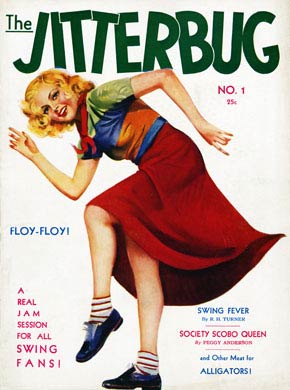
Jitterbug Magazine, 1940s
The Savoy Ballroom in New York City opened in 1926, launching Swinging Jazz into stardom, creating the music that truly symbolizes the 1930s and 1940s decades. The Lindy Hop is one of the most popular, and original, swing dances of the 1940s, evolving from the Charleston of the late 1920s. When the 'age of jazz' was emerging and growing into a completely new genre, the dance styles evolved alongside it. Swing had a jovial decade long run until the 1950s rock n’ roll era took its place.

The Lindy Hop originated in 1927 when George “Shorty” Snowden, an enthusiastic dancer, was asked to name the new moves by a reporter. Gaining inspiration from a newspaper headline “Lindy Hops the Atlantic”, after famed aviator, Charles Lindbergh, the pilot who completed the first solo flight across the Atlantic that same year. Others refer to the dance as the “Jitterbug”, a six beat variation dubbed by Cab Calloway. The 1930s saw a major growth of admiration for swing and the Lindy Hop dance, but it was not until the 1940s, when US servicemen really took the dance by storm and popularized the moves across the world.

The dance has many variations depending on the tempo of the music. Dancers can choose to go slow and smooth, the very meaning of elegance, or they can dance fast and wild, using stunning footwork that seems to make them fly across the dance floor.
Faye McKenzie dancing with a service member at the Hollywood Canteen.

Herbert White created a Lindy Hop dance troupe, called the Whitey’s Lindy Hoppers, out of the Savory Ballroom. The troupe was showcased in various films, including “Hellzapoppin” (1941), “Sugar Hill Masquerade” (1942), and “Killer Diller” (1948).

As with any new pop culture phenomena, swing dance received some negative reviews. In 1936, Philip Nutl, the President of the American Society of Teachers of Dancing, said swing would not last through the winter. However, by 1942, the craze could not be ignored and swing was ceremoniously accepted by all. The wave of popularity lasted until the mid 1950s but was replaced by new moves by younger generations. However, swing did see a revival in the 1990s, with grandparents influencing their grandchildren in the ways of the past.

There are fifteen different swing variations that have developed over the decades.
1. Ballroom West Coast Swing: Popular in ballroom dance schools.
2. Cajun Swing: Born in the bayous of Louisiana.
3. Carolina Shag: Popular in the Carolinas and pays particular attention to the leader’s nimble feet.
4. Country Western Swing: A style of the Jitterbug popularized in the 1980s and usually danced to Country Western music.
Swing dancers at the Trocadero in L.A, CA, 1940s
5. DC Hand Dancing: Washington D.C.’s version of the Lindy.
6. East Coast Swing: Six count style of the Lindy, poplar in dance organizations.
7. Imperial Swing: popular in St. Louis, Missouri.
8. Jive: International style of swing usually danced in world competitions.
9. Lindy: smooth style swing dance
10. Pony Swing: Country Western style of the Cajun swing.
11. Push Swing: Popular in Dallas, Texas, the dance involves spinning the follower between dance positions with a rock rhythm break.
12. Savoy Swing: a style of swing particularly popular in the New York Savoy Ballroom, 1930s and 1940s. This style is very fast, jumpy, and casual-looking.
13. Supreme Swing: style dance popular in Tulsa, Oklahoma.
14. West Coast Swing: Popular in California night clubs, 1930s and 1940s, the use of nimble feet is required to do this dance justice.
15. Whip: Houston, Texas created the Whip which is similar to the Push Swing dance but with a wave rhythm break.

I hope you are inspired to dance out our own Jive this year!
Take Care,
Elizabeth