Search This Blog

Showing posts with label Luminary. Show all posts

Tuesday, December 9, 2014

Flames of Memory/ Our D-Day Fallen: Private First Class Jack G. Powers


Hello Everyone!

D-Day Luminaries. Picture provided by Mark East Photography
Three days from now the entire Memorial (and road leading up to the site) will be lined with luminaries for our "Flames of Memory" and "Christmas in Wartime" Events. Each light in honor of a D-Day fallen soldier, all 4,413 of them. Also, there will be luminaries dedicated by loving family members of their own fallen soldiers through various conflicts. It is a beautiful and moving reminder of the sacrifice and bravery of our Allied soldiers on one of the bloodiest invasions of World War II, as well as the brave men and women who have given their lives in service of their country. It would be a privilege for you all to come out to the site and support us and our heroes. December 12 through the 14th, 6 pm to 9pm, and the site will be open (free admission) to all those who want to pay their respects.

~~~~~~~~~~~~~~~~~~~~~~~~~~~~~~~~~~~~~~~~~~~~~~~~~~~~~~~~~~~~~~~

I would also like to take the opportunity to introduce you all to another of our D-Day Fallen, Private First Class Jack G. Powers. A loving and caring member of the Bedford Boys and community.

PFC Jack Powers

Jack Powers was an extremely lovable and caring man, recalled his sister Eloise. He and two of his brothers enlisted into the National Guard and were eager to set off on an adventure. At twenty-one years old, Jack and his brother, Clyde, stood on the train platform, while the band played, awaiting the train to New York.

Jack was a skilled musician and dancer. He practiced guitar daily and could jitterbug better than any man in town. Jack’s uncle Harold Wilkes was also in formation on the platform. You could say it was a family affair. In fact, the Powers brothers’ were one part of thirty-three sets of brothers who stormed the beaches on D-Day.

While in England, Powers received the rare honor of being chosen for the 29th Division’s Rangers, an elite combat unit, essentially the American version of the British Commandos. Company A was improving by leaps and bounds in England. Many of the men gained at least seven to ten pounds of muscle over the course of their training and many other talented soldiers were selected for advancement. 

Since Power’s was promoted to the Rangers unit, that meant being separated from his friends and family. Even though he was excited and honored to be part of the elite group of men, he still missed his Company A family. When his Rangers unit was disbanded, Powers was upset that he had spent so much time training apart from them, but was eager to return. So eager in fact that he was considered AWOL for a bit and was stripped of his sergeant’s stripes by Captain Fellers.

PFC Powers grave in Normandy.
When it came time to launch the invasion, Powers was very nervous and seemed distressed, which surprised some of the men because Jack always came across as level headed and calm. The ex-ranger was just as nervous as the rest of the men.

Powers did not make it through the invasion but his brother Clyde had. Like so many other sets of brothers, many lost one, if not all, of their family that day. Clyde was overcome with sadness at the loss of his brother but he had to continue on with his mission, just like so many others, including fellow Bedford Boy Roy Stevens, who lost his brother Ray. Each man dealt with his grief differently. Some took it out in their fighting, killing as much as possible, while others suffered in silence, frozen by sorrow. Clyde, in particular, suffered survivor’s guilt at the loss of his dear brother.


I hope you all will be able to join us and I recommend bringing some tissues because you will be moved to tears.

Take care and keep warm,
Elizabeth

Tuesday, December 2, 2014

Oh Christmas Tree!


Hello Everyone,
Festival of Trees, 2014

Christmastime is finally here! A time for peppermint hot chocolate, twinkling lights, and Christmas trees galore. Speaking of Christmas trees, the locals around the Memorial have probably noticed the influx of Christmas cheer within the Bedford Welcome Center because of the Festival of Trees celebration. What’s that you ask? The Festival of Trees is an annual Christmas celebration where local businesses and organizations compete for the best decorated tree within a pre-determined theme. The locals are encouraged to come out and vote in order to determine the top three, who will then equally distribute the winnings. This year’s theme is Christmas on the Home-front, 1944 and after previewing the trees, I must say this year will be a close one for sure! Of course the National D-day Memorial is represented and I am partial to our tree, but nonetheless, please take the time to visit the Welcome Center and vote for your favorite tree. The trees are up from November 19, 2014 until December 31, 2014, so the voting has already begun! The Welcome Center will also have extended hours on December 5, 12, 13, 14, and the 19, until 9 pm, so you will be able to enjoy the beauty at night. The 12th, 13th, and 14th also coincide with the Memorial’s Luminary Project, so you will be able to enjoy both events for the holiday season. I implore you to visit both events this season; it will put you in the holiday mood and give you some perspective on those lost and holiday hardships for the soldiers.
In the spirit of the theme, let’s talk about the history of the Christmas tree! How did the tradition begin, how did it evolve, and how has it changed today?

The Beginning
Pagan depiction of the use of evergreens
Since the beginning of time, evergreens have had a special meaning for people in the winter. Pines, spruce, and firs stay green all year long despite the cold, hence why people used such lush vegetation during the holidays. In some countries, it was thought that evergreens could keep away evil spirits in the night. Also, before Christianity, the pagans believed the Sun God was sick or weak during the winter and the longest night of year, known as the Winter Solstice, marked the turning point for him to regain his strength and the use of evergreen boughs reminded them of the promise of spring and summer. In fact, many cultures used evergreens to symbolize the renewal of spring, such as the Egyptians, early Romans, the ancient Celtic people, and even the ferocious Vikings.
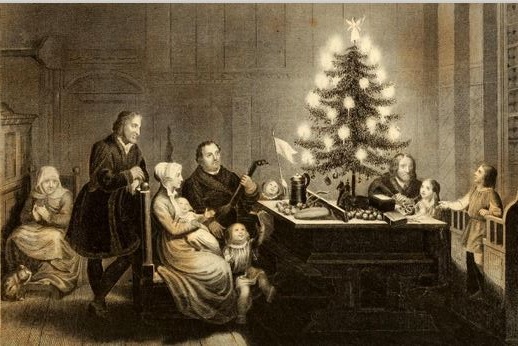
Martin Luther and family around their first lit tree.
As many of you might know, the German’s are associated with starting the Christmas tree tradition we know and love today. Did you know they also began the traditions of advent calendars, gingerbread houses, and our cherished Christmas cookies? Christians of the 16th century began to bring in whole trees, not just boughs, into their homes to be decorated. Some Christians would build wooden pyramids and decorate that with the evergreens and candles to symbolize the birth of Christ. In Germany, it is believed that Martin Luther, Protestant reformer, was the first to use candles upon the tree because it reminded him of the brilliant stars in the night sky and the beauty had to be represented on the tree.
The Royal Family decorating their Christmas Tree, 1840s
Despite such an early start for the Christmas tree tradition, it was not until the 1830s that the first Christmas tree was put on display in America. Ironically, Pennsylvania German settlers brought the tradition to America much earlier, in the 1740s, but it took nearly one hundred years for the Christmas tree to shed its pagan stereotype in the minds of American Christians. One of the reasons why it took so long for the Christmas tree to become popular in America was because of the New England Puritan’s strict observance of Christmas celebrations. They believed decorating Christmas trees, singing carols, and overall joy would violate the sacred birth of Christ. Strict penalties were handed out to any of those who were partaking in those ‘heathen traditions’. These strict laws stayed true until the 19th century when the enormous influx of German and Irish immigrants changed the American tradition. England also saw a change in tradition in the 1840s when Queen Victoria and Prince Albert, who was German, were illustrated in the London News decorating their own tree with their children. Anything done by the royal family, particularly Queen Victoria, instantly became popular with the country. Within fifty years, German ornaments were extremely popular in the United States and were shipped overseas on a regular basis and, of course, Americans preferred having the biggest tree possible, while European traditions call for a more modest tree of about four feet in height.

Modern Era of the Christmas Tree           
Decorating the Rockefeller Center tree, 1930s
The most famous Christmas tree display, at least for Americans, is the Rockefeller Center tree in New York City, New York. The tradition began in 1931, when construction workers of the Depression era placed a small and simple tree in the center of the square, the next year they did the same, and then the next; shortly, Christmas tree lights and decorations were added. Today, the tree typically has over 25,000 Christmas lights!
Not surprisingly, World War II caused another great change for the Christmas tree and brought us even closer to what we expect today. Since many of the prized Germany and Japanese made ornaments were no longer being shipped overseas, the Corning Glass Company of New York began their glass ornament production, virtually eliminating the need for anything else! Also, ribbons and bows were scarce because of the material used, as well as the fir trees themselves. Lumber was needed for the war effort, so production began on artificial trees to fill in the void.
White House Christmas tree, 1944.
The traditions we know and love can be seen throughout most of the world, especially in Protestant dominated countries, with a few variations. Most cultures decorate an evergreen tree in various was, but many Catholic dominated countries tend to focus more on the Nativity scene, connecting to the roots of the holiday, like Italy and Mexico.

Tree Trivia
The first commercialized selling of the Christmas tree was not until the 1850s in the United States.

The tallest living Christmas tree is about 122 feet tall and 91 years old, in Woodinville, Washington.
The first National Christmas Tree Lighting Ceremony held at the White House was in 1923, by President Calvin Coolidge.

Christmas trees are grown in every state, including Hawaii.
WWII soldiers decorating a palm tree for Christmas.

It was not uncommon for many soldiers on the front-lines, in World War II, to decorate random trees around them, or to chop one down for their makeshift headquarters.

World War II soldiers in the Pacific theater used palm trees to replace their traditional trees from back home.

I hope to see you all at our Luminary Nights and the Festival of Trees!


Take Care and don't forget to vote for your favorite tree (a.k.a the D-Day Memorial's tree), 
Elizabeth

Tuesday, November 11, 2014

Luminary Project and D-Day Fallon


Hello All!

Veterans Day at the Memorial, 11/11/14
I hope you all have thanked numerous Veterans today! As John F. Kennedy said, “As we express our gratitude, we must never forget that the highest appreciation is not to utter words, but to live by them.” I could not agree more with JFK; he is saying that we thank our soldiers for being valiant and courageous, but sometimes forget what that truly entails. Also, we should strive to exhibit the values we hold so dear. As a whole, we all need to remember that we can always do more and put our words into action. Since the holiday season is upon us, it is a great reminder of what we can do for others; a time to show our appreciation properly. There are many ways to get involved with the Memorial and in the community; all you have to do is ask.

Veterans Day Ceremony, 11/11/14
The next event coming up is our Luminary Project, held December 12-14, 2014, 6pm to 9pm. The Luminary Project honors the 4,413 men killed on D-Day. As evening approaches, the flames of memory come alive throughout the site, from the drive leading up to the Memorial, throughout the grounds, and interwoven in the Elmon T. Gray Plaza; each blazing luminary igniting the lamp of freedom.

My first luminary experience was last year, and let me tell you, it was both outstanding and haunting. It is one of those occasions that will put the loss of D-Day into raw perspective. Each light signifying a lost soul for the ultimate sacrifice that helped us win the war for the Allied nations. It is truly a site to see for all ages. I encourage and implore you to join us throughout the weekend; you will not regret one moment here.

Luminary night at the D-Day Memorial
If you would like to get more involved; Lumaries are sold throughout the year, even up to that week, and are displayed from December 12-14. Each luminary costs $20, or six for $100, and they can be purchased in honor or memory of anyone of your choosing, D-Day veteran or not. Remember, all proceeds benefit the Memorial and business or organizations are more than welcome to purchase quantities.

In honor of the Flames of Memory, I would like to share a little bit about one of the Fallon Bedford Boys, Nick Gillaspie.

~~~~~~~~~~~~~~~~~~~~~~~~~~~~~~~~~~~~~~~~~~~~~~~~~~~~~~~~~~~~~~~~~~~~~
D-Day Fallon: Nick N. Gillaspie


Nick N. Gillaspie
Private First Class
Company A, 116th IRB, 29th Infantry Division
PFC Nick N. Gillaspie

Nick Gillaspie was another avid Baseball player among the Bedford Boys, along with Frank Draper and Elmere Wright. He grew up with four brothers and went to a one-room schoolhouse. He was known around Bedford for his impeccable manners and kindness, as well as his rook playing skills. His Rook skills came in handy on the Queen Mary’s voyage over to England since the men had a lot of down time on the ship.

Games of any kind were important to the soldiers because it was the only way to pass the time. When they were given the chance to relax, but could not go on leave, many soldiers opt for card games, gambling games, or the book of games devised by the government. Pocket guides and game books were handed out regularly to help the soldiers pass the time and learn about the cultures they would eventually encounter.


Gillaspie is another member of the Bedford Boys we do not know much about, but we do know he was on the same LCA Wallace “Snake Eyes” Carter was on. Unfortunately, what we know of that particular LCA is that everyone perished early on in the beach landings. He has never been forgotten and never will be, just like all of our Bedford Boys.

I hope to see you all soon, take care!
Elizabeth


Tuesday, December 10, 2013

Memorial Event: Flames of Memory

Friday night begins one of my favorite events at the National D-Day Memorial - Flames of Memory.  We will be lighting 4,413 luminaries from Friday, December 13th until Sunday, December 15th.  This is one light for each and every Allied soldier, sailor, and airmen killed in action on June 6, 1944 as the Allied forces launched the largest amphibious operation in history.  Luminaries will line the path from the Memorial’s entrance all the way to the Memorial’s wall of names in the main plaza.  The Memorial is encouraging visitors to come see this stunning display of luminaries.  Admission will be free but donations are appreciated on the night of the event.  All proceeds benefit the National D-Day Memorial.

The public is invited to join us on site each night from 6PM to 10PM, free admission.  Visitors are invited to walk through the site to experience this moving experience.  In addition to the luminaries, visitors will hear the sounds of Christmas music through the site, and visit a special Christmas in wartime display with living historians in a 1940s encampment. 


We at the National D-Day Memorial Foundation are very pleased to announce that we have been accepted as a "Wreaths Across America" location.  A wonderful complement to our luminary event, the mission of "Wreaths Across America" is to "Remember, Honor, and Teach" others about the sacrifices made by those who have served and continue to serve in our Armed Forces.  This is carried out in part by coordinating wreath laying ceremonies on Saturday, December 14 at Arlington, as well as veterans' cemeteries and other locations in all 50 states.

On December 14th at noon there will be a wreath laying ceremony to remember those who fell in the service of our country as well as to honor our veterans and active duty military personnel deployed worldwide.  A total of eleven wreaths will be laid as part of the ceremony.  The seven ceremonial wreaths are donated by Morrill Worcester of Worcester Wreath Company and have a red bow and an American flag accompanied by a service flag. The ceremonial wreaths consist of one wreath each for the Army, Marine Corps, Navy, Air Force, Coast Guard, Merchant Marine, and one for POW/MIA.  Four additional sponsorship wreaths will be laid as part of the ceremony. The sponsorship wreaths are sponsored by Ray and Barbara Antunes and American Legion Post #8 of Cherryfield, Maine.


National D-Day Memorial Foundation President April Cheek-Messier noted “We are delighted to become a part of the Wreaths Across America initiative.  The wreath laying ceremony will be an excellent complement to our luminary display.  Bringing awareness to the sacrifices made by those who have served our country is important every day of the year and even more important during the holidays.”  The Memorial will open its doors free of charge from 11am to 1pm to accommodate those who wish to attend the wreath laying ceremony.  


We hope to see you at the National D-Day Memorial this weekend for Flames of Memory.


Until next time, 

Felicia