Search This Blog

Showing posts with label WWII Christmas. Show all posts

Tuesday, December 15, 2015

A 1940’s DIY Christmas

Hello, Friends!

The National D-Day Memorial's 2015 Christmas Tree
for the Festival of Trees
Each year in Bedford, Virginia, our Welcome Center hosts an event called “Festival of Trees.” Businesses and organizations decorate trees throughout the Welcome Center and the public is able to vote for their favorite tree for $1 a vote. Voting began November 18th and goes on through December 31st, 2015. All of the proceeds of the winning trees will be donated to their selected charities, with the Memorial's being our educational initiatives. 

This year’s theme is “DIY (Do It Yourself) Christmas.” While DIY is the “it” thing in home decorating today thanks to Pinterest, the Memorial hit the jackpot of sorts since Christmas both on the homefront and warfront during World War II for most involved improvising and creating their own decorations in order to support the war effort. Nothing was put to waste with most items being reused and recycled. So as I selected items to decorate the tree, I took into account things that would be readily available on the homefront during the war and could be repurposed for Christmas ornaments and decorations. Below are a few of the decorations we created for this event:


Materials Needed: Popcorn, cranberries, thread, needle and acrylic sealant spray

1.       Thread cranberries and popcorn onto a string to use as garland
2.       Stretch the cranberry and popcorn garland out on your work surface.
3.       Shake the can of acrylic sealant spray vigorously for several seconds. Hold the can of acrylic sealant spray about 10-inches above the garland.
4.       Start at one end of the garland and coat it with a thin layer of the acrylic sealant. Continue in this manner while moving down the strand. Let the sealant dry for at least 12 hours.
5.       Turn the garland over carefully and coat the backside of the garland with the acrylic sealant in the same manner as before. Let dry for at least 12 hours before using the cranberry and popcorn garland.
6.       Store the garland in an airtight plastic container after use. Add a few silica gel packets to the container before storing it away to help prevent moisture from building up in the storage container. Place the container in a cool and dry location.

During the early 20th century, popcorn was a holiday favorite not just for food but for decorations.

Of course, during World War II, acrylic sealant spray would not be available. But for the sake of preserving our decorations for almost two month, we needed to use it to keep it looking fresh and to keep the bugs and animals away.

Cookie Cutter Ornament featuring Bedford Boy,
Frank Draper


Materials Needed: Cookie cutters, photographs, scrap paper, and glue

1. Choose patterned papers or color-photocopy pictures onto card stock. Trace cutter on top; cut out. Dab white craft glue along cutter's edge. Press paper in place; let dry.
2. Thread narrow ribbon through needle; poke between paper and cutter, and wrap ribbon around top of cutter and tie a knot.

We chose to use photocopied photos of the Bedford Boys for the tree to give a personal touch to the tree.


We would love for you to come out and take a look at the Memorial’s tree, as well as all of the other gorgeously decorated trees. Just make sure to vote for our tree though! 

The Welcome Center is located at 816 Burks Hill Road, Bedford, VA 24523 with special hours as following:  Open until 9:00pm on Friday, December 4, 2015, Friday, December 11, 2015, Saturday, December 12, 2015, Sunday, December 13, 2015 and Friday, December 18, 2015. The Welcome Center will be closed Thanksgiving, Christmas and New Year’s Day along with closing at 12:00pm on Christmas Eve and New Year’s Eve.


Until next time,


Maggie

Tuesday, December 23, 2014

Christmas Love Letters: Missing Home


Holiday V-Mail, December, 1944.

Hello all, 

Christmas is just two days away! Are you as excited as I am? Maybe you are, or maybe no, not this year?  I know the holidays can be a joyous time for some and dreadful for others, depending on what life has dealt you at the time. Many individuals are lucky enough to spend the holidays with their loved ones, while others are missing those nearest to their hearts for whatever reason. I do not know if you feel the same, but I feel very fortunate to live in the age of technology where even distance can be conquered if we have the means, and will, to do so. We can be thousands of miles away from our family and still be able to see their faces through the internet. Of course, even that could never replace physically being in their presence, but it beats the alternative. During World War II, the only way families could stay in contact with loved ones overseas was through letters. It must have been torture not knowing where they were exactly, not knowing if they were safe or if they would be okay by the time the letter was received.
 

I would like to share a few holiday letters written by a Bedford Boy to his lovely wife, Sergeant John B. Schenk to Ivylyn Jordan Schenk.

“12-9-42, My Darling Lynn, Oh yes you guessed it. I am just a little homesick. Just think what fun I am missing by being over here. When you get this letter it probably will be Xmas so here is hoping you have a most pleasant one. Two of the boys were just in my room and brought a fruit cake with them. We were discussing what we were going to do when we get home and we all said the first thing would be to go on a honeymoon. Of course I had to tell them about ours and they agreed it was much better than traveling…”

“December 16, 1942, 7:30P.M., My Darling Lynn, Here it is nine days till Xmas and I haven’t got a bit of Xmas spirit… I am invited to have Xmas dinner with the same people I had dinner with last nite. We did have a real nice time. Each person had a foot of silver on each side of his plate. When I finished the meal I had used every piece so I think I did a good job of it...”

John Schenk and his wife, Ivylyn.
“December 24, 1942, England, My Darling Lynn, Here tis Xmas Eve and I am 4000 miles away from you but my heart and soul are with you. My love for you is increasing each day. Every night and many times during the day I am praying for your happiness. Also I pray for a quick end to this foolish war and by the looks of things my prayers are being answered. When I say foolish I mean foolish. Tell me what can one gain by war. Of course it is different with us. Our freedom was endangered and we are fighting to keep it. I guess I am first a lover of peace is the reason I think all disagreements could be settled without the loss of lives. It takes civilized people to see it that way I guess. I was in town this A.M. and the British just like the Americans believe in Xmas. Everyone greets you with a smile and wishes you a merry Xmas. People like that couldn’t believe in war. On every smiling face you could see that God was there. These people believe in him just as we do. Even the war worn German prisoner has a smile for us. It may be that he is getting more to eat than usual but I think down deep in his heart he is much like you and I. He is forced into battle by Hitler’s threats. For him it is either fight or starve. Anyway darling we, the allies are going to win this war. It is you we are fighting for not ourselves. Our lives are not worth the value of a Confederate bill and you know from history that isn’t worth much.”
“… Judging from this letter you would think I was home sick but really I am not. Well not very much any way. I would give an arm just to see you and hold you close and tell you how much I love you. Darling you are all I have so take good care of yourself. God will bring me back to soon. Good nite and a Merry Christmas. All My Love, John.”

John was killed in action on June 6, 1944. As you may have guessed, these letters were the last holiday exchange these two would ever have together. In fact, the only Christmas we know they spent together was in 1941, before they were married.

Letters such as John’s show us how similar human beings really are, even when we come from such different times and places. I think anyone missing a loved one over the holidays can feel a connection with John and Ivylyn through their letters. John’s sentiments make me thankful for what I have and hold dear. I hope they do the same for you.
 
Christmas Card delivered to GIs, WWII.
Take care,
Elizabeth

Tuesday, December 2, 2014

Oh Christmas Tree!


Hello Everyone,
Festival of Trees, 2014

Christmastime is finally here! A time for peppermint hot chocolate, twinkling lights, and Christmas trees galore. Speaking of Christmas trees, the locals around the Memorial have probably noticed the influx of Christmas cheer within the Bedford Welcome Center because of the Festival of Trees celebration. What’s that you ask? The Festival of Trees is an annual Christmas celebration where local businesses and organizations compete for the best decorated tree within a pre-determined theme. The locals are encouraged to come out and vote in order to determine the top three, who will then equally distribute the winnings. This year’s theme is Christmas on the Home-front, 1944 and after previewing the trees, I must say this year will be a close one for sure! Of course the National D-day Memorial is represented and I am partial to our tree, but nonetheless, please take the time to visit the Welcome Center and vote for your favorite tree. The trees are up from November 19, 2014 until December 31, 2014, so the voting has already begun! The Welcome Center will also have extended hours on December 5, 12, 13, 14, and the 19, until 9 pm, so you will be able to enjoy the beauty at night. The 12th, 13th, and 14th also coincide with the Memorial’s Luminary Project, so you will be able to enjoy both events for the holiday season. I implore you to visit both events this season; it will put you in the holiday mood and give you some perspective on those lost and holiday hardships for the soldiers.
In the spirit of the theme, let’s talk about the history of the Christmas tree! How did the tradition begin, how did it evolve, and how has it changed today?

The Beginning
Pagan depiction of the use of evergreens
Since the beginning of time, evergreens have had a special meaning for people in the winter. Pines, spruce, and firs stay green all year long despite the cold, hence why people used such lush vegetation during the holidays. In some countries, it was thought that evergreens could keep away evil spirits in the night. Also, before Christianity, the pagans believed the Sun God was sick or weak during the winter and the longest night of year, known as the Winter Solstice, marked the turning point for him to regain his strength and the use of evergreen boughs reminded them of the promise of spring and summer. In fact, many cultures used evergreens to symbolize the renewal of spring, such as the Egyptians, early Romans, the ancient Celtic people, and even the ferocious Vikings.
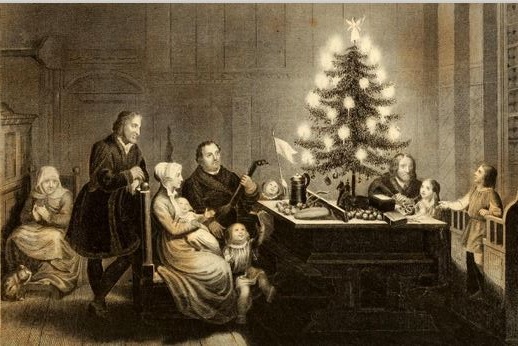
Martin Luther and family around their first lit tree.
As many of you might know, the German’s are associated with starting the Christmas tree tradition we know and love today. Did you know they also began the traditions of advent calendars, gingerbread houses, and our cherished Christmas cookies? Christians of the 16th century began to bring in whole trees, not just boughs, into their homes to be decorated. Some Christians would build wooden pyramids and decorate that with the evergreens and candles to symbolize the birth of Christ. In Germany, it is believed that Martin Luther, Protestant reformer, was the first to use candles upon the tree because it reminded him of the brilliant stars in the night sky and the beauty had to be represented on the tree.
The Royal Family decorating their Christmas Tree, 1840s
Despite such an early start for the Christmas tree tradition, it was not until the 1830s that the first Christmas tree was put on display in America. Ironically, Pennsylvania German settlers brought the tradition to America much earlier, in the 1740s, but it took nearly one hundred years for the Christmas tree to shed its pagan stereotype in the minds of American Christians. One of the reasons why it took so long for the Christmas tree to become popular in America was because of the New England Puritan’s strict observance of Christmas celebrations. They believed decorating Christmas trees, singing carols, and overall joy would violate the sacred birth of Christ. Strict penalties were handed out to any of those who were partaking in those ‘heathen traditions’. These strict laws stayed true until the 19th century when the enormous influx of German and Irish immigrants changed the American tradition. England also saw a change in tradition in the 1840s when Queen Victoria and Prince Albert, who was German, were illustrated in the London News decorating their own tree with their children. Anything done by the royal family, particularly Queen Victoria, instantly became popular with the country. Within fifty years, German ornaments were extremely popular in the United States and were shipped overseas on a regular basis and, of course, Americans preferred having the biggest tree possible, while European traditions call for a more modest tree of about four feet in height.

Modern Era of the Christmas Tree           
Decorating the Rockefeller Center tree, 1930s
The most famous Christmas tree display, at least for Americans, is the Rockefeller Center tree in New York City, New York. The tradition began in 1931, when construction workers of the Depression era placed a small and simple tree in the center of the square, the next year they did the same, and then the next; shortly, Christmas tree lights and decorations were added. Today, the tree typically has over 25,000 Christmas lights!
Not surprisingly, World War II caused another great change for the Christmas tree and brought us even closer to what we expect today. Since many of the prized Germany and Japanese made ornaments were no longer being shipped overseas, the Corning Glass Company of New York began their glass ornament production, virtually eliminating the need for anything else! Also, ribbons and bows were scarce because of the material used, as well as the fir trees themselves. Lumber was needed for the war effort, so production began on artificial trees to fill in the void.
White House Christmas tree, 1944.
The traditions we know and love can be seen throughout most of the world, especially in Protestant dominated countries, with a few variations. Most cultures decorate an evergreen tree in various was, but many Catholic dominated countries tend to focus more on the Nativity scene, connecting to the roots of the holiday, like Italy and Mexico.

Tree Trivia
The first commercialized selling of the Christmas tree was not until the 1850s in the United States.

The tallest living Christmas tree is about 122 feet tall and 91 years old, in Woodinville, Washington.
The first National Christmas Tree Lighting Ceremony held at the White House was in 1923, by President Calvin Coolidge.

Christmas trees are grown in every state, including Hawaii.
WWII soldiers decorating a palm tree for Christmas.

It was not uncommon for many soldiers on the front-lines, in World War II, to decorate random trees around them, or to chop one down for their makeshift headquarters.

World War II soldiers in the Pacific theater used palm trees to replace their traditional trees from back home.

I hope to see you all at our Luminary Nights and the Festival of Trees!


Take Care and don't forget to vote for your favorite tree (a.k.a the D-Day Memorial's tree), 
Elizabeth

Tuesday, December 24, 2013

Christmas in World War II


We at the National D-Day Memorial wish everyone a happy holiday season and wish you all a wonderful new year!  As we look toward to 2014, we wanted to bring you a little information about how people celebrated the season during World War II.  I want to say thank you to our wonderful education intern, Elizabeth, as she has prepared the following post for you.  We look forward to seeing you all at the Memorial next year for all our events, especially the 70th Anniversary!  As always thank you for your support of the National D-Day Memorial!

Until next time, 
Felicia  

~~~~~~~~~~~~~~~~~~~~~~~~~~~~~~~~~~~~~~~~~~~~~~~~~~~~~~~~~~~~~~~~~~~~~~

Happy Holidays D-Day Memorial followers! ‘Tis the season to rejoice in family and holiday cheer! Now more than ever, the American people know what it feels to be without some of their dearest family members during the holiday season. Fathers, mothers, sons and daughters serving in our military make the ultimate sacrifice when they chose to serve. Unfortunately, this means they miss their families during the holidays; likewise, the people they have left behind feel the pain of separation just as much. The same was said for people during World War II, even more so since they did not have the luxury of advanced communication technology. The home front was a different place than what we know today. Not only were the lack of communication hard on families, but also the lack of supplies and closely monitored rationing made it hard for people to celebrate the season the way they had for so many years. Here are some yuletide facts about Christmas on the home front during World War II.

Facts

-Like most other items, Christmas trees were in short supply during the war. Not because the trees were being massed produced into something useable, but because there were not enough workers available to cut the trees down. Also, there was a shortage of available railroad space to ship the trees across the country. Thus, the beginnings of artificial Christmas trees (American-made Visca trees of course).

- Just before American involvement in the war (1941), a family could buy a 5-foot Christmas tree for just 75 cents. Today, depending on the area, a 5-foot tree could set you back as much as $35. The cost of about 46 trees in 1941!

Christmas 1941 - A Virginia boy plays with his B-25
- We often do not think of this while decorating our trees, but many ornaments, especially at the time, were made with aluminum and tin, a highly rationed item. As a result, many families opted to make their own ornaments. Magazines would provide ideas and patterns especially designed for non-priority war materials, such as paper, string, and things found in your own backyard.

- Another interesting fact about ornaments at the time, many popular ornaments like hand-blown German-made ornaments, as well as exotic looking Japanese-made ornaments, were thrown away with the outbreak of the war in support of their soldiers. The Corning Glass Company, out of New York, started to make ornaments themselves in response to this occurrence.  Not only did the population feel better about using American-made decorations, but also Corning could make more ornaments in a minute than it would take a German glass blower in one day.

- The electric bubble lights were also designed in the 1940s and are still used today.

- Some people wanted a snowy look on their trees so their solution was to mix Lux soap powder with water and brush the branches with the concoction.

-  Another bit of information we tend to forget is who will dress up as Santa Claus if most of the men are off at war? Women stepped up to the plate, dressing as Santa Claus in department stores, like Saks Fifth Avenue in New York City.

- “I’ll Be Home For Christmas” and “White Christmas” were both written in the 1940s for the soldiers and quickly became popular as popular as they are today.

- People were limited on their travel plans because of rationing of tires and gasoline. Instead, families would save their ration stamps to have a nicer meal for the holidays.


~Elizabeth


Sources: 
http://www.nww2m.com/2011/12/celebrating-christmas-on-the-home-front/
http://sarahsundin.blogspot.com/2011/12/christmas-in-world-war-ii-home-front.html
http://www.prweb.com/releases/2012/12WWIIChristmasVideo/prweb10259374.htm


Monday, October 21, 2013

Our D-Day Fallen: Sergeant Charlie Wilburn Grayson


Luminaries around the Memorial
As we enter the holiday season, we are reminded everyday of the sacrifices made by our servicemen and women around the world as they work to defend our country.  We are also reminded of the ultimate sacrifice paid by many of those defenders across generations and the loved ones they left behind here on the homefront.

This year from December 13th to December 15th at 6pm to 10pm, we will pay tribute to the men killed in action on June 6, 1944 by placing 4,413 luminaries around the site.  That is one light for each soldier, sailor, and airmen; one light for each father, brother, son, uncle, husband, and friend; one light for each life given in service of the Allied nations on June 6, 1944.  Four thousand, four hundred and thirteen lights for four thousand, four hundred and thirteen lives cut short on the field of battle.  

Redstone Arsenal, 1940
Lives like that of Sergeant Charlie Wilburn Grayson.  Born August 31, 1916, Charlie grew up close to Huntsville, Alabama.  During the Great Depression, Madison County led Alabama in cotton production; however all this changed with the outbreak of World War II when this quiet community, with a population of about 13,000, was selected by the U.S. Army to become the new home of the Huntsville Arsenal and the Redstone Arsenal.  Personnel at these two facilities alone approached 20,000.  

Charlie attended school through the seventh grade before leaving to help his family earn money during the Great Depression.  On the 1940s census, Charlie’s occupation was listed as a “real construction worker” in government work.  On June 7, 1940, at 23 years old, Charlie enlisted in the U.S. Army.  Like the men from Bedford, Virginia, this was his one year of active service under President Roosevelt’s Selective Service Act.  However, the attack on Pearl Harbor changed all of that.  He was now in the U.S. Army for the duration of the war.  

Charlie was part of the 8th Infantry Regiment, Antitank Company, 4th Infantry Division.  Like others preparing for this invasion, he spent months training in England.  The 4th Infantry Division, or the “Ivy” Division, was created on December 3, 1917 and reactivated on June 1, 1940 at Fort Benning, Georgia.  On January 18, 1944, the Ivy Division embarked from New York to a final training phase in England.  The Ivy Division had been added to the original invasion plans because of an enlargement of the landing area.  

8th Infantry Regiment, 4th Infantry Division moving over the seawall on Utah Beach


Charlie's headstone in Hayden Cemtery
Charlie and his fellow soldiers intensified their training, including practicing amphibious landings.  The 4th Division, led by the 8th Infantry Regiment, was selected to spearhead the landings on Utah Beach.  The soldiers of the 8th Infantry Regiment landed around 0630.  Charlie was part of the first wave during the invasion.  This is the end of Charlie’s story.  He was killed in action on June 6, 1944.  He left behind his wife, Garner B. Clark, mother, and six siblings.  In 1949, his family elected to have his body returned to the states.  He was re-interred at Hayden Cemetery in New Hope, Alabama.
~~~~~~~~~~~~~~~~~~~~~~~~~~~~~~~~~~~~~~~~~~~~~~~~~~~~~~~~~~~~~~~~~~~~~~~~
This holiday season help us remember the ultimate sacrifice paid by the 4,413 servicemen on June 6, 1944.  If you would like more information about the luminaries or if you would like to sponsor a luminary for a family member or friend, visit our website at www.dday.org.