Search This Blog

Showing posts with label Wartime Christmas. Show all posts

Tuesday, December 15, 2015

A 1940’s DIY Christmas

Hello, Friends!

The National D-Day Memorial's 2015 Christmas Tree
for the Festival of Trees
Each year in Bedford, Virginia, our Welcome Center hosts an event called “Festival of Trees.” Businesses and organizations decorate trees throughout the Welcome Center and the public is able to vote for their favorite tree for $1 a vote. Voting began November 18th and goes on through December 31st, 2015. All of the proceeds of the winning trees will be donated to their selected charities, with the Memorial's being our educational initiatives. 

This year’s theme is “DIY (Do It Yourself) Christmas.” While DIY is the “it” thing in home decorating today thanks to Pinterest, the Memorial hit the jackpot of sorts since Christmas both on the homefront and warfront during World War II for most involved improvising and creating their own decorations in order to support the war effort. Nothing was put to waste with most items being reused and recycled. So as I selected items to decorate the tree, I took into account things that would be readily available on the homefront during the war and could be repurposed for Christmas ornaments and decorations. Below are a few of the decorations we created for this event:


Materials Needed: Popcorn, cranberries, thread, needle and acrylic sealant spray

1.       Thread cranberries and popcorn onto a string to use as garland
2.       Stretch the cranberry and popcorn garland out on your work surface.
3.       Shake the can of acrylic sealant spray vigorously for several seconds. Hold the can of acrylic sealant spray about 10-inches above the garland.
4.       Start at one end of the garland and coat it with a thin layer of the acrylic sealant. Continue in this manner while moving down the strand. Let the sealant dry for at least 12 hours.
5.       Turn the garland over carefully and coat the backside of the garland with the acrylic sealant in the same manner as before. Let dry for at least 12 hours before using the cranberry and popcorn garland.
6.       Store the garland in an airtight plastic container after use. Add a few silica gel packets to the container before storing it away to help prevent moisture from building up in the storage container. Place the container in a cool and dry location.

During the early 20th century, popcorn was a holiday favorite not just for food but for decorations.

Of course, during World War II, acrylic sealant spray would not be available. But for the sake of preserving our decorations for almost two month, we needed to use it to keep it looking fresh and to keep the bugs and animals away.

Cookie Cutter Ornament featuring Bedford Boy,
Frank Draper


Materials Needed: Cookie cutters, photographs, scrap paper, and glue

1. Choose patterned papers or color-photocopy pictures onto card stock. Trace cutter on top; cut out. Dab white craft glue along cutter's edge. Press paper in place; let dry.
2. Thread narrow ribbon through needle; poke between paper and cutter, and wrap ribbon around top of cutter and tie a knot.

We chose to use photocopied photos of the Bedford Boys for the tree to give a personal touch to the tree.


We would love for you to come out and take a look at the Memorial’s tree, as well as all of the other gorgeously decorated trees. Just make sure to vote for our tree though! 

The Welcome Center is located at 816 Burks Hill Road, Bedford, VA 24523 with special hours as following:  Open until 9:00pm on Friday, December 4, 2015, Friday, December 11, 2015, Saturday, December 12, 2015, Sunday, December 13, 2015 and Friday, December 18, 2015. The Welcome Center will be closed Thanksgiving, Christmas and New Year’s Day along with closing at 12:00pm on Christmas Eve and New Year’s Eve.


Until next time,


Maggie

Thursday, December 25, 2014

Christmas Time is Here


MERRY CHRISTMAS, EVERYONE!
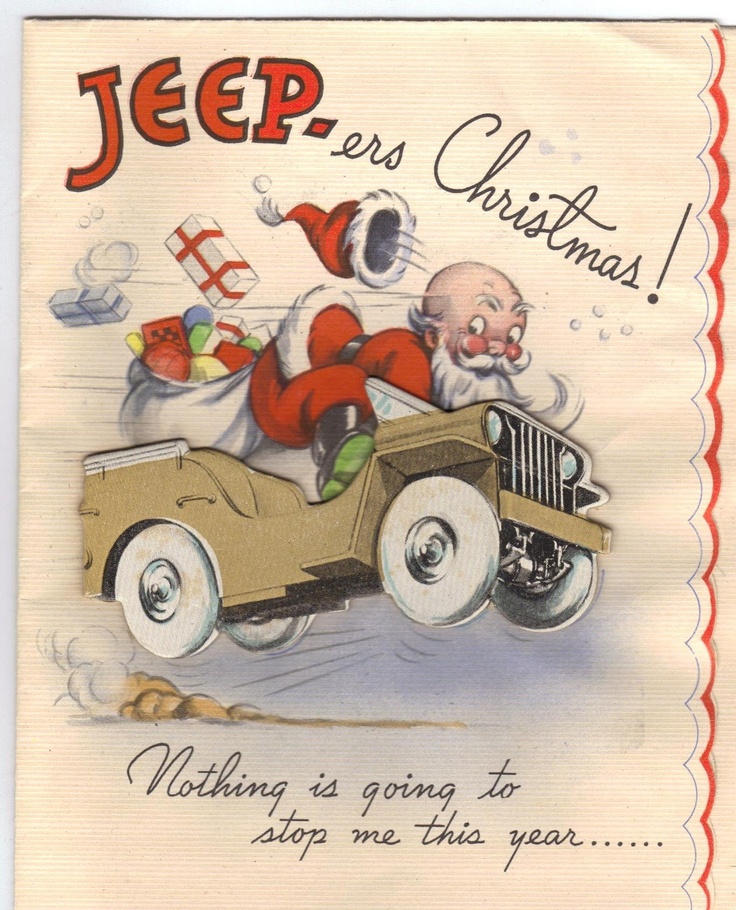
Christmas card, 1944.

The day has finally come, the day we cherish so dear, the day we come together and celebrate the many reasons for the season, Christmas. It is a beautiful day for celebrating the traditions we hold close to our hearts. Christmas has taken on many forms since it was first celebrated two millennia ago; in fact, there are at least five distinct changes over these many, many years.

Puritan official notice banning Christmas celebrations


Winter feasts originated in pagan societies in which the ancient peoples needed to spur life and hope in the deep, dark winter months of Europe. Their yuletide feasts sparked the renewal of spring and the hope for a year of plenty. Then, the biggest change of all came with the birth of Christ and the new Christian faith. While the date of Jesus’ birth is unknown; logically, we can all assume it would have most likely been in the spring, but the Papacy declared the 25th of December as the official day; most likely continuing the feasts and festivals of pagan customs.  Boisterous celebrations continued to be held for centuries. But, not so ironically, the Puritans in Boston felt joyous celebrations diminished the meaning of Christmas and actually banned all merry celebrations of any kind, which put a damper on the rest of the country. (Maybe, that’s part of the reason England all but kicked them out of the country? Just a thought.) That only lasted a short time, thank goodness, and by the 19th century, Christmas went through another major reinvention.

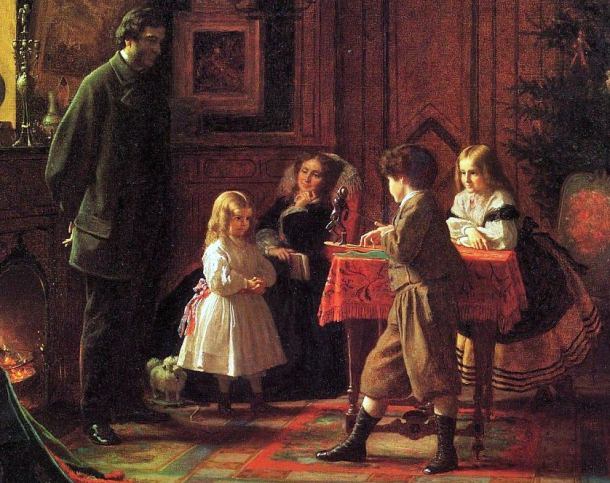
Eastman Johnson's Christmas Time: the Blodgett Family, 1864.

Americans changed the Christmas holiday into a family occasion of nostalgia and joy. With so many cultures melding into one, it is no wonder America would be the place to change the holiday forever. During this time, the classic novel A Christmas Carol, by Charles Dickens, became one of the most popular holiday novels to date. The message of charity and good will towards men could not have come at a better time for the Americans and English. For the next one hundred years, following the novel, Americans looked to the new cultures melding into one for Christmas traditions and formed the perfect family holiday.  The most recent changes in traditions we celebrate today are actually a result of World War II. We all know it was the greatest generation, but many may not realize how they have literally helped shape the America we see today. These traditions are just another reason to appreciate and thank the men and women of the 1940s. We are forever in their debt.


Family singing carols in front of the tree, 1945.
If you have read the Christmas Tree blog from a few weeks ago, you will recall that even our modern Christmas tree traditions were changed by World War II. Since the war effort needed as much wood production as possible, our beloved, fresh Christmas trees were exchanged for artificial trees in order to ration. Now, it is just as common for a household to hang on to an artificial tree for years instead of purchasing a fresh tree year after year. Also, our ornament product changed to what we know and love today. Before the war, some of the most valuable decorations came from Germany and Japan. Gorgeous, glass ornaments adorned the freshest trees, but with the declaration of war against both countries, Americans wanted to turn elsewhere for their decorations. Corning Glass Company, in New York, came to the rescue with their own production of glass ornaments. Homemade gifts also became extremely popular. School children were encouraged to make handmade ornaments in the classroom and at home. Templates and designs were manufactured once popularity grew. Today, some of our favorite ornaments are the ones made during our childhood or made by our own children.

Soldier sharing his Christmas package with the children in a European town.
Having our Christmas shopping done early also became the norm in the 1940s. The need to ship packages overseas with enough time to reach the soldiers by Christmas became the priority for many families. We do not generally think about such things, but families had to send Christmas packages in October if they wanted their loved one to receive it by Christmas in the Pacific. Today, we cannot imagine not shopping early because there never seems to be enough time right before the holidays!

Also, did you know that many of our favorite holiday tunes were written during the war? I don’t know about you, but my holiday season does not start until the songs “White Christmas” and “Have Yourself a Merry Little Christmas” have been played in the house. “Let It Snow,” “Baby, It’s Cold Outside,” and of course, “I’ll Be Home for Christmas” are a few of the other songs written during the 1940s. All the songs relate back to the war and the feelings of pain and longing everyone felt for their loved ones. These holiday classics have held true for the past 70 plus years and they have been relevant through every conflict America has been part of since World War II. They will never leave our hearts.
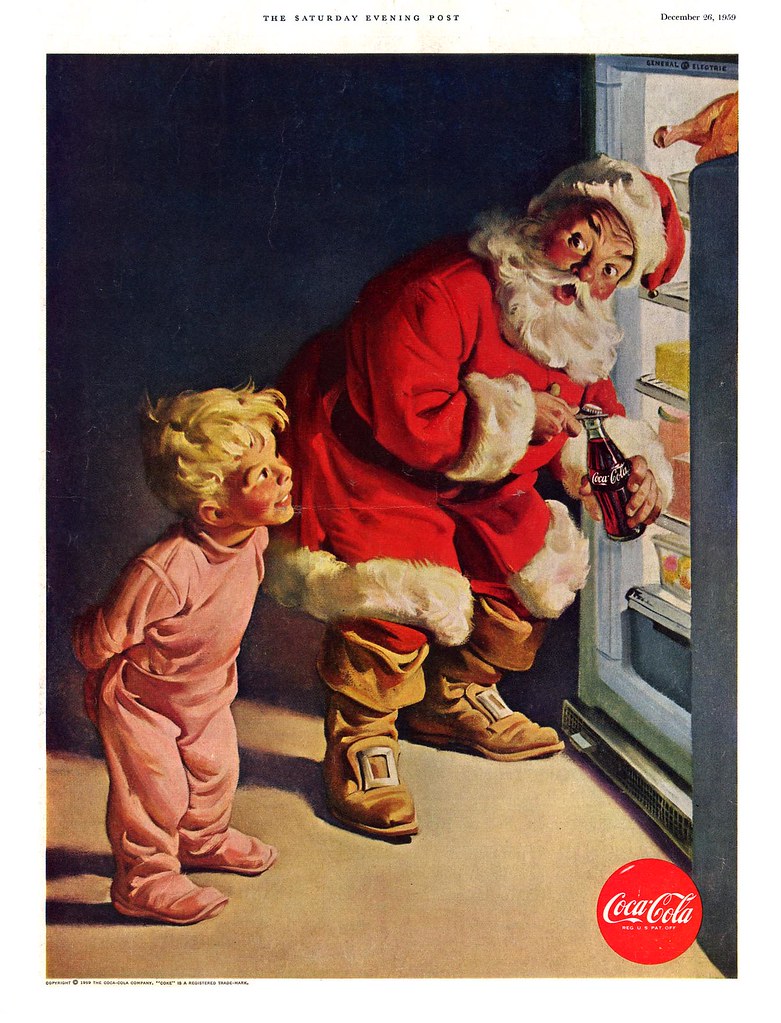
Coca-Cola Christmas add, December, 1943.

As if there aren’t already so many wonderful changes, even the look of Santa Claus changed during the war! Some may recall, before the war, Santa had a very traditional European look about him. Obviously, that had to change for the war effort, so Santa received an American makeover that has stuck through time.
Even our traditional holiday menu changed because of the war. Rationing and availability created a revised menu for many Americans and soldiers abroad. Of course, people still had their turkey and trimmings as best they could manage, but food items that were not on the rationed lists became prevalent in everyday homes, like oysters and lobster. When the soldiers came home, their families kept the new additions and now they are part of our traditions today.


Interesting Yuletide Facts:


During the Middle Ages, Christmas merriment was quite rowdy and could be compared to the Mardi Gras parties of today.

Medieval painting depicting Christmas celebration
Christmas was outlawed in Boston, Massachusetts from 1659-1681. The fine was five shillings.

It was not until June 26, 1870 that Christmas became a federally recognized holiday in the United States.

Captain John Smith consumed the first American made cup of eggnog in 1607, Jamestown.

Joel R. Poinsett brought the bright red and green plant, named after himself, to America from Mexico, in 1828.

The legend of Rudolph the Red Nose Reindeer was created in 1939 as a ploy to attract customers into the Montgomery Ward department store. It worked.

In 1941, a 5 foot Christmas tree was only .75 cents.

During World War II, the shortage of men resulted in a shortage of dressed up Santa’s. Women donned the costumes in their absence so thousands of children could still experience the magic of Christmas.

The term Xmas has actually been used for over a thousand years. The "X" is the Greek symbol for "Chi", which is the first letter for the Greek spelling of Christos, or Christ.

I hope you all have a Merry Christmas and a Happy New Year!

Take care,
Elizabeth

Tuesday, December 16, 2014

Christmas Recipe: Pfeffernusse


Hello All!

I wanted to start off by saying THANK YOU to all those who came out to our Luminary Event this past weekend. The event was a HUGE success and it means a great deal to everyone involved at the Memorial to see so many caring visitors supporting us! The Memorial had over a thousand visitors this past weekend; more than double the last two years. One of the most important duties the National D-Day Memorial has is making sure the memories of our fallen soldiers continue on for future generations. Our mission would not be made possible without the support of you all. We are truly thankful to have you part of our foundation. I also send a big thank you to the Virgina Moose Association for sponsoring this event. You all have made it possible for us to share these important memories with so many wonderful people.
~~~~~~~~~~~~~~~~~~~~~~~~~~~~~~~~~~~~~~~~~~~~~~~~~~~~~~~~~~~~~~~~~~~~~~~~~~
Onward to cookie making!

Pfeffernusse Cookies
I hope you are having a great morning so far and you are not too stressed about the holidays yet! There are only 8 days until Christmas, can you believe it? I am sure you have already made your holiday treats, but I thought I would share a special cookie recipe with you all, one that was popular during World War II and today! The Pfeffernüsse cookie is a delicious spice cookie, popular in Germany, Denmark, and the Netherlands. This particular cookie is special in my family’s household because we are both of German and Danish dissent and my grandparents, and great-grandparents, made these during the holiday season, despite the shortages during WWII. Obviously, since this particular cookie has a German connection, not all Americans were eager to make them during the war.  But as we all know, there were, and still are, a rather large number of those with German ancestry living in the country and the tradition has been kept by them.

The Pfeffernüsse is also known as pepernoten in Dutch, päpanät in Plautdietsch, or peppernuts in English. The origin of the cookie is not clear, but the traditional Dutch belief is that the pepernoten was connected to the feast of Sinterklaas, which is celebrated on December 5 in the Netherlands, the 6th in Germany and Belgium. Sinterklaas, as you may have guessed, is when children receive their gifts from St. Nicholas, or Santa Claus. For the Germans, the cookie has a closer association to traditional Christmas celebrations and has been part of European holidays since the 1850s. 
Woman baking cookies, 1940s.

It is commonly believed that the name pfeffernüsse indicates nuts within the cookie, although many varieties do not contain any nuts at all. However, the cookie is meant to be small, like the size of a nut, which may have had a hand in its given name. Also, throughout time, bakers have created their own unique recipes for their cookies; however, the common theme is the spices used and the use of molasses and honey to sweeten the cookie.

If you are unfamiliar with the pfeffernüsse cookie, then you can compare it to the Kruidnoten cookie or Russian Tea-cakes; commonly mistaken, both have a nutty, spicy, flavor and are of similar shape to the pfeffernüsse.

The cookie recipe I will use is from a cookbook from the 1940s titled: The Christmas Cookie Recipes: December 1944, BY The Home Service Bureau; The Electric Company, Milwaukee, Wisconsin


Jo’s Pfeffernuesse


4 eggs

2 cups sugar (use honey or molasses if short on sugar)

1 tablespoon cinnamon

1 tablespoon ground cloves

1 teaspoon black pepper

¼ cup finely cut candied orange peel

¼ cup finely cut candied lemon peel

¼ cup finely cut candied citron

4 cups enriched bread flour


1.  Beat whole eggs until light and fluffy.

2. Gradually add sugar, beating constantly.

3. After last of sugar has been added beat 15 minutes using high  speed of mixer.

4. Add cinnamon, cloves, pepper, finely cut orange and lemon peel and citron.

5. Fold in flour by hand.

6. Shape a little less that a tablespoonful into a ball. Place on greased cookie sheets.

7. Back at 400 degrees about 15 minutes.

8. Makes about 7 dozen.

Let’s get baking!! 

Take care,
Elizabeth

Tuesday, December 2, 2014

Oh Christmas Tree!


Hello Everyone,
Festival of Trees, 2014

Christmastime is finally here! A time for peppermint hot chocolate, twinkling lights, and Christmas trees galore. Speaking of Christmas trees, the locals around the Memorial have probably noticed the influx of Christmas cheer within the Bedford Welcome Center because of the Festival of Trees celebration. What’s that you ask? The Festival of Trees is an annual Christmas celebration where local businesses and organizations compete for the best decorated tree within a pre-determined theme. The locals are encouraged to come out and vote in order to determine the top three, who will then equally distribute the winnings. This year’s theme is Christmas on the Home-front, 1944 and after previewing the trees, I must say this year will be a close one for sure! Of course the National D-day Memorial is represented and I am partial to our tree, but nonetheless, please take the time to visit the Welcome Center and vote for your favorite tree. The trees are up from November 19, 2014 until December 31, 2014, so the voting has already begun! The Welcome Center will also have extended hours on December 5, 12, 13, 14, and the 19, until 9 pm, so you will be able to enjoy the beauty at night. The 12th, 13th, and 14th also coincide with the Memorial’s Luminary Project, so you will be able to enjoy both events for the holiday season. I implore you to visit both events this season; it will put you in the holiday mood and give you some perspective on those lost and holiday hardships for the soldiers.
In the spirit of the theme, let’s talk about the history of the Christmas tree! How did the tradition begin, how did it evolve, and how has it changed today?

The Beginning
Pagan depiction of the use of evergreens
Since the beginning of time, evergreens have had a special meaning for people in the winter. Pines, spruce, and firs stay green all year long despite the cold, hence why people used such lush vegetation during the holidays. In some countries, it was thought that evergreens could keep away evil spirits in the night. Also, before Christianity, the pagans believed the Sun God was sick or weak during the winter and the longest night of year, known as the Winter Solstice, marked the turning point for him to regain his strength and the use of evergreen boughs reminded them of the promise of spring and summer. In fact, many cultures used evergreens to symbolize the renewal of spring, such as the Egyptians, early Romans, the ancient Celtic people, and even the ferocious Vikings.
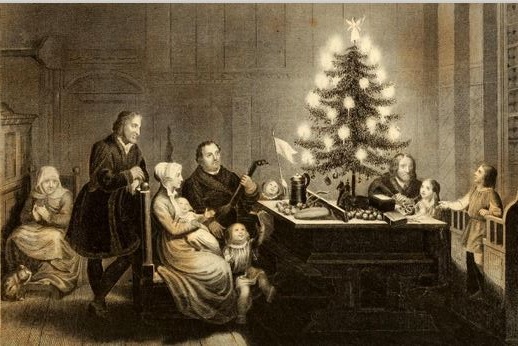
Martin Luther and family around their first lit tree.
As many of you might know, the German’s are associated with starting the Christmas tree tradition we know and love today. Did you know they also began the traditions of advent calendars, gingerbread houses, and our cherished Christmas cookies? Christians of the 16th century began to bring in whole trees, not just boughs, into their homes to be decorated. Some Christians would build wooden pyramids and decorate that with the evergreens and candles to symbolize the birth of Christ. In Germany, it is believed that Martin Luther, Protestant reformer, was the first to use candles upon the tree because it reminded him of the brilliant stars in the night sky and the beauty had to be represented on the tree.
The Royal Family decorating their Christmas Tree, 1840s
Despite such an early start for the Christmas tree tradition, it was not until the 1830s that the first Christmas tree was put on display in America. Ironically, Pennsylvania German settlers brought the tradition to America much earlier, in the 1740s, but it took nearly one hundred years for the Christmas tree to shed its pagan stereotype in the minds of American Christians. One of the reasons why it took so long for the Christmas tree to become popular in America was because of the New England Puritan’s strict observance of Christmas celebrations. They believed decorating Christmas trees, singing carols, and overall joy would violate the sacred birth of Christ. Strict penalties were handed out to any of those who were partaking in those ‘heathen traditions’. These strict laws stayed true until the 19th century when the enormous influx of German and Irish immigrants changed the American tradition. England also saw a change in tradition in the 1840s when Queen Victoria and Prince Albert, who was German, were illustrated in the London News decorating their own tree with their children. Anything done by the royal family, particularly Queen Victoria, instantly became popular with the country. Within fifty years, German ornaments were extremely popular in the United States and were shipped overseas on a regular basis and, of course, Americans preferred having the biggest tree possible, while European traditions call for a more modest tree of about four feet in height.

Modern Era of the Christmas Tree           
Decorating the Rockefeller Center tree, 1930s
The most famous Christmas tree display, at least for Americans, is the Rockefeller Center tree in New York City, New York. The tradition began in 1931, when construction workers of the Depression era placed a small and simple tree in the center of the square, the next year they did the same, and then the next; shortly, Christmas tree lights and decorations were added. Today, the tree typically has over 25,000 Christmas lights!
Not surprisingly, World War II caused another great change for the Christmas tree and brought us even closer to what we expect today. Since many of the prized Germany and Japanese made ornaments were no longer being shipped overseas, the Corning Glass Company of New York began their glass ornament production, virtually eliminating the need for anything else! Also, ribbons and bows were scarce because of the material used, as well as the fir trees themselves. Lumber was needed for the war effort, so production began on artificial trees to fill in the void.
White House Christmas tree, 1944.
The traditions we know and love can be seen throughout most of the world, especially in Protestant dominated countries, with a few variations. Most cultures decorate an evergreen tree in various was, but many Catholic dominated countries tend to focus more on the Nativity scene, connecting to the roots of the holiday, like Italy and Mexico.

Tree Trivia
The first commercialized selling of the Christmas tree was not until the 1850s in the United States.

The tallest living Christmas tree is about 122 feet tall and 91 years old, in Woodinville, Washington.
The first National Christmas Tree Lighting Ceremony held at the White House was in 1923, by President Calvin Coolidge.

Christmas trees are grown in every state, including Hawaii.
WWII soldiers decorating a palm tree for Christmas.

It was not uncommon for many soldiers on the front-lines, in World War II, to decorate random trees around them, or to chop one down for their makeshift headquarters.

World War II soldiers in the Pacific theater used palm trees to replace their traditional trees from back home.

I hope to see you all at our Luminary Nights and the Festival of Trees!


Take Care and don't forget to vote for your favorite tree (a.k.a the D-Day Memorial's tree), 
Elizabeth